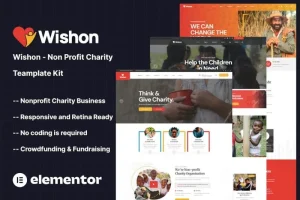
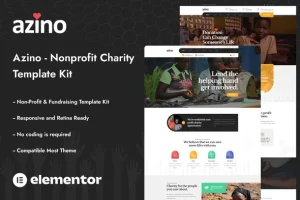
Relief – Non Profit & Charity Elementor Template Kit
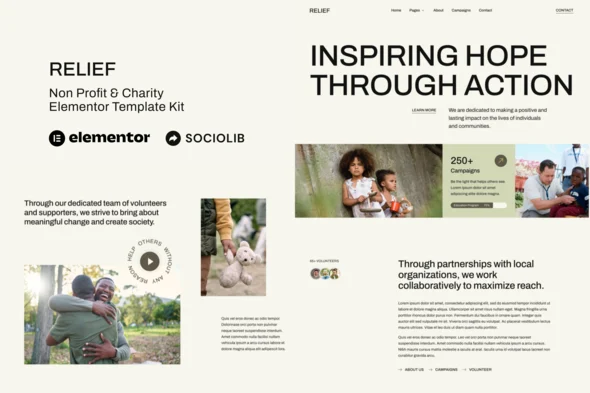
Relief Non Profit & Charity Elementor Template Kit Overview & Layout Delivery Architecture
Relief Non Profit & Charity Elementor Template Kit is a page-builder asset for the Elementor ecosystem, engineered for nonprofits and digital agencies to assemble charity, humanitarian, and fundraising websites without writing code. The package removes the blank-canvas bottleneck of manual page composition by supplying eleven pre-structured layouts whose content ships as Elementor JSON and renders through the builder’s visual drag-and-drop engine. Within agency delivery workflows, it operates as a reusable design baseline: each page is imported individually, restyled through centralized design tokens, and published on any theme that supports Elementor, with Hello Elementor serving as the reference runtime.
Technical Specifications & Deployment Matrix
| Engineering Metric | Deployment Specification |
|---|---|
| Base Technology / Framework | Envato Template Kit targeting Elementor 3.8.x and Elementor 3.10.x page-builder releases |
| Runtime / Language Requirements | WordPress installation with the Elementor plugin and the free Template Kit Import plugin; no builder subscription required |
| Data Exchange / Communication Protocols | Template payloads transferred as zipped JSON via the Tools > Template Kit import interface |
| Front-End / Engine Dependencies | ElementsKit Lite (installed with the kit); Hello Elementor theme recommended, most Elementor-capable themes supported |
| Database / Persistence Footprint | None proprietary — imported layouts persist only as standard Elementor-managed content inside WordPress |
Global Design Tokens & Template Import Pipeline
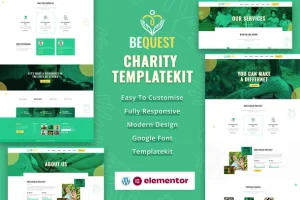
Import, token override, and page assignment form the three-stage execution pipeline of this architecture. During import, the Template Kit Import plugin parses each zipped layout payload and reconstructs it as native Elementor widget and container structures inside the builder canvas; the bundled Install Requirements routine activates ElementsKit Lite before any template is pulled in, so header and footer modules resolve their widget dependencies on first render. Once a layout lands on a page, global typography and color tokens govern the visual output — styling can be adjusted centrally through the kit’s Global Style sheet or overridden on individual elements, which keeps multi-page projects visually consistent while permitting per-section exceptions. The eleven-template inventory spans Home, Programs, Campaign, Volunteer, Our Work, About, Contact, and News Post layouts, plus a reusable Header, Footer, and Global Style definition wired through the ElementsKit Header Footer module for site-wide chrome. For organizations evaluating parallel design baselines within the same builder ecosystem, BEQUEST offers an alternate nonprofit-focused kit covering comparable donation and campaign page archetypes.
Architectural & Functional Highlights
- JSON Layout Payloads: Eleven templates (Home, Programs, Campaign, Volunteer, Our Work, About, Contact, News Post, Header, Footer, Global Style) import as discrete, individually editable Elementor documents rather than a monolithic dump.
- Centralized Design Tokens: Font families and color values propagate kit-wide through the Global Style definition, so a single token edit restyles every imported page without per-widget rework.
- ElementsKit Header/Footer Wiring: Site-wide navigation and footer chrome are bound to the entire site through the ElementsKit Header Footer module, replacing manual per-page block placement.
- Sequential Import Discipline: The documented workflow requires one-template-at-a-time imports, which reduces payload collisions and keeps the builder canvas responsive during reconstruction.
- Responsive Container Rendering: Layout sections adapt across viewport widths using container-based structure, preserving reading order on mobile devices without duplicated page variants.
Production Implementation & Operational Resilience
In agency staging environments, the documented sequence is deterministic: install Template Kit Import from Plugins > Add New, upload the kit archive without unzipping it, trigger Install Requirements, then import pages one at a time. Each new page should be created under Pages, opened with Edit with Elementor, and configured with Elementor Full Width layout while hiding the page title — steps that prevent theme chrome from double-framing imported sections. Operators should also confirm the server’s wp_memory_limit allocation before large imports, since the JSON-to-widget reconstruction of multiple templates in a single session can exhaust default PHP memory ceilings on shared hosting. When a payload or dependency fails mid-import, the process fails at the template boundary rather than corrupting previously imported pages, which allows a clean re-import of the affected layout. Because the kit ships static layouts rather than a form engine, collecting campaign pledges or volunteer sign-ups on the same WordPress install is handled by deploying Gravity Forms alongside the imported pages. Demo imagery originates from an Envato Elements collection, so production launches require licensing those assets or substituting equivalents before public deployment. For decoupled implementations outside the Elementor kit pipeline entirely, Charito functions as an independent WordPress theme addressing comparable nonprofit program and volunteer outreach requirements.
Frequently Asked Questions
Does the kit require a paid Elementor subscription to import and edit templates?
No, it does not. The package installs through the free Template Kit Import plugin available from the WordPress plugin repository, and all bundled layouts, including the header and footer definitions, are fully editable within the standard Elementor builder without any subscription requirement.
Is a WordPress theme included in the Relief download?
No. This is a template kit, not a theme, meaning it delivers page content for the Elementor builder rather than theme-level files. It has been optimized for the free Hello Elementor theme but remains compatible with most themes that support Elementor rendering.
Can the demo images shown in the layouts be used directly on a live nonprofit website?
No. The preview imagery comes from an Envato Elements collection and is not pre-licensed for production use. Teams must either license those images from Envato Elements or replace them with their own photography before publishing the imported pages publicly.