Rebuilto – Construction WordPress Theme
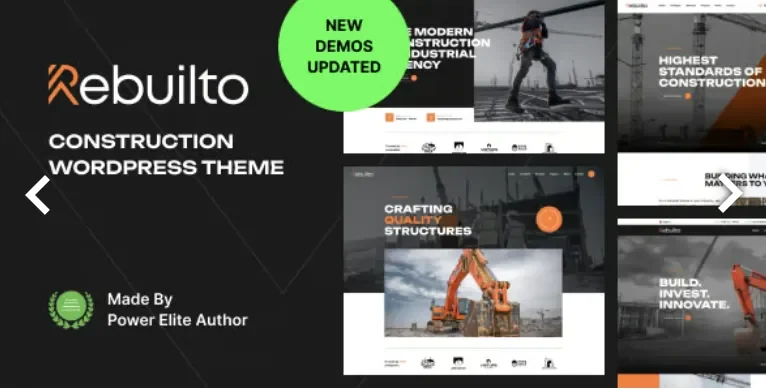
Rebuilto Construction WordPress Theme Overview & Agency-Grade Site Assembly Engine
Rebuilto Construction WordPress Theme is an Elementor-driven site-building package engineered for construction companies, contractors, and engineering firms to publish service pages and project portfolios without writing code. The package addresses the recurring bottleneck of presenting completed and ongoing builds by shipping eight importable homepage demos, a header and footer builder, and an unlimited sidebar generator. Within agency delivery pipelines it functions as a deployable foundation: engineers import demo data, adjust layout structure through the WordPress Customizer, and hand clients a self-service editing environment running on familiar builder mechanics.
Technical Specifications & Deployment Matrix
The following matrix consolidates the verifiable runtime parameters extracted from the vendor’s technical documentation.
| Engineering Metric | Deployment Specification |
|---|---|
| Base Technology / Framework | WordPress theme package — PHP Files, CSS Files, JS Files |
| Runtime / Language Requirements | WordPress 7.0.x down to 5.0.x; standard PHP hosting stack |
| Page Builder / Engine Dependencies | Elementor (compatibility tracked through 3.35.6), Slider Revolution 6.7.x, Contact Form 7 |
| Browser / Device Compatibility | Firefox, Safari, Opera, Chrome, Edge; responsive layout, 4+ column grids, touch-friendly interface, high-resolution rendering |
| Configuration / Persistence Footprint | WordPress Customizer option tree, widget-ready regions, CMB2-dependent meta handling |
Elementor Rendering Pipeline & Construction Business Mechanics
Rebuilto renders every page through the Elementor builder engine, which stores layout data and emits widget markup at runtime. Inbound requests traverse the standard WordPress template hierarchy until the active template defers to Elementor’s rendering loop; each widget then queries its content source — project posts, sliders, or form shortcodes — and writes the resulting markup into the DOM tree. The eight prebuilt homepage demos (Homes 6, 7, and 8 were added in version 1.1.0) ship as importable layouts that map widget instances, menus, and Customizer presets onto a fresh database. Portfolio listings and post grids rely on the theme’s post grid widget, which the vendor patches to track Elementor core releases — compatibility fixes are recorded for versions 3.22.0 through 3.35.6 — so widget output stays aligned with upstream API changes. For studios weighing parallel foundations in the same vertical, Consik targets construction and architecture studios on Elementor and Bootstrap 5, functioning as an independent comparison path rather than an extension of this codebase.
Core Technical Capabilities of Rebuilto
- Customizer Option Tree: Main options, side area options, social links, post list settings, styling, layout, and header and footer sections are configurable through WordPress native options, with individual feature toggles and full-width versus boxed site width control exposed without template edits.
- Header/Footer Builder & Mega Menu Logic: Header and footer regions are assembled through a builder function, while version 1.1.3 introduced automatic calculation of mega menu position on page load, correcting placement without manual offsets.
- Slider Revolution Engine: The bundled slider ships with compatibility up to 6.7.14 and drives parallax background imagery on rows, headers, boxed content, and client logo strips.
- Sidebar Generator & Styling Controls: An unlimited number of sidebars can be generated per template context, and main plus secondary site colors, manual button height and shape parameters, and vector icons for retina displays are adjustable from the styling layer.
Production Implementation & Operational Resilience
Deployment begins with demo data import, a pipeline the vendor repaired in version 1.2.0 after import failures; the same release cycle corrected carousel CSS, video popup styles, and swiper CSS omissions tied to Elementor 3.26.0. Error handling at the plugin boundary is documented directly in the changelog: version 1.0.2 fixed a fatal error triggered when the CMB2 plugin was deactivated, and 1.0.8 added an activation check before Mailchimp-dependent code executes, indicating conditional guards wrap optional plugin integrations. Typography degrades safely — demos built on Adobe Fonts substitute default or Google Fonts when those typefaces are unavailable, so front-end rendering never depends on external font availability. Page speed scores vary with the selected demo, server configuration, and content, and certain features such as parallax rows and slider assets can negatively impact measured Core Web Vitals, so profiling each demo before launch is a sound staging practice. Because PHP, CSS, and JS files ship inside the package, secondary development can push button styling further through additional CSS rules, override template fragments, and select main or secondary colors from the styling layer while per-feature toggles keep unused modules disabled. Builds requiring a native WooCommerce storefront sit outside this package’s documented scope; Construction WordPress Theme Pro covers that requirement as a standalone alternative with full demo import and unlocked feature sets.
Frequently Asked Questions
Is Rebuilto optimized for the Gutenberg block editor?
No. The vendor documentation explicitly marks Gutenberg optimization as absent; all page assembly runs through Elementor, and layout data is stored and rendered by that builder engine rather than native block-editor structures.
Are the demo images and Adobe Fonts included in the downloadable package?
No. Sample images in the live preview serve demonstration purposes only and are excluded, while Adobe Fonts used in some demos fall back to defaults or Google Fonts when unavailable. The delivered package contains PHP, CSS, and JS files.
Does Rebuilto operate with Contact Form 7?
Yes. Contact Form 7 is listed among compatible plugins, so lead and inquiry forms can be embedded into Elementor-built pages alongside the bundled Slider Revolution engine and the theme’s widget-ready sidebar regions.
-
18 December 2024 LatestSeptember 18, 2026