RealStatic – React Nextjs Real Estate Template
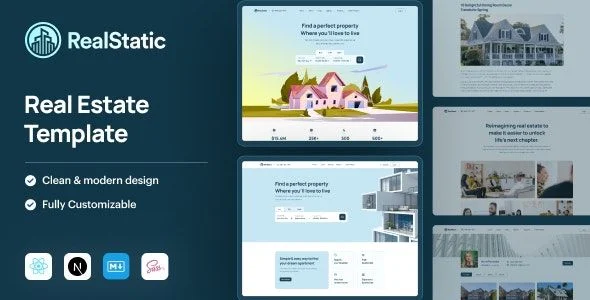
RealStatic React Nextjs Real Estate Template Overview & Front-End Architecture
RealStatic is a React Nextjs Real Estate Template engineered for development teams and agencies that need to launch high-performance property portals, realtor portfolios, and single-property showcase sites. The package addresses two recurring bottlenecks in real estate front-end delivery: slow initial page loads that depress conversion rates, and weak crawlability caused by client-side-only rendering. In production workflows, it functions as the presentational layer of a property platform, giving agencies a prebuilt layout system while leaving data sourcing open to any backend that can communicate over HTTP.
Technical Specifications & Deployment Matrix
| Engineering Metric | Deployment Specification |
|---|---|
| Base Technology / Framework | Next.js with React.js component architecture |
| Runtime / Language Requirements | Node.js execution environment with TypeScript source |
| Data Exchange / Communication Protocols | API-driven data consumption; compatible with headless CMS backends such as a decoupled WordPress instance |
| Front-End / Engine Dependencies | Tailwind CSS utility-first styling framework |
| Database / Persistence Footprint | None bundled; persistence is delegated to the connected backend service |
Server-Side Rendering Pipeline & Rendering Execution Flow
Next.js server-side rendering drives the entire request cycle of this template. When a visitor or crawler requests a property detail page, the framework executes the page’s React components on the server, serializes the resulting DOM into fully formed HTML, and ships that markup to the browser before hydration attaches interactive event listeners. Because search engine bots receive complete content on the first response rather than an empty JavaScript shell, indexation of listing pages and agent profiles improves measurably. The TypeScript layer enforces static type contracts across component props, data mappers, and filter state objects, which reduces runtime type errors during customization and simplifies refactors when property data schemas change. Styling flows through Tailwind CSS, where each component declares its own utility classes, allowing a developer to adjust spacing, typography, or color tokens at the component level without editing detached global stylesheets. The decoupled architecture means the property listing data, agent records, and blog content can be fetched from any REST-speaking source, and swapping the data provider requires only re-pointing the fetch layer rather than rewriting the page tree. For teams evaluating comparable Next.js front-ends in adjacent verticals, Furnisy demonstrates the same Tailwind-plus-Next.js stack applied to furniture commerce, while Xhibiter shows the identical rendering approach powering an NFT marketplace surface.
Core Technical Capabilities of RealStatic
- Server-Side Rendering (SSR): Pages are rendered to HTML on the server per request, cutting time-to-content for first visitors and giving crawlers indexable markup without executing client bundles first.
- TypeScript Source Layer: Typed interfaces govern property objects, filter parameters, and component props, so a mismatch between the API payload shape and the UI contract surfaces at compile time instead of in production.
- Dynamic Property Search: The advanced search module binds filter state to query parameters, letting users narrow listings by criteria while the URL remains shareable and re-renderable on the server.
- Multiple Homepage & Inner Page Layouts: Pre-designed page shells for listing grids, agent profiles, agency profiles, and single-property detail views reduce layout construction time to composition rather than blank-page development.
- Mobile-First Responsive System: Layout behavior is defined from the smallest viewport upward using Tailwind breakpoint utilities, ensuring the listing grid, search bar, and navigation adapt without separate mobile templates.
Production Implementation & Operational Resilience
Deployment targets Node.js-capable hosting: a VPS with a Node process manager, a container platform, or a static-export pipeline where SSR output is prebuilt at build time. Before going live, verify that the Node version on the server matches the version pinned during development, because Next.js major releases carry engine requirements that affect build behavior. Performance is tuned toward Core Web Vitals, which means the bundle ships with code-split routes, and hydration cost stays proportional to the visible page rather than the entire application tree. Error handling and payload validation live at the data boundary: because the template consumes API responses, implement response-shape guards so a malformed listing object fails visibly during development rather than silently rendering empty cards. Where the data source resides on a separate domain, configure CORS headers on the backend to explicitly allow the front-end origin, or proxy API routes through the Next.js server layer to keep requests same-origin. Customization boundaries are well defined: Tailwind configuration controls the design tokens, page components under the app structure control layout and markup, and the data-fetching layer is the single point of contact for backend wiring. For agencies running multi-vertical delivery schedules, this same decoupled Next.js pattern is embodied in Gigo as an independent token launchpad application, illustrating how one architectural approach serves different product domains. The codebase is structured and documented, so onboarding a second developer onto a client project mainly involves reading the component tree, not reverse-engineering build tooling.
Frequently Asked Questions
Does the template include a back-end database or admin panel for managing listings?
No, it ships as a front-end package only. Listing, agent, and blog data are consumed through an API, so you connect your own backend, such as a headless WordPress instance or any CMS exposing JSON endpoints.
Is the source code written in plain JavaScript or TypeScript?
TypeScript. The codebase uses typed definitions across components and data structures, which improves maintainability, catches prop and payload mismatches at compile time, and speeds up refactoring during client-specific customization work.
Can the layout styling be customized without rewriting CSS from scratch?
Yes. Styling is handled through the Tailwind CSS utility framework, so colors, spacing, typography, and responsive breakpoints are adjusted per component through utility classes and central configuration rather than large hand-written stylesheets.
Are dedicated page layouts included for agent and agency profiles?
Yes. The package provides multiple pre-designed homepage variants plus inner pages covering agent profiles, agency pages, property listings, single-property views, and a blog layout for content marketing.