Rauhum – Architecture & Interior Elementor Template Kit
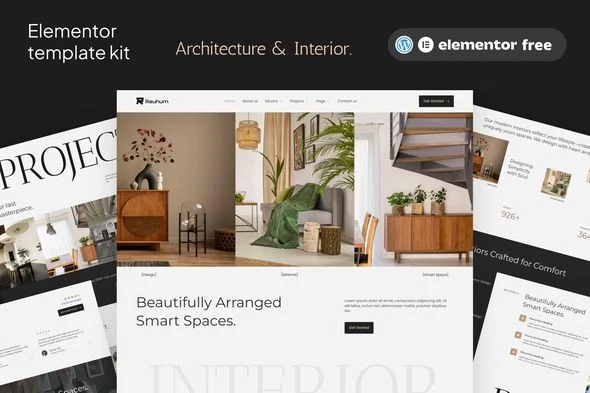
Rauhum Architecture & Interior Template Kit Overview & Layout Delivery Architecture
Rauhum Architecture & Interior Elementor Template Kit is a design-data package for WordPress, engineered for architects, interior designers, and design studios to publish portfolio-driven websites without writing code. It removes the manual layout assembly bottleneck by shipping 16 pre-structured pages as Elementor document data that imports through the Envato Elements plugin rather than functioning as a traditional theme. Within agency delivery workflows, the kit operates as a reusable production blueprint, letting teams stand up client-ready architecture and interior design sites in a fraction of the usual build time.
Technical Specifications & Deployment Matrix
| Engineering Metric | Deployment Specification |
|---|---|
| Base Technology | Envato Elementor Template Kit (design data only, not a WordPress theme) |
| Runtime Requirements | WordPress v6.8 and Elementor v3.28.4 |
| Data Exchange Format | Elementor JSON layout structures imported via the Envato Elements plugin or directly through Elementor |
| Required Plugins (bundled) | Elementor Free, ElementsKits Lite, MetForm, Gum Elementor Addon |
| Persistence Footprint | No theme files or custom database schemas; all layout data lives inside Elementor’s native document model |
Design-Token Architecture & Page Rendering Pipeline
The kit’s core mechanism is a global Theme Style layer that cascades typography and color tokens across every imported document. During installation, the Envato Elements plugin parses the packaged layout structures and materializes each page — Homepage, About Us, Service, Service Detail, Project, Project Detail, Pricing Plans, Our Team, FAQs, 404, Blog, Single Blog, Header, and Footer — as an editable Elementor document. Because the layouts are built on container-based architecture, sections, columns, and widgets remain fully manipulable through the visual editor, and global design-token edits propagate to all sixteen pages at once instead of requiring per-page restyling. The package was assembled on a defined design system, which keeps spacing, heading scales, and color relationships consistent across portfolio grids, service blocks, and project detail pages.
Architectural & Functional Highlights
- Global Theme Style tokens: Centralized color and typography definitions push updates across every page from a single Elementor panel, removing per-section restyling during client revision cycles.
- Unlimited color palette plus 900+ ready fonts: Typography and color systems are token-driven, so brand swaps require no stylesheet edits or custom CSS overrides.
- 16 production-ready pages: The full set spans home, about, service and service detail, project and project detail, pricing, team, FAQ, 404, blog and single blog, plus header and footer templates.
- Fully responsive container layouts: Content reflows across mobile and desktop viewports using Elementor’s native responsive controls without separate mobile page variants.
- Cross-browser rendering: Layouts are verified for Chrome, Firefox, Safari, and Opera, relying on standard CSS behavior rather than browser-specific hacks.
For studios evaluating a parallel dark-mode design system within the same architecture and interior sector, Indoor ships as an alternative Elementor kit with an agency-focused dark aesthetic, and it can serve projects where Rauhum’s lighter visual direction does not match the brief.
Production Implementation & Operational Resilience
Before importing, verify the WordPress memory allocation: large kit imports with multiple bundled plugins typically demand a wp_memory_limit of 128M or higher to avoid truncated JSON parsing during the Envato Elements upload sequence. Install Elementor, ElementsKits Lite, MetForm, and Gum Elementor Addon first, then import templates in staging before pushing to the live environment. Header and footer activation runs through ElementsKit’s Header Footer module: import both templates, create new header and footer records with Entire Site scope, toggle activation on, and load each template into the builder. If Elementor Pro is already present, the native Theme Builder can take over header and footer management instead.
Form handling follows a defined sequence: import the MetForm block templates, open the page containing the form widget, enable the Navigator, and pull the imported form template into the widget through the My Templates tab before updating. Elementor Pro users can skip MetForm installation entirely and rely on native form widgets.
Regarding asset boundaries, the kit ships with demo images sourced from Envato Elements; production deployments must either source those images separately or replace them with owned photography, since the media files are placeholders rather than deliverables. Styling customization stays within Elementor’s visual controls — design tokens, container paddings, and widget settings — and no PHP-level template overrides are involved, because the package is layout data, not a theme. For decoupled implementations outside the template-kit delivery model, Sedona exists as an independent full WordPress theme with Elementor support and RTL coverage, suiting construction-focused projects that need theme-level architecture instead of imported page data. Update distribution follows a buy-once model with ongoing kit revisions delivered at no additional cost.
Frequently Asked Questions
Can the kit be activated as a standalone WordPress theme?
No. The package contains Elementor design data only and must be imported through the Envato Elements plugin or directly via Elementor; it does not register theme files, template hierarchy overrides, or any theme-level functionality within WordPress.
Does the kit require Elementor Pro to function?
No. All sixteen pages run on Elementor Free, with ElementsKits Lite handling headers and footers. Elementor Pro is optional and only changes the workflow, enabling the native Theme Builder for headers and footers and native widgets instead of MetForm.
Are the demo images included as usable production assets?
No. The preview images come from Envato Elements and serve as placeholders only; each deployment must source those images independently or substitute owned media, which can be swapped directly inside the imported Elementor layouts.