Raise To PickUp Phone Call with AdMob Facebook Android
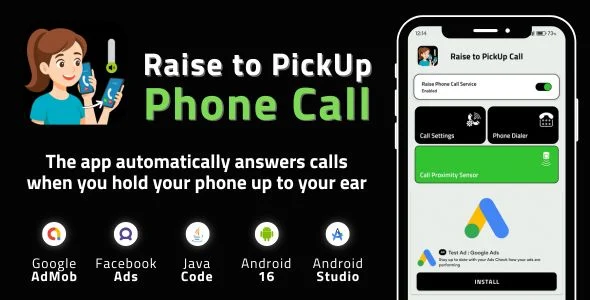
Raise To PickUp Phone Call Overview & Sensor-Driven Call Control Architecture
Raise To PickUp Phone Call is a native Android utility application source code, engineered for indie publishers and mobile agencies to ship a hands-free incoming call manager without rebuilding telephony logic from scratch. The package resolves a concrete interaction bottleneck: accepting or declining calls requires a physical button press, which fails when a device sits on a desk, is mounted in a vehicle, or is handled with wet or gloved hands. In production workflows it operates as a rebrandable foundation — studios swap the caller themes, wire their own AdMob and Facebook ad units, and publish to Google Play after minimal configuration.
Technical Specifications & Deployment Matrix
| Engineering Metric | Deployment Specification |
|---|---|
| Base Technology / Framework | Native Android development in Java (.java) with XML layout resources |
| Runtime / OS Requirements | Android 9.0 through Android 15.0, with engine-level support extending to Android 16 using SDK 36 |
| Delivered Artifacts | .apk installer, .java source files, .xml layout and configuration files |
| Monetization Layer | AdMob and Facebook Audience Network SDKs, pre-integrated into the build |
| Required Runtime Permissions | ANSWER_PHONE_CALLS, FOREGROUND_SERVICE_PHONE_CALL, FOREGROUND_SERVICE_SPECIAL_USE |
| Persistence / Resource Footprint | Lightweight foreground service with battery-conscious sensor event handling |
Sensor Dispatch Pipeline & Foreground Service Execution Flow
The engine answers incoming calls by routing hardware sensor events through a persistent foreground service, eliminating on-screen button interaction entirely. When an incoming call state is detected, the service listens for motion and orientation signals from the device accelerometer; lifting the handset toward the ear triggers the answer action via the ANSWER_PHONE_CALLS permission path. Because this listener must survive while the screen is off or the app is backgrounded, the service runs under FOREGROUND_SERVICE_PHONE_CALL and FOREGROUND_SERVICE_SPECIAL_USE declarations — without those grants, the core raise-and-shake mechanics remain inert on recent Android builds.
Gesture rejection follows a parallel dispatch lane. A deliberate shake motion, measured against a user-adjustable sensitivity threshold, fires the decline action so false positives from pocket movement or vehicle vibration stay controllable. The theme layer then overrides the default incoming-call surface: selectable caller themes, a customizable answer button with configurable style and animation, and a flashlight alert that blinks the camera LED on each incoming ring. A built-in dialer pad handles outbound calls, and the ad layer exposes AdMob and Facebook inventory placements ready for publisher unit IDs. For agencies assembling a broader Android utility portfolio under the same AdMob monetization model, TS DocScan Android provides a parallel scanner application with matching ad-unit and push-notification wiring.
Architectural & Functional Highlights
- Raise-to-Answer Detection: Accelerometer and proximity signals captured by the foreground service trigger call acceptance when the handset is lifted to the ear, executing the telephony action without any tap event.
- Shake-to-Reject with Tunable Sensitivity: Motion-threshold calibration lets each user balance responsiveness against false declines caused by ambient movement, keeping gesture recognition accurate per device.
- Caller Screen Theme Engine: The incoming-call UI is overridden with selectable themes and a customizable call button whose visual style and animation can be restyled, giving each publish a distinct brand surface.
- Flashlight Call Alerts: Camera LED blinking during an incoming ring supplies a visible signal for silent environments or hearing-impaired users, activated from the same call-state listener.
- Dual Ad Network Integration: AdMob and Facebook ad placements are already implemented in the codebase, so publishers only substitute their own unit identifiers before generating a release build.
Production Implementation & Operational Resilience
Deployment begins with the included .apk for immediate device validation, followed by source-level work in the .java and .xml files for branding, theme adjustments, and ad-unit substitution. Builds should target SDK 36 to cover Android 16, and the permission manifest must remain intact: removing the ANSWER_PHONE_CALLS or foreground-service grants breaks the entire gesture pipeline on current-generation devices, a documented operational boundary rather than a defect.
Resilience planning addresses two known Android friction points. First, OEM battery managers and vendor task killers can terminate foreground services on aggressive skins, so production testing should verify the listener survives on the target device lineup. Second, sideloaded .apk installs may be blocked by Google Play Protect scanning; the documented procedure disables Play Protect app scanning during installation, after which the installer enables the Restricted Setting entry inside App Info and re-enables protection. Handling both steps in onboarding copy reduces install-abandonment for direct-distribution channels. Error behavior around sensor sensitivity is user-managed rather than hard-coded — the calibration setting acts as the fallback mechanism against misfires. For teams evaluating phone-utility experiences delivered outside the Android runtime entirely, a separate path such as Video Downloader for Twitter exists as an independent WordPress plugin for building a dedicated media-save tool on the web stack, requiring no shared codebase with this application.
Frequently Asked Questions
Does the deliverable include a compiled .apk file in addition to the raw source?
Yes. The package ships with the .apk installer alongside .java source files and .xml resources, so you can validate the running application on a device before opening the project for customization and rebuild work.
Will the raise-to-answer feature function if the foreground service permissions are not granted?
No. The documentation states explicitly that without ANSWER_PHONE_CALLS plus the FOREGROUND_SERVICE_PHONE_CALL and FOREGROUND_SERVICE_SPECIAL_USE grants, the core raise-to-pickup feature will not operate on the latest devices.
Is Facebook advertising supported alongside Google AdMob?
Yes. Both ad networks are implemented in the shipped code, and publishers substitute their own AdMob and Facebook unit identifiers during the rebrand and release-build phase before store submission.
Does the codebase support Android 16?
Yes. The engine is built against SDK 36 with Android 16 support, while the compatibility matrix additionally covers Android 9.0 through Android 15.0, giving the release a wide device reach.