Radio Universal – Todo Players HTML5 ShoutCast, Icecast
Radio Universal Overview & Streaming Front-End Architecture
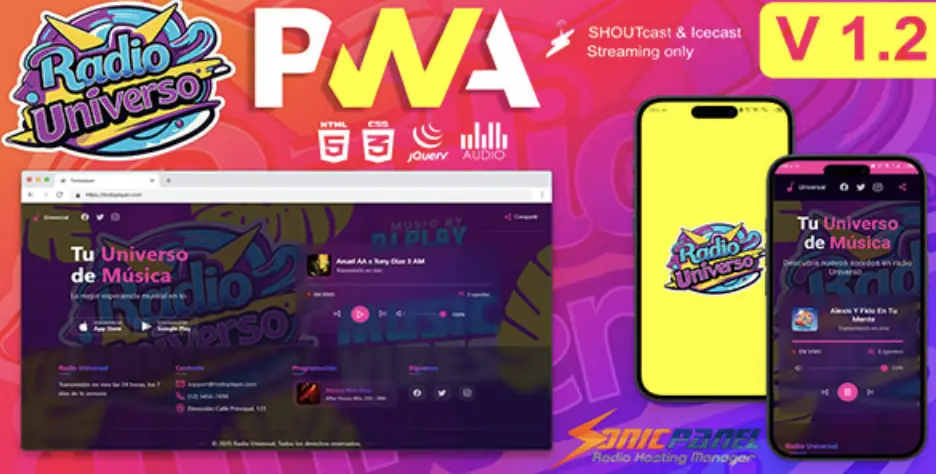
Radio Universal is an HTML5 radio player front-end built with JavaScript, CSS, and semantic markup, engineered for station operators and web agencies to publish continuous 24/7 SHOUTcast and Icecast audio streams on the open web. The package targets a persistent deployment constraint: browser audio plugins are obsolete across every current engine, while store-distributed native apps impose release pipelines that independent broadcasters rarely maintain. Within production workflows it operates as a self-hosted web surface that plays MPEG and AAC streams, renders program schedules and contact modules, and installs on Android, iOS, and desktop through Progressive Web App conventions without any app store submission.
Technical Specifications & Deployment Matrix
| Engineering Metric | Deployment Specification |
|---|---|
| Base Technology / Framework | HTML5 audio engine with vanilla JavaScript, HTML, and CSS files; no third-party plugins required |
| Runtime / Language Requirements | Any static web host serving HTML, JS, and CSS assets over HTTP |
| Data Exchange / Communication Protocols | Direct streaming from SHOUTcast, Icecast, SonicPanel, RadioJar, and compatible servers; MPEG and AAC audio formats (format compatibility should be verified per stream) |
| Front-End / Engine Dependencies | Native HTML5 audio playback with touch-capable interactive volume slider; service worker and manifest for PWA installation |
| Database / Persistence Footprint | None; static asset package with browser-side PWA caching, no server-side persistence layer |
Audio Engine & Execution Pipeline
The core playback mechanism connects a native HTML5 audio element directly to a remote streaming endpoint. When a listener presses play, the browser establishes a continuous HTTP stream against the SHOUTcast, Icecast, or SonicPanel source URL, and decoded MPEG or AAC frames render through the standard Web Audio stack without plugin mediation. A service worker layers on top of this pipeline, caching the application shell so the interface qualifies for installability on Android, iOS, and desktop browsers and survives subsequent sessions as a standalone window. Since version 1.2, the codebase also polls and displays live metadata, with confirmed compatibility against SonicPanel endpoints, so track and show information refreshes alongside the audio stream.
The interface layer dispatches user events — play, pause, and an interactive volume slider with touch support — against this engine, while layout logic adapts the same DOM across smartphone, tablet, and large-screen viewports. Version 1.2 refined iOS viewport handling specifically to correct rendering behavior in Safari’s mobile environment, and a floating install prompt now surfaces installation calls-to-action on both mobile and desktop browsers. Sharing actions extend to WhatsApp, Telegram, and Messenger, dispatching the station URL through each platform’s native share pathway.
Core Technical Capabilities of Radio Universal
- Pure HTML5 Streaming Engine: Audio decodes through the browser’s native media stack, eliminating Flash-era plugin dependencies and keeping the codebase minimal for fast loading and low memory usage on constrained devices.
- Progressive Web App Installation: Service worker and manifest configuration allow listeners to install the player as a standalone app on Android, iOS, and desktop, bypassing store review cycles entirely.
- Live Program Schedule Module: Shows, hosts, and broadcast times render in a structured layout, letting stations publish their programming grid without external scheduling services.
- Audience Engagement Surface: Built-in social links for Facebook, Instagram, and Twitter, contact options covering email, phone, and WhatsApp, plus optional Play Store and App Store buttons, consolidate interaction paths into one static deliverable.
- Cross-Browser Compatibility Envelope: The rendering and playback logic operates across Chrome, Safari, Firefox, Opera, and Edge, tracing a compatibility lineage back through legacy Internet Explorer releases.
Production Implementation & Operational Resilience
Deployment reduces to uploading the HTML, CSS, and JavaScript files to any static host and pointing the player configuration at the station’s stream URL. Before going live, operators should confirm their streaming server permits direct browser access and that the audio encoding is MPEG or AAC, since format mismatches between the source and the HTML5 decoder represent the most common failure mode for web radio front-ends. SonicPanel operators gain the additional benefit of synchronized metadata display, while the refined program schedule layout introduced in 1.2 keeps multi-hour grids legible on narrow viewports. Assistance scope for the package excludes server-specific configuration and custom feature development, so environment-level stream troubleshooting remains an operator responsibility handled through the vendor documentation and FAQs. On the customization axis, the codebase exposes UI and color options that adjust the visual identity without touching the playback engine; deeper modifications sit outside the documented boundary. For teams whose distribution strategy requires a compiled Android binary rather than a browser-installed PWA, Single Radio App Android exists as a separate native codebase wired for AdMob, Facebook, and OneSignal services, following an entirely different build pipeline. Similarly, for studios evaluating an independent custom-code path outside the browser runtime altogether, Transistor M radio (android) offers a standalone application template rather than an extension of this HTML5 package.
Frequently Asked Questions
Does Radio Universal require a back-end server or database to operate?
No. The deliverable consists of JavaScript, HTML, and CSS files that stream audio directly from the broadcasting server to the listener’s browser, with no plugins, server-side scripts, or persistence layer involved in the runtime.
Can listeners install the player as a standalone app on iOS without the App Store?
Yes. The package ships with Progressive Web App support, allowing installation across Android, iOS, and desktop browsers, and version 1.2 added a floating install prompt to improve conversion on both mobile and desktop environments.
Does the player display live now-playing metadata from the streaming server?
Yes. Version 1.2 introduced metadata display with confirmed compatibility for SonicPanel endpoints, so track and program information updates in the interface while the audio stream continues playing uninterrupted.
-
1.2 LatestOct 28, 2026