Pyramid Solitaire – HTML5 Solitaire Game
Pyramid Solitaire Overview & Browser Game Engine
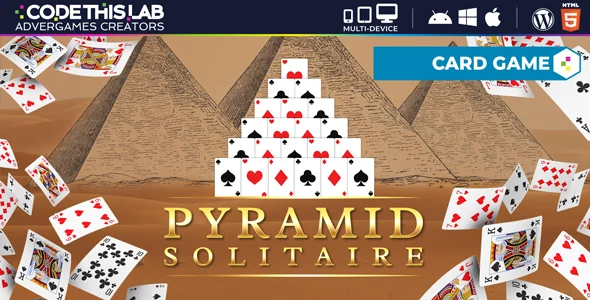
Pyramid Solitaire is an HTML5 card game built with JavaScript and the CreateJS library, engineered for web developers and publishers who deploy browser-based casual games on standard hosting environments. The package resolves the recurring bottleneck of responsive canvas delivery by shipping with a fixed 1360×640 stage that automatically scales to occupy a full device-oriented screen, eliminating the need to author viewport-fitting logic from scratch. Its operational role spans direct static-hosting uploads, WordPress embedding through the CTL Arcade plugin, and full-source reskinning for branded game portals.
Technical Specifications & Deployment Matrix
| Engineering Metric | Deployment Specification |
|---|---|
| Base Technology / Framework | HTML5, JavaScript, third-party CreateJS library (not Construct 2 or any other framework) |
| Files Included | JavaScript JS, HTML, CSS |
| Native Stage Resolution | 1360×640, scaling to fit a full device-oriented screen |
| Compatible Browsers | Chrome, Firefox, Safari, Opera, Edge |
| Front-End / Engine Dependencies | CreateJS display and tween libraries; loading and sound recovery routines for slow connections |
| WordPress Integration Path | Fully compatible with the CTL Arcade plugin |
| Delivery Format | ZIP archive ready for direct server upload |
Core Game Engine & Execution Pipeline
The entire card tableau, from the pyramid layout to pair-matching logic, renders through the CreateJS display list and executes as client-side JavaScript with no server round-trips. Because every asset, stylesheet, and script travels inside one ZIP archive, the engine boots directly from static hosting: the HTML entry point loads the JavaScript bundle, the preloading routine queues card sprites and audio, and the 1360×640 stage scales its canvas to the surrounding viewport. The codebase is organized so a developer can locate the rendering layer, the game-state logic, and the skin definitions without reverse engineering a compiled or minified black box, a distinction that matters because this title is hand-written against CreateJS rather than exported from a visual editor.
Architectural & Functional Highlights
- Viewport-Adaptive Stage: The fixed 1360×640 resolution scales to fill a full device-oriented screen, so the same build serves desktop monitors, tablets, laptops, iPhone, and Android hardware without separate layout branches.
- Full Source Code Inclusion: JavaScript, HTML, and CSS sources ship unobscured, allowing direct modification of skins, branding, and game behavior, or delegation of those changes to any developer of your choosing.
- WordPress Arcade Channel: The build is verified against the CTL Arcade plugin, which adds ad banner placement for passive revenue, social share buttons, plus leaderboard and rating functionality on top of the shipped game.
- Slow-Network Recovery: The changelog documents loading recovery and sound-loading recovery logic for slow connections, alongside fullscreen fixes on Android, fullscreen implementation for iOS, and text autofit that eases language customization.
- Cross-Browser Verification: The engine has been tested on the most common web browsers and devices, including Chrome, Firefox, Safari, and Opera across phones, tablets, and laptops.
For studios evaluating an alternative rendering stack for the same deployment target, Tower Challenge represents an independent Phaser-based pipeline for browser game delivery, useful as a comparison point when selecting a JavaScript game framework rather than a CreateJS one.
Production Deployment & Implementation Considerations
Deployment requires nothing beyond static file hosting. The ZIP package is uploaded to a server directory, the HTML entry point is referenced, and the stage scales itself to the device-oriented viewport; no database, server-side scripting language, or persistence backend participates in the runtime. Because compatibility varies across hosting configurations, verifying HTML5 asset support with your admin team or host company before rollout is the documented prerequisite.
Implementation boundaries are stated plainly in the source documentation. Sounds are enabled on mobile, yet full audio compatibility cannot be guaranteed on every mobile browser due to known conflicts between certain mobile browsers and HTML5 audio, and Windows Phone cannot load sounds at all because that platform’s audio and video tags carry unsolvable defects. Wrapping the game in third-party wrappers such as PhoneGap, Cordova, or Iudei falls outside the supported scope, and a reskin or at minimum a rebrand is advised before any native app conversion. Customization scope covers skins, branding, and full source modification, with text autofit reducing the friction of translating the interface. As a parallel option on a different authoring stack, Prisoner Bob exists as a standalone Construct 3 C3P project for teams that prefer a visual-editor pipeline delivering WebGL 2.0 output.
Frequently Asked Questions
Does the download include the complete, editable source code?
Yes, the package contains the JavaScript, HTML, and CSS sources written against the CreateJS library. Every skin, branding element, and gameplay behavior can be modified directly in the code, or the work can be assigned to any developer you contract.
Can the game be installed on WordPress without manual file transfers?
Yes, the build is fully compatible with the CTL Arcade plugin, which handles embedding and adds monetization and engagement layers such as ad banners, social share buttons, and leaderboard plus rating functionality on your existing site.
Is audio playback guaranteed on every mobile device?
No, sounds are enabled on mobile but full compatibility across all mobile browsers cannot be granted due to known issues between some mobile browsers and HTML5 audio, and Windows Phone cannot play sounds at all. The documentation explains how to avoid sound loading where needed.