Profin – Finance Law Firm Elementor Template Kit
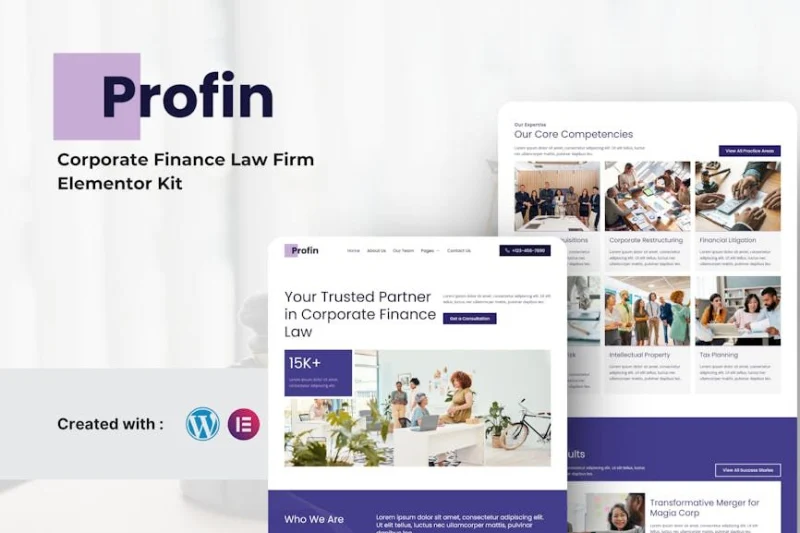
Profin Finance Law Firm Elementor Template Kit Overview & Corporate Web Foundation
Profin Finance Law Firm Elementor Template Kit is an Elementor-based layout package engineered for legal, financial, and corporate agencies to launch credibility-focused client sites through prebuilt, importable page structures. The package resolves a persistent delivery bottleneck in corporate web projects: producing a visually consistent page system — services, team profiles, FAQs, and related screens — without designing each one from a blank canvas. Within agency workflows, it functions as an import-ready design system that teams deploy, rebrand through global tokens, and hand off as finished client deliverables.
Technical Specifications & Deployment Matrix
| Engineering Metric | Deployment Specification |
|---|---|
| Base Technology / Framework | WordPress running the Elementor page builder; layouts delivered as an importable template kit |
| Runtime / Environment Requirements | Standard WordPress hosting with Elementor installed; wp_memory_limit of at least 128M recommended for JSON import operations |
| Data Exchange Mechanism | Template definitions transferred as JSON layout structures through the Elementor import/export pipeline |
| Front-End Dependencies | Global typography and color tokens, Flexbox/Grid containers, retina-ready media assets; cross-browser support spans Chrome, Firefox, Safari, and Opera |
| Persistence Footprint | No custom persistence layer; imported layouts reside in standard WordPress content storage as editable Elementor documents |
JSON Layout Pipeline & Design Token Architecture
The core mechanism is JSON-based layout import into the Elementor editor. Each of the 10+ templates encodes a container tree — nested Flexbox and Grid containers holding widget configurations, spacing rules, and device-specific settings. When the import wizard parses a template file, it reconstructs that tree as native editor objects, so every imported section remains fully editable through drag-and-drop controls after deployment rather than arriving as a frozen picture of a design.
Typography and color are bound to kit-level global tokens instead of per-widget values. Changing the primary palette or swapping the heading typeface in the global styles panel propagates across every template in one operation, converting a full rebrand from a page-by-page editing task into a single site-wide update. This token layer is what allows the same package to serve different firms while preserving layout integrity.
Import operations parse the full JSON payload in a memory-resident pass. Hosts configured with a low wp_memory_limit can abort mid-import and leave a template partially written; raising the allocation before starting the sequence prevents truncated layouts. Once pages are in place, agencies servicing additional finance accounts can run this identical token-driven workflow through Oslim, a consulting finance kit that occupies the same Elementor import pipeline for parallel client builds.
Core Technical Capabilities of Profin
- Global Design Token Layer: Fonts and colors are defined once at kit level and referenced by every template, so a single style-panel edit restyles the entire site without touching individual pages.
- Container-Based Responsive Engine: Layouts are composed from Flexbox and Grid containers with per-device rules, producing correct rendering on desktop, tablet, and phone without an external CSS framework.
- Retina-Ready Media Preparation: Image assets are prepared for high pixel-density displays, keeping graphics and typography sharp on modern screens.
- Lean Rendering Output: Widget composition is kept deliberately minimal, reducing DOM depth and supporting fast page loads across the supported browser set.
Production Implementation & Operational Resilience
In staging or client-preview environments, the recommended sequence is to import the kit before content entry, since layouts arrive with placeholder structure that editors replace in place. If a transfer interruption or memory exhaustion halts the import midway, already-written pages remain intact, and the affected template can be re-imported individually rather than restarting the full set — a containment property that keeps multi-page rollouts recoverable.
Customization boundaries matter here. All modification happens inside Elementor’s style controls: global tokens for systemic change, per-widget settings for local overrides, container rearrangement for structural edits. There is no PHP template layer to fork and no stylesheet to patch; behavior extending beyond layout and styling requires development outside the kit’s scope. Cross-browser validation across Chrome, Firefox, Safari, and Opera also reduces the pre-launch QA surface, since rendering discrepancies are addressed at the kit level rather than per engagement. For teams weighing a decoupled implementation outside the Elementor runtime, Finoza exists as an independent finance consulting WordPress theme that covers the same advisory vertical through theme-level template hierarchy instead of kit imports.
Frequently Asked Questions
Does Profin replace the active WordPress theme on a site?
No. The package is a template kit — a collection of Elementor layouts imported as editable pages. The site’s active theme continues to govern overall site structure, while the kit supplies the page-level design system.
Can the kit serve accountants and business consultants, not only law firms?
Yes. The layout set targets the broader legal, financial, and corporate sector, covering financial advisors, accountants, and business consultants. Service, team, and FAQ templates carry neutral professional structures that fit advisory practices beyond legal work.
Is code editing required to modify an imported page?
No. Every imported layout opens in the Elementor editor, where sections are rearranged by drag-and-drop and fonts or colors are adjusted through global style controls. No HTML, CSS, or PHP editing is needed for standard customization.