Private Web Browser with AdMob Ads Android
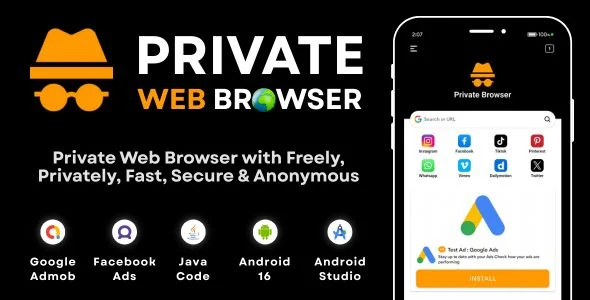
Private Web Browser Overview & Privacy-First Android Engine
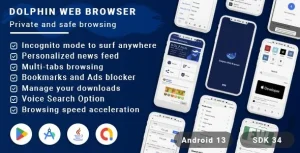
Private Web Browser is a Java-based Android application source package, engineered for mobile developers and agencies to ship a privacy-focused browsing product with integrated ad monetization. The package targets the recurring bottleneck of building an incognito-capable browser from scratch, supplying pre-wired session isolation, anonymous surfing, and encrypted traffic handling on top of a Material Components UI layer. In production workflows, it functions as a deployable white-label candidate: agencies can rebrand the XML layouts, bind their own AdMob and Facebook ad units, and push the build to Google Play with minimal architectural surgery.
Technical Specifications & Deployment Matrix
The runtime matrix below captures every verifiable engineering parameter documented in the package, giving release engineers a single reference for environment planning and store submission checks.
| Engineering Metric | Deployment Specification |
|---|---|
| Base Technology / Framework | Native Android application, JAVA source with XML layouts using Material Components |
| Minimum SDK Floor | API 24 (Android 7.0) |
| Target SDK / Compile Baseline | API 36 (Android 16), SDK 36 |
| Device Compatibility Range | Android 9.0, 10.0, 11.0, 12.0, and 15.0 (plus other API 24+ devices) |
| Deliverable File Formats | .apk (installable build) plus full .java and .xml source tree |
| Monetization Layer | Google AdMob and Facebook ad network integration |
Incognito Session Pipeline & Privacy Enforcement
The engine enforces privacy at the session layer: every browsing run executes in incognito mode from launch. When a user submits a URL or search query, the request is dispatched through the rendering pipeline without writing persistent session history, and the traffic path is protected by encryption before data leaves the application layer. Anonymous surfing is handled at the network boundary, where the architecture conceals the originating IP address so remote endpoints cannot correlate requests back to the device identity.
Because the entire stack is compiled in Java against native Android views, the rendering path avoids heavyweight abstraction layers. This direct view binding keeps the installed footprint small and the battery drain low during extended browsing sessions, which matters for retention on mid-range hardware. The XML layout system, built with Material Components, governs the interface hierarchy, so every screen — address bar, tab surface, and ad container — resolves through standard Android view inflation rather than a custom rendering engine.
Architectural & Functional Highlights
- Incognito Session Isolation: Each browsing session operates in incognito mode, meaning the engine does not persist user history between runs and treats every launch as a clean state.
- Anonymous IP Concealment: The networking layer hides the device IP during outbound requests, preventing site-side identification and behavioral correlation of the user.
- Dual Ad Network Wiring: Google AdMob and Facebook ad placements are pre-integrated, letting developers activate monetization by binding unit IDs and placement IDs during configuration rather than writing ad logic from scratch.
- Lightweight Resource Profile: The compiled package remains small in size and battery-friendly, an outcome of the native Java/XML construction with no cross-platform runtime overhead.
On the monetization side, the AdMob wiring follows the standard unit-binding pattern common to commercial Android utilities. Teams shipping adjacent products will recognize the same configuration discipline in ScanQR, an independent Android scanner app that applies an equivalent AdMob integration path for a different app category.
Production Implementation & Operational Resilience
Deployment begins in Android Studio with the Java and XML source tree, compiled against SDK 36 with a minimum API of 24. This floor means the build installs on any device running Android 7.0 or newer, covering the Android 9 through Android 15 matrix and the Android 16 target tier. Because the compile target is API 36, the package satisfies current Play Store target-API requirements without a migration pass, which removes a common submission blocker for older browser codebases.
Before a release build, engineers must register their own AdMob application ID and Facebook placement identifiers in the project configuration; the shipped defaults exist only for development validation. Release builds should be signed with a production keystore, after which the included .apk deliverable lets QA teams verify runtime behavior on physical devices prior to store upload.
Resilience comes from the native construction: Material Components handle layout adaptation across screen densities, and the lightweight footprint keeps memory pressure low on constrained hardware. Secondary development is fully open since the complete .java and .xml sources ship with the package — teams can restyle the interface by editing XML layouts, adjust the browsing pipeline in Java, or rewire ad placements without reverse engineering compiled artifacts.
For delivery engagements whose goal is wrapping an existing website rather than shipping a general-purpose private browser, WebApp represents a decoupled WebView-based Android path that exists outside this codebase and requires no Java modifications.
Frequently Asked Questions
Does the download include a compiled APK in addition to the source files?
Yes. The deliverables contain an installable .apk alongside the complete .java and .xml source tree, so teams can validate runtime behavior on real hardware before opening the project in Android Studio or rebuilding it against their own signing configuration.
Can Google AdMob and Facebook ads operate inside the same build?
Yes. Both networks are integrated in the codebase, and developers activate monetization by binding their own AdMob unit IDs and Facebook placement identifiers during the configuration phase, with ad surfaces rendered across the browsing interface.
Will the application install on devices running below Android 7.0?
No. The minimum SDK is API 24, which corresponds to Android 7.0 and defines the lowest supported runtime; the documented compatibility matrix covers Android 9.0 through Android 15.0, plus Android 16 at the target tier.
Does a closed incognito session leave local browsing artifacts on the device?
No. Sessions execute in incognito mode, so the engine does not persist browsing history between runs; this session-level isolation is the documented privacy posture of the package and applies to every launch by default.