Premium Game – Word Search Pro Game – HTML5,Construct3
Word Search Pro Overview & Grid-Based Puzzle Runtime Architecture
Word Search Pro is a Construct 3 HTML5 word puzzle package, engineered for game studios and web publishers to deploy a grid-based vocabulary game across browser and mobile Webview environments. The build resolves the core bottleneck of casual-puzzle delivery: generating randomized letter grids with words hidden along horizontal, vertical, and diagonal axes while persisting session state entirely on the client, without any backend server. Within agency production workflows, it operates as a self-contained source package — a native c3p project plus an exported HTML5 build — that can be reskinned, wired for ad monetization, and shipped cross-platform from one event-driven codebase.
Technical Specifications & Deployment Matrix
| Engineering Metric | Deployment Specification |
|---|---|
| Base Technology / Framework | Construct 3 event-system engine; native .c3p project source supplied |
| Runtime / Language Requirements | HTML5 / JavaScript export executed in modern browsers (Firefox documented) |
| Display Resolution | 720×1080 px portrait canvas layout |
| Data Persistence | Browser LocalStorage for game data and last-played session restore |
| Monetization Layer | Integrated AdMob advertisement hooks within the event system |
| Deliverable Files | .c3p source project and exported HTML build files |
Grid Generation & Word Placement Execution Pipeline
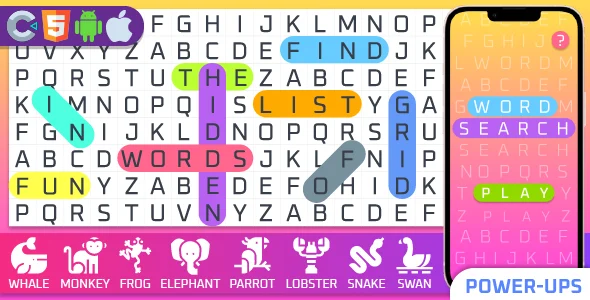
Runtime grid generation embeds hidden words along horizontal, vertical, and diagonal axes. When a player selects one of the ten content categories, the Construct 3 event sheets read the category’s difficulty configuration and dispatch it to the board-assembly routine, which allocates the letter matrix, places the target vocabulary along valid directional vectors, and back-fills the remaining cells with distractor characters. The result is a square grid in which every listed word is guaranteed to exist on the board before the round begins.
Input handling runs through the engine’s unified pointer events, so a single drag gesture works identically for mouse input on desktop and touch input on mobile screens. As the player drags across the grid, the codebase continuously validates the selection vector against the placed-word index; a confirmed match triggers the visual marking routine, removes the word from the remaining-words list, and writes round progress to LocalStorage. A countdown governs round pressure, and the built-in power-up mechanic — additional time — is dispatched as an event-driven state modification rather than a hardcoded behavior, which keeps the timing logic testable inside the Construct 3 editor.
The AdMob integration sits at defined trigger points in the event flow, allowing advertisement calls to fire between rounds or at configured moments without interrupting active input capture. For studios evaluating parallel Construct 3 puzzle titles to widen a casual-games portfolio, 9-Patch Puzzle Quest follows the same source-included, multi-browser deployment model as an independent offering.
Core Technical Capabilities of Word Search Pro
- Category-Difficulty Engine: Ten categories ship with distinct difficulty mappings, so board density, word count, and directional complexity vary per selection without duplicating event logic.
- LocalStorage Session Persistence: Round state, unlocked progress, and the last-played game are serialized to LocalStorage, enabling full session restore after a page reload or app restart.
- AdMob Monetization Hooks: Advertisements are invoked through engine events at defined trigger points, keeping monetization decoupled from the puzzle-validation code path.
- Power-Up Event System: The “more time” power-up modifies the countdown state through the event sheet, providing a measurable difficulty-relief mechanic that can be tuned per category.
- Reskin-Ready Asset Layer: Visual assets sit apart from game logic on the 720×1080 layout, so tile art, typography, and interface graphics can be replaced inside the c3p project without touching placement algorithms.
Production Implementation & Operational Resilience
Deployment requires only static file hosting: the exported HTML build and its assets can be served from any web server or bundled into a native Webview container for app-store distribution, since all game logic executes client-side in the browser’s JavaScript runtime. The small file size of the build keeps initial payload low, which matters for mobile networks where every kilobyte of the loading phase affects playable latency. Because persistence relies on LocalStorage rather than remote calls, no CORS configuration or API gateway is needed; the same origin policy imposes no constraints on a statically hosted instance.
Firefox is the browser documented by the seller, so verification passes on Chromium-based engines and Safari are advisable staging steps before a public launch, since canvas rendering and pointer-event timing can differ marginally between JavaScript engines. In Webview wrapping scenarios, confirm that the container enables LocalStorage access — a disabled storage partition would break session restore, the single external dependency the architecture actually has.
Secondary development is explicitly supported through the supplied c3p source. Reskinning is confined to asset replacement within the Construct 3 editor: swap sprite sheets, adjust the 720×1080 layout, and re-export through the standard build pipeline. Event-sheet modifications — adding categories, retuning difficulty mappings, or repositioning AdMob triggers — are the correct extension path for behavior changes. For publishers building an educational vertical alongside this title, Math Magic Battle exists as a separate Construct 3 learning game outside this package’s scope.
Frequently Asked Questions
Does the package ship with editable project source, or only a compiled build?
Yes, the deliverables include the native Construct 3 .c3p project file alongside the exported HTML5 build, so every event sheet, layout, and asset can be opened and modified directly inside the Construct 3 editor.
Can an interrupted round be resumed after the browser is closed?
Yes, the codebase writes the last-played game and round data to LocalStorage, and the load routine restores the saved session on the next launch, provided the browser or Webview container has not cleared its storage partition.
Does the game require a backend server or database to store player progress?
No, all persistence is handled client-side through the browser’s LocalStorage API. The exported build can be hosted as static files, which removes any server-side dependency, database provisioning, or API configuration from the deployment checklist.
Is the advertising integration mandatory, or can it be removed before release?
No, the AdMob layer is wired through discrete event-sheet trigger points rather than being baked into the core validation loop, so those advertisement events can be disabled or stripped during secondary development without affecting grid generation or input handling.