Polo – Responsive Multi-Purpose HTML5 Template
Polo Overview & Static Multi-Page Front-End Architecture
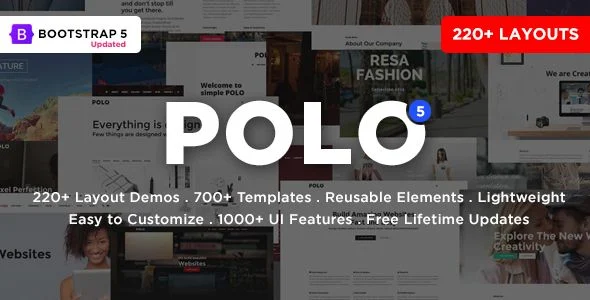
Polo Responsive Multi-Purpose HTML5 Template is a Bootstrap 5 and Bootstrap 4 front-end codebase, engineered for agencies and freelance developers to ship multi-vertical marketing sites without rebuilding shared components from scratch. The package addresses the central bottleneck of static site production—reproducing headers, footers, sliders, portfolio grids, and blog layouts across corporate, hotel, shop, event, wedding, and one-page deliverables—by shipping 220+ pre-built demos and 700+ HTML files in which those blocks are already wired together. Within a production workflow, it operates as a scaffold and component inventory: a developer selects the demo closest to the client brief, prunes unused markup, recompiles the Sass layer against the brand palette, and deploys the trimmed file set.
Technical Specifications & Deployment Matrix
| Engineering Metric | Deployment Specification |
|---|---|
| Base Technology / Framework | Bootstrap 5.x and Bootstrap 4.x, HTML5, CSS3 |
| Runtime / Language Requirements | Static HTML/JS rendering; PHP required only for the contact form, Mailchimp subscription, and PHPMailer delivery endpoints |
| Build & Preprocessing | Gulp task runner with Sass/SCSS source files included in the package |
| Front-End / Engine Dependencies | jQuery, Owl Carousel, Slider Revolution, Isotope, Magnific Popup, Stellar, Vide, Chart.js, amCharts, Datatables, particles.js, Moment.js |
| Browser & Compliance Footprint | Firefox, Safari, Opera, Chrome, Edge; W3C-valid HTML; responsive and retina-ready output |
Bootstrap Grid Pipeline & Component Composition Flow
Polo renders every page as precompiled static HTML bound to the Bootstrap grid system and a JavaScript initialization layer. Each HTML document links CSS compiled from the SCSS source tree, while a shared script stack binds interactive behavior to DOM selectors at load time: Owl Carousel drives carousel and text sliders, Isotope powers masonry filtering across portfolio and blog grids, Magnific Popup handles lightbox media, and Stellar plus simplr-smoothscroll govern parallax offsets and scroll interpolation. Navigation variants—20 header styles, 20 menu styles, sticky bars, mega menus, and a side panel—toggle through wrapper classes rather than duplicate templates, which keeps markup delta between demos small. AJAX page transitions intercept navigation events and swap page content without a full document reload, and 12 page-title variants apply entry animation effects through the bundled animate.css library.
The shortcode inventory exceeds 70 units, each with multiple visual variants, and spans pricing tables, countdown timers, pie charts, ion range sliders, daterangepicker controls, clipboard.js copy actions, Bootstrap Switch toggles, and Datatables. Shop templates include AJAX quick-view modals, portfolio layouts expose 22 hover effects over masonry and classic grids, and 15 widgets cover Instagram, Twitter, and Flickr feed ingestion alongside Google Maps rendering through the gMap wrapper. For studios evaluating a standalone, narrower landing-kit alternative built outside this multi-page structure, Bulkit – Saas Landing Pages functions as a parallel static starting point.
Core Technical Capabilities of Polo
- Demo & Layout Variance Engine: 220+ demos and 700+ HTML files switch between wide, boxed, frame, and modern layout styles through wrapper-level classes, letting one codebase serve landing, agency, hotel, fashion, magazine, and shop verticals without structural rewrites.
- Slider & Media Layer: A full-screen slider with parallax behavior, image and video backgrounds via Vide and mb.YTPlayer for YouTube, plus the Slider Revolution jQuery plugin, give the marketing surface multiple motion pipelines behind a single initialization pattern.
- Form & Data Endpoints: The working PHP contact form routes through PHPMailer with client-side validation via the jQuery Validator plugin, while Mailchimp integration handles newsletter capture—these are the only segments requiring server-side PHP execution.
- Layout Integrity & Fidelity: W3C-valid HTML, a 4+ column grid, and retina.js high-DPI asset substitution keep rendering consistent across the five documented browsers and across desktop, tablet, and smartphone viewports.
Production Implementation & Operational Resilience
Because the deliverable is a static multi-page package, it deploys to any web server or CDN-capable host that can serve HTML, CSS, and JS files; PHP execution becomes relevant only when the contact form or newsletter endpoints are exercised. The SCSS source layer means theming runs through variable redefinition—colors, typography drawn from Google Fonts, spacing, and breakpoints—followed by a Gulp recompile, while direct overrides on the compiled CSS remain available for teams that prefer not to run the build chain. Font Awesome supplies the icon set, and five sidebar variants split between modern and classic treatments.
Asset boundaries deserve attention during client staging: the demo imagery is not shipped inside the package. Nearly all photographs are released under Creative Commons CC0 from sources such as Unsplash, Pixabay, Pexels, and The Stocks, so they can be re-downloaded and replaced without licensing friction, while a small subset requires attribution or substitution. Given the 700-file scale, pruning unused demo directories before hand-off reduces repository weight and speeds QA passes. For teams that have outgrown static templating and need a component-driven React rendering pipeline instead, Drozy – Modern Blog & Magazine NextJs Template operates as an independent Next.js codebase outside the Bootstrap stack, appropriate for decoupled implementations rather than any merge into this package.
Frequently Asked Questions
Are the demo images included in the downloaded package?
No, all images exist purely for demonstration and are excluded from the download. Almost every asset is CC0-licensed and re-downloadable from Unsplash, Pixabay, Pexels, or The Stocks, so replacements can be sourced without licensing conflicts.
Does every page require a PHP-enabled server to display?
No. All HTML files render as static markup on any web server; PHP execution is needed only where the working contact form, PHPMailer delivery, or Mailchimp subscription endpoints are invoked by included PHP files.
Is a local Gulp and Node.js environment required to restyle the template?
Yes, when editing the Sass source layer. The bundled Gulp workflow recompiles SCSS variables into final CSS, so restyling through the source files requires a Node.js build setup; overriding compiled CSS directly avoids that dependency.