Politics – Political Candidate Leader Elementor Template Kit
Politics Elementor Template Kit Overview & Campaign Site Assembly Role
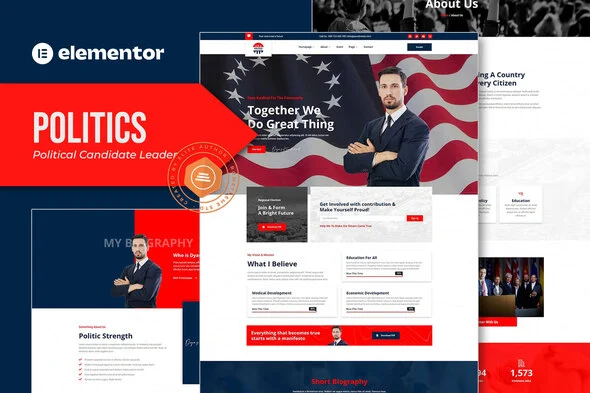
Politics Elementor Template Kit is an Envato-format Elementor Template Kit built for agencies, consultants, and campaign staff who need to publish candidate and political-party websites without writing custom layout markup. It removes the bottleneck of hand-constructing page structures for campaign-critical journeys such as candidate biographies, donation appeals, event promotion, and volunteer recruitment by supplying pre-composed, import-ready page templates. Within an agency delivery workflow, it functions as a design-and-layout layer that runs entirely inside the Elementor editor, letting production teams import individual pages, swap copy and imagery, and publish constituency-facing sites at predictable speed.
Technical Specifications & Deployment Matrix
| Engineering Metric | Deployment Specification |
|---|---|
| Base Technology / Framework | Envato Template Kit for the Elementor page builder (3.4.x, 3.5.x, 3.6.x) |
| Runtime / Language Requirements | WordPress with the Elementor editor active; adequate server memory (wp_memory_limit) for kit uploads |
| Data Exchange / Communication Protocols | Template JSON payloads uploaded through the Envato Elements plugin; forms handled via Contact Form 7 |
| Front-End / Engine Dependencies | Elementor, ElementsKit Lite (header and footer builder), Contact Form 7 |
| Database / Persistence Footprint | No kit-owned database schema; imported pages, global styles, and header/footer blocks persist as standard WordPress content objects |
Template Composition & Import Execution Pipeline
The kit operates through a JSON-based import pipeline: each page ships as a structured layout payload that the Envato Elements plugin parses and materializes inside the Elementor editor.
Deployment follows a deterministic sequence. The installer activates the Envato Elements plugin from the WordPress Plugins screen, uploads the untouched kit archive through Elements > Installed Kits, and presses the Install Requirements button so the dependency chain — Elementor, ElementsKit Lite, and Contact Form 7 — resolves before any layout data is parsed. Each template payload is then converted into editable Elementor documents, with global typography and color tokens applied so sitewide restyling happens from a single controls surface rather than per-widget edits. Because imports write layout data into the editor state one page at a time, sequential imports keep memory consumption bounded and prevent partial document generation during staging pushes.
The kit covers the full narrative arc of a political web presence: a Home Party landing page for party organizations, a Home Candidate variant for individual contenders, About Us and About Me pages, a Became A Volunteer recruitment page, an Event page, a Biography page, an Honored Member showcase, a News listing, and a Contact page wired for Contact Form 7 fields. Header and footer regions are assembled through the ElementsKit Lite builder rather than hard-coded theme regions, which keeps global navigation editable independently of individual page documents. For teams whose campaign brief demands a full-theme architecture with bundled theme-level controls instead of a kit-based layout layer, Reform — Political Campaign & Government WordPress Theme exists as a parallel WordPress solution occupying the same political-campaign problem space.
Core Technical Capabilities of Politics Elementor Template Kit
- Dual-Scenario Home Templates: Two structurally distinct entry pages — party organization and individual candidate — allow a single kit license to serve municipal, party, and personal-leadership deployments without rebuilding hero sections, CTA stacks, or content grids from scratch.
- ElementsKit Header & Footer Builder: Global header and footer regions are defined as reusable builder blocks, so navigation changes propagate across every imported page instead of requiring per-page manual synchronization during content turnover.
- Contact Form 7 Integration: The Contact template ships with form regions designed around Contact Form 7 fields, giving campaign offices a working constituent-contact channel immediately after plugin activation and form configuration.
- Volunteer & Event Funnel Pages: Dedicated Became A Volunteer and Event templates map the two highest-conversion campaign actions into standalone layouts, shortening the path from visitor to sign-up.
- Sequential Single-Template Imports: The documented one-at-a-time import workflow keeps per-import payload size small, reducing timeout risk on shared hosting where the PHP memory ceiling is low.
Production Implementation & Operational Resilience
In agency staging environments, the correct sequence is dependency installation first, template import second, and page assignment third. After a template lands in the My Templates library, the operator creates a new page, opens it in the Elementor editor, switches page settings to Elementor Full Width, hides the native page title, and inserts the stored template from the gray folder icon. Skipping the Install Requirements step is the primary failure mode: layout widgets that depend on ElementsKit Lite will render as unresolved modules until the plugin is active. Administrators should also confirm the wp_memory_limit allocation on budget hosting before bulk workflows, since import payloads and editor sessions both draw on the same memory pool. Where kit-based assembly cannot satisfy a brief that requires deep theme-level customization, Vox Populi – Political Party, Candidate Grassroots stands as a separate WordPress theme option for grassroots campaign builds. Customization boundaries within this kit are deliberate: secondary development means overriding colors and typography through global tokens, replacing section copy, and substituting imagery — not modifying plugin source. All demo photography is sourced from Envato Elements, so production deployments must either license those assets or replace them with owned campaign photography before public launch.
Frequently Asked Questions
Does the kit include a builder for site-wide headers and footers?
Yes. Headers and footers are constructed through ElementsKit Lite, which is declared as a required dependency and activated via the Install Requirements button before any template import begins.
Is the kit compatible with Elementor 3.6.x?
Yes. The kit is documented against Elementor 3.4.x, 3.5.x, and 3.6.x, so any of these three editor versions can parse the imported layout payloads without requiring a legacy rollback.
Should multiple templates be imported at the same time?
No. The documented workflow states that templates must be imported one at a time, because sequential imports keep each upload payload small and avoid memory exhaustion or partially rendered documents on constrained hosting.
Can the bundled demo images be published on a live campaign site without licensing?
No. Demo imagery comes from Envato Elements and requires a separate license for production use, or teams must substitute their own photography before the site is exposed to the public.
Does the Contact template work immediately after import?
Yes, provided Contact Form 7 is activated during the requirements step; the form region then needs its fields and mail settings configured before constituent messages route to the campaign inbox.