Podover – Podcast WordPress Theme
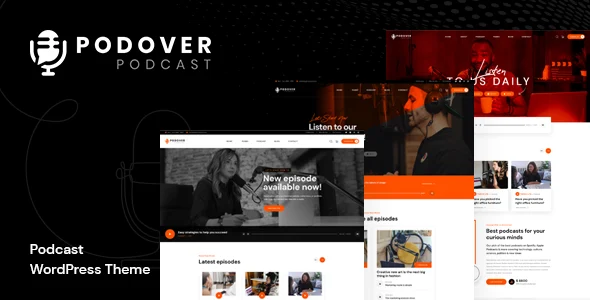
Podover Podcast WordPress Theme Overview & Audio Publishing Architecture
Podover Podcast WordPress Theme is an audio-first WordPress theme engineered for podcasters, vlog producers, and online radio operators to publish episodic audio content without hand-coding custom post types or player components. The package eliminates the recurring engineering bottleneck of wiring episode metadata, transcripts, and timeline-synced playback into the standard WordPress template hierarchy by shipping dedicated audio, events, and MegaMenu modules alongside six importable homepage demos. Within an agency delivery workflow it operates as a self-contained Elementor-driven deployment base scalable from single-host shows to multi-host podcasting networks.
Technical Specifications & Deployment Matrix
| Engineering Metric | Deployment Specification |
|---|---|
| Base Technology / Framework | WordPress theme package (PHP, CSS, Sass, JS source files) with bundled Ovatheme audio, events, framework, and MegaMenu modules |
| Runtime / Language Requirements | WordPress 5.9.x through 7.0.x; PHP 7.x and 8.x compatibility confirmed in the v1.0.6 maintenance release |
| Compatible Extensions | Elementor, Slider Revolution, WooCommerce 6.x–10.x, Contact Form 7, WPML, MailChimp, Yoast SEO, Rank Math, W3 Total Cache, WP3 Super Cache |
| Front-End / Engine Dependencies | Elementor drag-and-drop page builder as the primary layout engine; responsive, high-resolution, widget-ready rendering |
| Browser Coverage | Chrome, Firefox, Safari, Opera, Edge across desktop, tablet, and mobile viewports |
Podcast Episode Rendering Pipeline & Execution Flow
Each inbound request flows through the standard WordPress template hierarchy, then delegates composition to Elementor page structures populated by the bundled audio module. That module registers episodes, hosts, and events as structured content objects, so an episode detail page can render a full transcript, chapter markers, and a visible audio player bound to each timeline segment. Audience comment threads and submission forms attach directly to these detail templates, keeping engagement inside the same rendering context as the media itself.
Four prebuilt listing styles govern how episode archives are queried and displayed: single-episode grids and season/show groupings that aggregate multiple episodes under one parent container. This grouping model is the structural foundation for podcast networks, because a network page can enumerate shows while each child listing paginates its own episodes. Live-streaming configurations extend the same pipeline toward continuous online radio broadcasting rather than fixed-episode distribution. Agencies comparing a parallel theme package in this runtime can also evaluate Podify Pro when scoping audio-publishing projects with comparable demo-import and audio feature requirements.
Core Technical Capabilities of Podover
- Timeline-synced episode engine: Episode detail templates expose transcript blocks and chapter timestamps, each anchored to a playable audio position so listeners navigate long-form content by segment rather than scrubbing blindly.
- Professional audio player controls: The player implements jump-forward and skip-back buttons, playback speed adjustment, and volume control, reducing the need to embed third-party iframe players with inconsistent styling.
- Host and event data objects: Dedicated host detail pages and event listing/detail templates let producers publish talent profiles and upcoming live recordings without registering additional custom types manually.
- One-click demo import: All six homepage demos and inner page templates import in a single installation action, populating the database with representative content for rapid client staging.
- MegaMenu composition layer: The bundled menu module supports multi-column layouts with embedded shortcodes and custom elements, replacing flat native menus for content-heavy podcast networks.
Production Implementation & Operational Resilience
In client staging environments, deployment follows a predictable sequence: theme activation, plugin bundle installation, one-click demo import, then content replacement inside Elementor. The WooCommerce compatibility range spanning versions 6.x through 10.x permits merchandise storefronts and the built-in donate page to share the same runtime as episode archives, with preset donation amount options accelerating contributor conversion paths. WPML compatibility extends content translation across episode, host, and event objects for multilingual networks, while Contact Form 7 handles inquiry and comment capture.
Customization boundaries are well defined. The WordPress Customizer exposes main options, sidebar configurations, social links, styling controls, layout settings, and header/footer sections, and the header/footer builder plus sidebar generator allow structural overrides without template-file surgery. Because Sass sources ship in the package, front-end teams can modify design tokens at stylesheet origin and recompile, preserving maintainability through successive updates. Selective main and secondary color options provide a fast rebrand path. Caching is addressed through declared compatibility with W3 Total Cache and W3 Super Cache, and SEO tooling support covers both Yoast SEO and Rank Math. The maintenance record through v1.2.7 shows iterative security patches, Elementor version alignment fixes, and coordinated updates across the audio, events, framework, and MegaMenu modules, which signals that module and theme versions should be upgraded together. For decoupled implementations outside a full theme runtime, iGUE exists as an independent Elementor template kit alternative covering similar podcaster layout goals.
Frequently Asked Questions
Does the delivered package include Sass source files for asset-level customization?
Yes, the ThemeForest file set contains PHP, CSS, Sass, and JS files, allowing front-end developers to adjust design tokens at stylesheet origin and recompile rather than layering overrides on compiled CSS.
Is Podover optimized for the Gutenberg block editor?
No, the theme is explicitly documented as not Gutenberg-optimized. Its page composition layer is Elementor, and the six homepage demos plus inner templates are constructed with Elementor drag-and-drop widgets and premade elements.
Can this theme power an online radio station with live audio streaming?
Yes, the feature set explicitly covers live audio streaming and online radio station deployments, extending the package beyond pre-recorded episode distribution toward continuous broadcast scenarios for media organizations.
-
v1.2.5 LatestOct 27, 2026