Pixag – A Hypercasual Game with Admob Ads
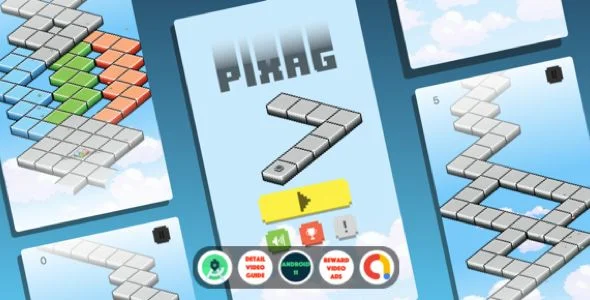
Pixag Overview & Mobile Game Source Architecture
Pixag is a Cocos2d-x Android game source code package, engineered for indie publishers and mobile studios to ship a one-tap zigzag hypercasual title without a heavyweight engine dependency. The codebase removes the build overhead typically imposed by full 3D engines such as Unity, because the entire project compiles and exports through a standard Android Studio toolchain built on native Java and XML layers. Within an agency or solo publisher workflow, the package operates as a reskin-ready deployment unit: teams swap the included layered PSD and PNG art assets, bind their own AdMob identifiers, and produce a store-facing APK targeting Android 9.0 through Android 13.
Technical Specifications & Deployment Matrix
| Engineering Metric | Deployment Specification |
|---|---|
| Base Technology / Framework | Cocos2d-x game engine; no Unity or external engine runtime required |
| Runtime / Language Requirements | Android 9.0 through 13.0; Java (.java) and XML source layers; .dex, .so, .dat and .db build artifacts |
| Monetization / Communication Protocols | Google Mobile Ads (AdMob) banner, interstitial and rewarded video request flows |
| Front-End / Asset Dependencies | Layered PSD and layered PNG sources; HTML, CSS, LESS, Sass, Stylus, JavaScript JS and PHP helper files |
| Database / Persistence Footprint | Local .db and .dat storage for character unlocks, rating-screen state and run tracking |
Zigzag Input Pipeline & Monetization Execution Flow
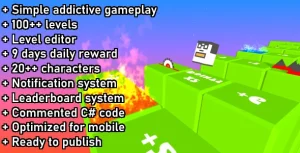
The core mechanism is an event-driven, one-touch input loop: every screen tap dispatches a direction-change event to the character controller, which flips the zigzag trajectory across isometric pixel-art corridors. At runtime, the touch listener captures the tap, the controller inverts a horizontal direction flag, and the next frame tick propagates the new heading. A collision validator continuously tests the character bounds against corridor edges; contact with an edge terminates the run, hands control to the game-over state machine, and queues the restart flow. Because the loop is endless, difficulty scales through traversal distance rather than scripted level data, which keeps the asset footprint small and the per-frame update budget light on battery and thermal load.
Monetization is wired through the Google Mobile Ads layer: banner units occupy persistent UI slots, interstitial units fire at defined session boundaries such as run failures, and rewarded video slots expose an opt-in ad path to players. Session state, including unlocked characters and rating-screen behavior, persists in local storage, so a process kill or device restart does not wipe progression. The included reset button flushes this local state when a clean device profile is needed for QA cycles. For studios surveying parallel Android source packages that demonstrate multi-network ad wiring beyond AdMob, the Live Microphone Voice Tools with AdMob Facebook Ads Android project documents a comparable standalone ad-integration pattern on a separate utility codebase.
Architectural & Functional Highlights
- One-touch event dispatch: a single tap flips the direction flag and triggers per-tick edge collision testing, producing a minimal input-to-render cycle suited to low-end hardware.
- Triple-format AdMob implementation: banner, interstitial and rewarded video units are already coded and reachable through identifier configuration rather than new SDK wiring.
- Character unlock persistence: multiple playable characters are stored in local .db/.dat records that survive app restarts and process termination.
- Store-compliance and engagement modules: a smart rating screen, share button, more-games button, info screen and reset button ship as ready UI components aligned with Google Play guideline requirements.
- Asset-level reskin pipeline: layered PSD and layered PNG sources plus a step-by-step video guide allow artwork replacement without edits to game logic.
Production Implementation & Operational Resilience
Deployment starts inside Android Studio: import the project, replace art resources, insert your AdMob publisher identifiers, then compile a signed release build for Google Play submission. The documented compatibility band spans Android 9.0 through 13.0, and guideline compliance is addressed at the code level, which reduces store review friction. Because the Cocos2d-x foundation runs a lighter per-frame workload than a full 3D engine, the resulting build avoids shipping a Unity-class runtime and stays efficient on battery-constrained devices.
Error containment follows a defined path: run-state failures route through the game-over handler instead of crashing the render loop, and the reset-game button clears local persistence for device-lab verification. Optional capability modules, including in-app purchasing, Google leaderboards, OneSignal push notifications, alternate ad networks such as Facebook Audience Network and MoPub, and code paths for the Galaxy, Huawei and Xiaomi stores, exist as package upgrade scopes rather than base deliverables, so teams planning those features should verify component availability during release planning. For teams weighing standalone alternatives where monetization spans AdMob, AppLovin and Yodo1 under a remote admin panel, the Lucky Scratch to Win PRO with Earning System package represents a separate server-administered codebase outside this game’s runtime.
Frequently Asked Questions
Does the deliverable include a prebuilt APK alongside the source code?
Yes, the package ships with a runnable .apk file in addition to .java, .xml, .dex, .so, .dat and .db artifacts, so the game can be tested on a device before any recompilation or reskin work begins.
Can the game be reskinned without programming knowledge?
Yes, a step-by-step video guide documents the full reskin workflow, and the layered PSD and layered PNG sources allow designers to replace characters and environments without modifying the underlying game logic.
Are all three AdMob ad formats already implemented in the source?
Yes, banner, interstitial and rewarded video units are coded into the project, so publishers only need to bind their own AdMob identifiers during configuration in Android Studio before export.
Is background music bundled with the project files?
Yes, the package includes a music layer designed to blend with gameplay, so the default build produces a complete audio-visual experience without sourcing external sound files.