Pinball Space Adventure – HTML5 Arcade Game
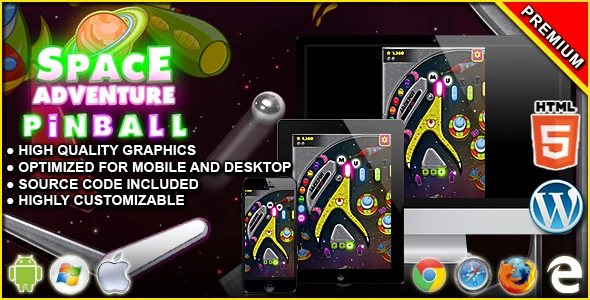
Pinball Space Adventure Overview & HTML5 Arcade Game Engine
Pinball Space Adventure is an HTML5 arcade game built with JavaScript and the CreateJS library, engineered for web studios and game portal operators to deploy classic flipper gameplay directly in the browser. The package addresses the recurring need for a self-contained, server-light arcade title whose 768×1280 canvas scales to fill a full device-oriented portrait screen without any native app build. Within production workflows, it operates as a drop-in static asset: upload it to any standard web host, or route it through the CTL Arcade WordPress plugin to gain ad banners, social sharing, and leaderboard channels around the playfield.
Technical Specifications & Deployment Matrix
| Engineering Metric | Deployment Specification |
|---|---|
| Base Technology / Framework | HTML5 and JavaScript built on the third-party CreateJS library (not Construct 2 or any other export framework) |
| Canvas Resolution | 768×1280 native stage that scales to fit a full device-oriented screen |
| Files Included | JavaScript JS, HTML, and CSS — full source code, unobfuscated |
| Browser Compatibility | Chrome, Firefox, Safari, Edge, and Opera (Opera rendering bug fixed in the 04/03/2024 maintenance release) |
| Device Coverage | Validated on the most common browsers and devices, including tablets, laptops, iPhone, and Android hardware |
| Audio Behavior | Boots muted by default; the startup flag is configurable in index.html. Windows Phone cannot enable sound due to unsolvable audio/video tag issues |
Client-Side Playfield Runtime & Execution Pipeline
The title executes entirely client-side, driving playfield rendering, flipper input handling, and score accumulation through the CreateJS display pipeline inside the browser. The objective loop is classic arcade design: survive as long as possible while stacking points. Because the codebase avoids Construct 2 and comparable exporters, every gameplay constant remains editable at the raw JavaScript level rather than locked inside a generated bundle. For decoupled content expansion on a separate Construct 3 toolchain, HexaDice stands as an independent puzzle title and not an extension of this engine.
Architectural & Functional Highlights
- Full Source Code Delivery: JavaScript, HTML, and CSS files ship in the ZIP package, allowing studios to rewrite skins, swap branding, and adjust startup behavior without reverse engineering compiled output.
- Adaptive Canvas Scaling: The 768×1280 stage stretches to occupy the full device-oriented screen, keeping one build serving both phone and tablet viewports.
- Slow-Connection Recovery: Dedicated loading and sound-loading recovery logic, added in the 16/09/2019 revision, prevents asset-fetch delays on constrained networks from blocking the game session.
- Configurable Audio State: The game starts muted to align with browser autoplay restrictions; the Howler-driven audio layer exposes this default as a single setting in index.html.
- WordPress Arcade Channel: Full CTL Arcade plugin compatibility unlocks ad banner placement for passive revenue, social share buttons, and native leaderboard plus rating functionality on top of the base game.
Production Deployment & Implementation Considerations
Deployment requires nothing beyond a standard web server: the ZIP contents are uploaded as static files and reached through the browser, or the title is wired into WordPress via the CTL Arcade plugin when monetization surfaces are required. Server compatibility is broad, though verifying host configuration with an administrator before public rollout remains a sensible pre-flight step. The release history also documents sustained maintenance — an iOS 13 rendering fix, a screenfull library update, an Opera bug fix in March 2024, and removal of the legacy start button in favor of the muted-boot flow.
Implementation boundaries are stated openly in the documentation. Full audio parity across every mobile browser cannot be guaranteed because of known conflicts between certain mobile browsers and the HTML5 audio stack, and Windows Phone devices cannot enable sound at all. Pixel-identical rendering on every conceivable screen size is likewise not promised; validation instead targets the most common browsers and devices. Teams planning native app distribution through wrappers such as PhoneGap or Cordova are advised to reskin or rebrand first, and behavior inside third-party wrapper software sits outside the supported scope. Operators scaling a portal beyond a single machine can treat the 9 Mini HTML5 Games Bundle as a separate C2/C3 collection assembled on a different toolchain.
Frequently Asked Questions
Does the download include the full editable source code?
Yes. The ZIP package contains the complete JavaScript, HTML, and CSS source, so skins, branding assets, and the default muted startup flag in index.html can all be modified directly without reverse engineering any compiled or exported bundle.
Was the game exported from Construct 2 or a similar framework?
No. Development used plain HTML5 and JavaScript together with the CreateJS library, a distinction that shapes how developers approach modifications, since the gameplay logic lives in readable JS files rather than inside an exporter-generated project structure.
Can the game be shipped inside a native app wrapper unchanged?
No. The documentation advises a reskin or at minimum a rebrand before app conversion, and any issues encountered while running the title inside third-party wrappers such as PhoneGap, Cordova, or Iudei fall outside the item support scope.