Orisa – Creative Agency & Portfolio HTML Template
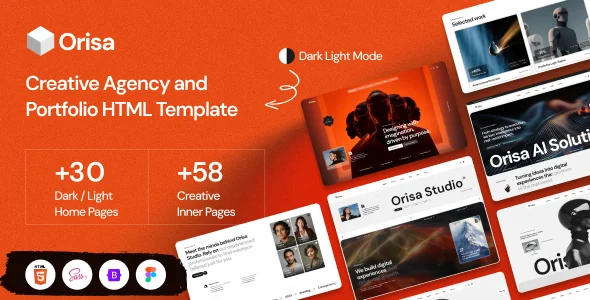
Orisa Creative Agency HTML Template Overview & Static Front-End Foundation
Orisa Creative Agency HTML Template is a static front-end build system engineered on Bootstrap 5.3 for agencies and studios that need production-grade portfolio markup without any server-side runtime. The package resolves the recurring bottleneck of hand-coding scroll choreography, responsive grids, and theme switching from scratch by shipping prebuilt layouts wired to the GSAP animation library. Within an agency delivery workflow, it functions as the presentation-layer deliverable: developers take the HTML, SCSS, and Gulp source, rebrand through variable overrides, and push the compiled output to any static host.
Technical Specifications & Deployment Matrix
| Engineering Metric | Deployment Specification |
|---|---|
| Base Framework | Bootstrap 5.3 mobile-first grid supporting 4+ column layouts |
| Runtime Requirements | Any static web server; no PHP interpreter, database engine, or CMS backend required |
| Front-End Dependencies | GSAP animation library, vanilla JavaScript modules, SCSS-compiled stylesheets |
| Source Tooling | Gulp task runner with structured SCSS partials for workflow automation |
| Persistence Footprint | Stateless; dark and light modes are toggled entirely client-side |
| Validation Standard | W3C-compliant, standards-based HTML5 and CSS3 markup |
GSAP Animation Engine & Static Rendering Pipeline
Orisa renders as precompiled static documents in which GSAP timeline instances drive every scroll and pointer interaction. Because no server round-trips exist, the browser parses the HTML document once, hydrates the compiled stylesheet, and initializes JavaScript modules that bind ScrollTrigger callbacks to DOM elements. Scroll positions fire timeline progressions that translate, scale, and reveal content blocks; pointer events feed mouse-tracking routines that update element transforms in real time. The dual-theme system operates through a root-level class swap, letting CSS custom properties cascade a dark or light palette across the entire DOM tree without a page reload.
The layout inventory scales across fifteen homepages, portfolio grids, case study pages, service detail variants, pricing pages, and team pages, all sharing the same component vocabulary. A “Kanso”-inspired visual hierarchy governs spacing decisions, balancing generous whitespace against large-format typography so content density never crowds the viewport.
Architectural & Functional Highlights
- GSAP scroll and pointer choreography: ScrollTrigger bindings orchestrate reveal sequences tied to viewport progress, while mouse-tracking listeners dispatch continuous transform updates, producing the interactive depth that defines the demo experience.
- SCSS variable architecture: Brand colors, typography scales, and spacing tokens live in SCSS variables compiled through Gulp, so a full rebrand reduces to editing a single token layer and rerunning the build.
- Client-side theme state: Dark and light modes ship pre-tested, toggled through class-based CSS switching rather than duplicate stylesheets, keeping the payload single-copy.
- Validated semantic markup: W3C-compliant HTML5 structure with a logical heading order supports crawler parsing and accessibility semantics across every page variant.
For teams that must also deliver an application backend alongside this marketing layer, Vuexy exists as an independent admin dashboard codebase covering Vue, Nuxt, Next.js, Laravel, and Django stacks, maintained separately from this static package rather than merged into it.
Production Implementation & Operational Resilience
Deployment targets are intentionally unconstrained: because the output is pure HTML, CSS, and JS, the build drops onto shared hosting, object storage, or any CDN edge without runtime configuration. In agency staging environments, the Gulp pipeline watches SCSS partials and recompiles on save, shortening the iteration loop between design review and browser verification. Error surfaces are correspondingly narrow—with no server logic, failures manifest as client-side asset 404s or blocked fonts, so maintaining relative path integrity and self-hosting font files keeps the site resilient. Core Web Vitals engineering—lean script loading and optimized assets—targets fast LCP and minimal layout shift, and retina-ready imagery keeps rendering sharp on high-density displays.
Customization boundaries are deliberately explicit for a static kit. Restyling means overriding SCSS variables and recompiling; extending means duplicating and editing HTML sections, since no template hierarchy or hook system exists. The accompanying Figma design source lets designers prototype layout revisions visually before any markup changes, closing the gap between design intent and shipped code. Cross-browser verification covers Chrome, Safari, Firefox, and Edge, and the layout passes Google mobile-friendliness checks at every viewport breakpoint.
Studios standardizing on WordPress with a page-builder pipeline rather than raw markup will find Markethink positioned as a separate Elementor Template Kit serving the same digital-agency niche, operating inside the WordPress runtime instead of this static stack.
Adjacent verticals follow the same pattern of parallel static builds. For non-profit and cause-driven projects, Environ delivers a charity-focused HTML template as an alternative codebase, sharing the deploy-anywhere model while targeting a different sector entirely.
Frequently Asked Questions
Does Orisa ship as a WordPress theme with PHP templates and an admin dashboard?
No. The package is a professional HTML5/CSS3 template containing static HTML, CSS, SCSS, and JS files, with no PHP backend, database layer, or CMS administration panel. It deploys to any static host as pure markup.
Can the preview images included in the package be reused in client projects?
Yes. All preview imagery was generated through AI platforms, and usage rights are granted for project work. Agencies can keep the demo visuals in production or swap them for their own assets without additional acquisition steps.
Is the original Figma design file part of the delivered package?
Yes. A full Figma UI kit ships alongside the code, allowing designers to prototype layout and typography revisions visually before developers port those changes into the SCSS and HTML source files.
-
v5.0.0 Latest