Organizer App for EventRight Pro Event Ticket Booking System
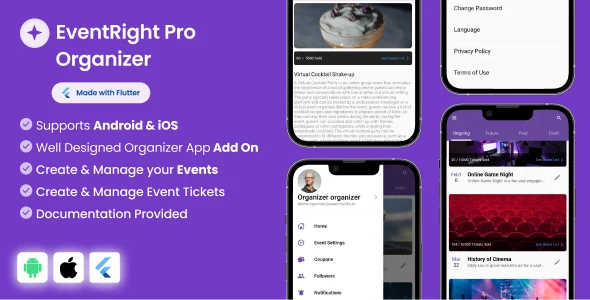
EventRight Pro Organizer App Overview & Mobile Client Architecture
EventRight Pro Organizer App is a Flutter 3.x mobile source code package built for agencies and product teams that need to extend event organizer workflows beyond a desktop administration panel. The codebase removes the constraint of desk-bound management by allowing organizers to create and edit events, configure ticket types, and coordinate on-site scanning staff directly from a handheld device. Within a production delivery pipeline, it operates as a companion client that authenticates against the same organizer accounts registered in the EventRight Pro web backend.
Technical Specifications & Deployment Matrix
| Engineering Metric | Deployment Specification |
|---|---|
| Base Framework | Flutter 3.x — SDK upgraded to 3.16.4 in the v2.0.0 release, written in Dart |
| Included Source Files | Dart application code, YAML dependency manifest (pubspec), Android XML resources, iOS .plist configuration |
| Platform Targets | Android and iOS build outputs via Android Studio and Xcode respectively |
| Backend Dependency | EventRight Pro backend (release 1.8.0 or later required for ticket check-in limit configuration) |
| Data Exchange | Communication with the EventRight Pro backend for authentication, events, tickets, and scanner assignments; base URL format validated by a bundled Flutter test |
The deliverable is a pure mobile client: all persistence, user records, and ticket inventory remain server-side in the EventRight Pro panel. For studios weighing a standalone product where the application and its administration layer ship together in one codebase, Single Radio Pro follows that self-contained model as a decoupled alternative running on a separate runtime.
Event & Ticket Management Execution Pipeline
Every organizer action — sign-in, event creation, ticket editing, and scanner delegation — travels from the Flutter client to the EventRight Pro backend, which returns the authoritative state rendered on the device.
Architectural & Functional Highlights
- Event and ticket CRUD from the app: Organizers add and edit events and ticket types without returning to the web panel, including the ability to define per-ticket check-in limits during creation or editing, a capability introduced in v1.1.0 with a backend 1.8.0 minimum.
- Multi-scanner delegation: The v2.1.0 release added the ability to assign or unassign multiple scanner operators to a single event, letting organizers distribute gate-checking duties across staff from the mobile interface.
- Unified credential model: The login flow accepts the same account used in the EventRight Pro web panel, eliminating duplicate organizer identities and account migration work when staff move between desktop and mobile.
- Base URL pre-flight validation: Version 2.0.0 introduced a Flutter test case that verifies the existence and format of the backend base URL, catching malformed endpoint strings before a build advances toward distribution.
- Input handling refinements: Country code selection for phone fields arrived in v1.2.0, and email regex patterns were corrected across three files in subsequent patches to prevent false validation errors during organizer registration.
Production Deployment & Implementation Considerations
Deployment begins with a functioning EventRight Pro backend, since the codebase contains no self-hosted data layer and depends entirely on the server for authentication, event records, and ticket state. The build environment must run Flutter SDK 3.16.4 or a compatible 3.x release, with Android Studio producing APK/AAB artifacts and Xcode compiling iOS binaries where the included .plist files govern bundle-level configuration. Version alignment matters: the check-in limit controls require backend release 1.8.0 or later, so environments running older server builds should be upgraded before the client is distributed. On the customization side, the documentation defines configuration-level procedures for replacing the splash screen image, adjusting application colors, swapping the logo, and changing the drawer and launcher icons, which allows a delivery team to rebrand the build without modifying Dart business logic. The package operates strictly as an add-on client tied to its parent platform — for operators needing a self-contained booking product outside the EventRight ecosystem, the Universal Hotel Booking and Reservation App represents an independent reservation-oriented codebase on a separate stack.
Frequently Asked Questions
Does the package function as a standalone event ticketing system?
No. The source code is a companion client that must connect to an existing EventRight Pro backend deployment, and the check-in limit controls introduced in v1.1.0 additionally require backend version 1.8.0 or higher to operate correctly.
Can organizers reuse their existing web panel credentials inside the app?
Yes. The authentication model accepts the same organizer account used in the EventRight Pro web panel, so staff can move between desktop administration and mobile event management without maintaining separate identities or migrating accounts.
Is branding customization possible without rewriting Dart business logic?
Yes. The bundled documentation specifies procedures for replacing the splash screen image, adjusting application colors, swapping the logo, and changing the drawer and launcher icons as configuration-level tasks rather than code-level modifications.
Does the codebase ship with automated verification tests?
Yes. Version 2.0.0 introduced a Flutter test case that validates the existence and format of the backend base URL, catching misconfigured endpoint strings before a build reaches staging or production distribution channels.