Orbit Crash – HTML5 Casino Game Script
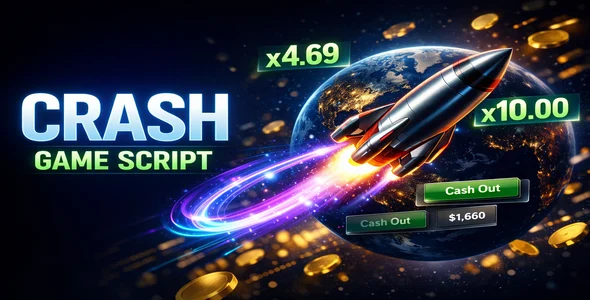
Orbit Crash Overview & Client-Side Betting Engine Architecture
Orbit Crash is an HTML5 crash-style casino game package written in pure JavaScript ES6, engineered for game portal operators and sweepstakes publishers to deploy a multiplier-based wagering experience without any backend stack. The codebase removes every server-side dependency by executing the complete game loop — cryptographic crash point generation, bet placement, multiplier progression, and payout settlement — entirely inside the browser. Within agency and staging workflows, the package behaves as a self-contained static asset: unzip it onto any HTTP host or static platform such as Netlify, Vercel, or GitHub Pages, and it reaches a playable state with no PHP runtime, MySQL database, or API keys involved.
Technical Specifications & Deployment Matrix
| Engineering Metric | Deployment Specification |
|---|---|
| Base Technology | HTML5, CSS, JavaScript (ES6 Modules) — fully static, no server runtime |
| Animation Engine | GSAP 3.12.5 driving SVG orbital rocket, Earth, parallax stars, and nebula effects |
| Randomness Source | window.crypto.getRandomValues() with a 95% RTP crash point formula (adjustable in utils.js) |
| Browser Compatibility | Chrome, Edge, Firefox, Safari, and Opera — desktop and mobile |
| Layout System | CSS Grid and Flexbox responsive layout for desktop, tablet, and mobile viewports |
| Audio Layer | MP3 background music plus click, crash, and cashout sound effects with mute toggle |
| Typography | Google Fonts (Inter) |
| Hosting Requirement | Any HTTP server or static host; JavaScript-enabled browser on the client |
Crash Round Lifecycle & Execution Pipeline
Each round resolves through a client-side pipeline: a cryptographically seeded crash point is drawn, the multiplier counter climbs alongside a GSAP-driven orbital rocket animation, and the dual betting panels settle independently at cashout or crash.
The state layer (state.js) coordinates wager records and round phases while the game loop (game.js) publishes multiplier updates to the UI layer (ui.js), which renders live betting tables, system notifications, and the color-coded crash history bar in real time. Two distinct wager positions operate per round, each holding its own stake and its own auto cashout target, so a player can hedge one panel early while letting the second ride toward a higher multiplier. The autobet module extends this by repeating wagers automatically per panel, converting a manual session into a rule-driven strategy loop.
Architectural & Functional Highlights
- Cryptographic crash point generator: The 95% RTP algorithm draws each round’s crash multiplier from window.crypto.getRandomValues() using a documented formula exposed in utils.js, allowing operators to audit and retune the payout curve directly in source.
- Dual independent betting panels: main.js wires two separate wager controllers, each with discrete auto cashout thresholds, so both positions resolve without interfering with one another during a single round.
- Bot simulation system: Synthetic players place randomized wagers and cash out at generated multipliers, populating the live betting table with activity that sustains table dynamics during low-occupancy deployments.
- SVG and GSAP visual composition: The space scene — Earth, orbital rocket, parallax starfield, and nebula layers — animates at 60 FPS through GSAP 3.12.5 timelines rather than raster video, keeping the render footprint vector-based and resolution-independent.
- Behavioral configuration surface: constants.js centralizes tunable game parameters while css/style.css carries all visual styling, giving developers two cleanly separated entry points for modifying logic and presentation respectively.
For operators weighing parallel titles within the same browser-based casino vertical, BlackJack 3D operates as an independent HTML5 table game targeting the same static-hosting deployment model, positioned as a separate catalog entry rather than a module of this codebase.
Production Deployment & Implementation Considerations
Deployment prerequisites are minimal by design. The package requires only an HTTP-capable host — shared hosting, a CDN-backed static platform, or even a local server — plus a modern browser with JavaScript enabled on the player side. Because there is no PHP interpreter, no SQL schema, and no external API dependency, configuration management reduces to two files: js/constants.js governs gameplay parameters such as round behavior and bot activity, while css/style.css controls the visual layer. Implementation boundaries are equally explicit: all wagering logic executes client-side, meaning balances, history, and RNG outcomes live in the browser session rather than a persistent server store. This architecture suits game portals, sweepstakes platforms, demonstration environments, and portfolio showcases; it does not provide server-authoritative transaction records. The shipped file manifest — index.html, the css directory, seven JavaScript modules, four MP3 audio assets, and the doc.html reference — maps one-to-one onto the runtime, so nothing requires compilation, bundling, or a Node.js build step before going live.
Frequently Asked Questions
Does the package need a Node.js build process, package manager, or bundler before deployment?
No. The source ships as ready-to-run HTML, CSS, and ES6 JavaScript files. Unzipping the archive onto any web server and opening index.html in a supported browser is the entire setup procedure, with no compilation, transpilation, or dependency installation required.
Are the sound effects and background music included as separate editable files?
Yes. The assets folder contains four standalone MP3 files — bgm.mp3, click.mp3, crash.mp3, and cashout.mp3 — plus a mute and unmute toggle, so audio can be swapped or replaced file-by-file without touching the JavaScript audio module.
Can the 95% RTP payout percentage be adjusted after the game is deployed?
Yes. The crash point formula is exposed inside utils.js as a documented, modifiable function. A developer can edit the constant that shapes the distribution, re-upload the single file, and the change takes effect on the next round without altering any other module.