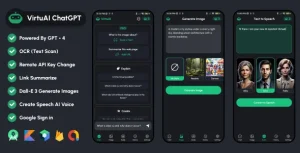
OpenAI’s Dall-E and Chat-GPT App
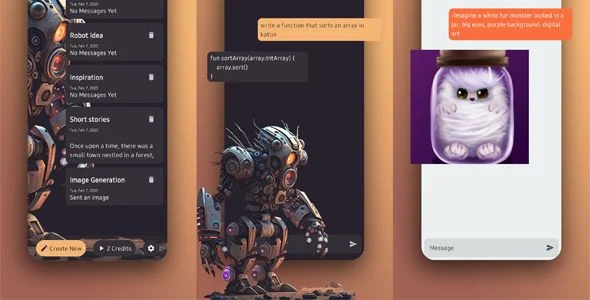
OpenAI DALL-E and ChatGPT App Overview & Dual-Engine AI Runtime
OpenAI DALL-E and ChatGPT App is a native Kotlin Android source code package, engineered for mobile developers and app entrepreneurs to deploy a combined conversational AI and text-to-art generation product. The codebase addresses the dual integration bottleneck of wiring a natural-language chat interface and a DALL-E image-generation endpoint into a single, stable Android runtime without building two separate applications. Within an agency release workflow, the package functions as a production starting point: it ships as an Android Studio project with a defined three-screen structure (home, settings, chat), a credit-metering system, and rewarded-ad monetization already wired into the user flow.
Technical Specifications & Deployment Matrix
| Engineering Metric | Deployment Specification |
|---|---|
| Base Technology / Framework | Native Android application built in Kotlin 1.8 on Android Studio Electric Eel |
| Runtime / OS Compatibility | Android 9.0 through Android 12.0 (plus additional target ranges) |
| Data Exchange / Communication Protocols | OpenAI REST APIs: ChatGPT conversational endpoints and DALL-E image-generation endpoints |
| Front-End / Engine Dependencies | Three-screen native UI: home, settings, and chat; rewarded video ad SDK integration |
| Deliverables / Persistence Footprint | Distributable .apk build plus documented Kotlin source; server-side state held by OpenAI account credits |
Dual-Engine AI Execution & Credit Metering Pipeline
The runtime routes every user action through a single credit-gated request pipeline. When a prompt is submitted on the chat screen, the application dispatches a JSON payload to the appropriate OpenAI endpoint, consumes a credit from the locally tracked balance, and renders the returned response or generated artwork inside the active screen state. Because both the conversational and art-generation features share this metering layer, monetization and API usage stay synchronized across the entire user journey.
The architecture is intentionally shallow: three screens, each with a single responsibility. The home surface exposes entry points to both AI features, the settings screen handles configuration input, and the chat screen manages the conversational thread plus the DALL-E prompt flow. Kotlin 1.8 coroutines and lifecycle-aware components keep network calls off the main thread, which is the standard pattern for maintaining responsive UI during long-running API round trips.
For studios evaluating parallel, browser-based conversational deployments rather than native builds, AI Chat GPT OpenAI operates as an independent HTML5 implementation that covers the chatbot use case without an Android toolchain. Similarly, for teams that need AI-driven visual content production on the WordPress side as a separate workflow, AI Infographic Maker provides a decoupled OpenAI-powered content path outside the mobile stack.
Architectural & Functional Highlights
- Dual OpenAI Integration: One codebase drives both conversational ChatGPT responses and DALL-E text-to-art generation, eliminating the need to maintain two separate applications or API abstraction layers.
- Credit Metering with Rewarded Ads: New installs receive 10 free credits, a value configurable in code; users extend their balance by completing rewarded video ad views, creating a self-sustaining monetization loop tied directly to API consumption.
- Configurable Free-Tier Threshold: The initial 10-credit grant is a source-level constant that can be raised or lowered to match unit economics before a Play Store submission.
- Native Kotlin Construction: Built on Kotlin 1.8 in Android Studio Electric Eel, the project opens directly in the current toolchain without legacy Gradle migrations or Java interop overhead.
- Documented Source Delivery: The package includes commented Kotlin source and an installable .apk, allowing teams to audit the request logic before shipping a signed production build.
Production Implementation & Operational Resilience
Deployment follows the standard Android release sequence: clone the project into Android Studio Electric Eel, resolve Gradle dependencies, insert OpenAI API credentials and the rewarded-ad unit identifiers, adjust the free-credit constant, then generate a signed app bundle for store distribution. Because the app depends on external OpenAI endpoints, production resilience is bounded by two external factors teams must plan around: API rate limits attached to the configured OpenAI account, and ad-network fill rates on the rewarded inventory that replenishes user credits.
Error behavior is straightforward to extend, since every generation and chat action passes through the shared request pipeline described above. Teams hardening the build for production traffic should validate JSON payloads before rendering, confirm credential handling sits outside version control, and test credit deduction logic against interrupted network sessions to guarantee the balance never desynchronizes from actual API consumption. The three-screen structure keeps the state surface small, which reduces the number of lifecycle transitions that require defensive handling during configuration changes such as rotation or backgrounding.
Android 9.0 through 12.0 coverage means the codebase must be exercised on both older runtime targets and scoped-storage-era Android versions before release. Since the deliverable includes the full Kotlin source, secondary development is unobstructed: teams can add screens, replace the ad provider, rework the credit rules, or attach additional OpenAI models without reverse engineering compiled artifacts.
Frequently Asked Questions
Is the initial free credit allocation fixed at 10 credits for every new user?
No, the default grant is 10 free credits per new user, but the value is explicitly configurable at the source level, so teams can raise or lower the threshold before compiling a release build.
Does the package generate AI artwork, or is it limited to conversational chat?
It supports both. The codebase integrates the DALL-E API for text-to-art generation alongside ChatGPT conversational responses, delivered through one shared three-screen native interface.
Can users regain credits without paying, and how is that handled technically?
Yes. Rewarded video ads are built into the flow, letting users watch an ad to receive additional credits and continue generating content, which ties monetization directly to ongoing API usage.
Is an installable binary included alongside the source files?
Yes. The deliverable contains a distributable .apk plus the documented Kotlin project source, so the runtime can be evaluated on a physical device before any recompilation or store signing is performed.
SnapDown – Snapchat Stories & Spotlights Downloader | ADMOB, FAN, APPLOVIN, FIREBASE, ONESIGNAL
BrainAI – AI Chat Powered by OpenAI (ChatGPT), GPT4o & Google AI | IOS Native SwiftUI Source Code
GemiBot v1.0 – Chat with Gemini AI from Google