OneSignal Notifier – Rest Api integration
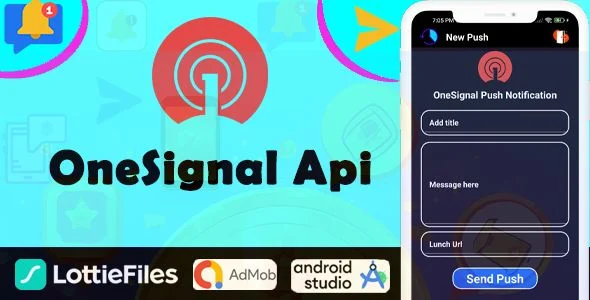
OneSignal Notifier Overview & Native Notification Administration Architecture
OneSignal Notifier is a native Android Studio application source package, engineered for mobile developers and release agencies to administer OneSignal push notification campaigns from a standalone device client. The package removes the dependency on browser-based dashboards by binding a developer-supplied App ID and REST API Key directly into the application, letting operators dispatch and manage notifications through OneSignal’s HTTP service layer. Within agency delivery workflows it functions as a production base that couples notification administration with AdMob monetization across banner, interstitial, and appOpen ad formats.
Technical Specifications & Deployment Matrix
The package ships as a configurable Android Studio project, and every build parameter below is pinned by the vendor documentation for reproducible compilation.
| Engineering Metric | Deployment Specification |
|---|---|
| Base Technology / Framework | Native Android application, Android Studio project (.java and .xml sources) |
| Runtime / Language Requirements | JDK 20, Android Studio Iguana | 2023.2.1 |
| Build Toolchain | Gradle 8.4 with Android Gradle Plugin 8.3.0-alpha13 |
| Data Exchange / Communication Protocols | OneSignal REST API (HTTPS/JSON) using App ID and REST API Key credentials |
| Front-End / Engine Dependencies | OneSignal SDK, Google AdMob (banner, interstitial, appOpen), Lottie animation runtime |
| Database / Persistence Footprint | No local database engine; notification state is managed through the OneSignal cloud service |
REST Credential Binding & Notification Execution Pipeline
The engine authenticates against OneSignal REST endpoints using developer-supplied credentials, then serializes campaign payloads as JSON for dispatch.
During initial setup, the operator enters the OneSignal App ID and REST API Key into the client. The Java layer attaches these credentials to outbound HTTPS requests directed at OneSignal’s notification service, which validates the key pair, accepts the message payload, and fans out delivery to subscribed devices in real time. Because administration runs through the REST surface rather than a web console, the same targeting inputs available on the dashboard — audience segmentation and personalized message content — can be exercised directly from the handset. The XML layout tree renders campaign states and dispatch feedback, with Lottie animation assets supplying motion transitions between operations.
Monetization runs on a parallel track. AdMob banner units mount inside the layout hierarchy, interstitial units present at defined interaction boundaries, and appOpen units fire during application lifecycle entry points, giving three revenue surfaces inside a single codebase.
Core Technical Capabilities of OneSignal Notifier
- Credential-based REST dispatch: The client binds an App ID and REST API Key at setup, forwarding authenticated JSON payloads to OneSignal endpoints so notification management happens entirely on-device without dashboard access.
- Targeted audience engagement: Dispatch logic supports targeted notification delivery and personalized message composition, aligning device-side campaign control with OneSignal’s segmentation model.
- Three-format AdMob monetization: Banner, interstitial, and appOpen ad units are wired into the project, letting operators generate ad revenue from the same build that handles campaign administration.
- Lottie-driven motion layer: Animation is delegated to the Lottie runtime, so visual transitions are defined as portable JSON animation assets rather than hand-coded view animations in the Java layer.
- Pure Java and XML codebase: With sources delivered as .java and .xml files, teams can audit, refactor, and reskin the project using standard Android Studio tooling and no cross-platform abstraction layer.
For teams surveying parallel Android codebases that already wire OneSignal dispatch next to AdMob monetization, the Halloween Block Android Studio project demonstrates the same dual-service pattern applied inside a puzzle game runtime.
Production Implementation & Operational Resilience
Successful compilation depends on exact toolchain alignment: Android Studio Iguana 2023.2.1, JDK 20, Gradle 8.4, and Android Gradle Plugin 8.3.0-alpha13. The alpha-channel AGP version deserves attention during CI setup — build agents must replicate this pinned plugin line, since mismatched Gradle or JDK versions are the most common cause of failed syncs in native projects of this configuration. The vendor documentation explicitly states these thresholds as prerequisites for compatibility with the OneSignal integration.
From a security standpoint, the REST API Key functions as a server-issued secret with full notification authority over the OneSignal project. Engineering teams should treat it accordingly during pre-deployment review: restrict its exposure in version control, and confirm it is provisioned per application rather than shared across unrelated client projects. AdMob unit identifiers must likewise be swapped from test placements to production IDs before a Play Store submission, and the .java/.xml structure makes this swap a straightforward resource and constants edit. Reskin work stays within documented boundaries — Lottie JSON assets can be replaced and XML layouts restyled without touching the REST dispatch logic, which keeps visual iteration decoupled from communication code. Broadcast-oriented builds such as Evera show a comparable single-app approach for streaming clients that also depend on OneSignal for listener messaging.
Frequently Asked Questions
Does the package deliver raw Java source files or only a compiled binary?
Yes, the deliverable includes the full Android Studio project with .java and .xml source files, allowing direct code inspection, refactoring, and reskinning inside the supported IDE environment.
Is a compiled demo APK available to test behavior before building the project?
Yes, the author distributes a demo APK that demonstrates the application’s notification management flow and interface, so operators can evaluate runtime behavior prior to setting up their own build environment.
Does the application support the AdMob appOpen ad format in addition to standard banners?
Yes, three AdMob formats are wired into the project: banner placements, interstitial units, and appOpen ads triggered at application entry, providing multiple monetization surfaces within one codebase.
Can the app send personalized messages instead of only generic broadcast notifications?
Yes, the feature set explicitly includes targeted notifications and personalized message composition, so campaigns can address specific audience segments rather than forcing a single generic broadcast to every subscriber.
MusiMax – Music Streaming & Downloading App | ADMOB, FAN, APPLOVIN, FIREBASE, ONESIGNAL
Multi Restaurants Food Delivery App + Admin Panel
TikTok Downloader – TikTok Videos Without Watermark & Mp3 | ADMOB, FIREBASE, ONESIGNAL