OM – A stylish blogging theme for WordPress
Om Overview & Visual Storytelling Architecture
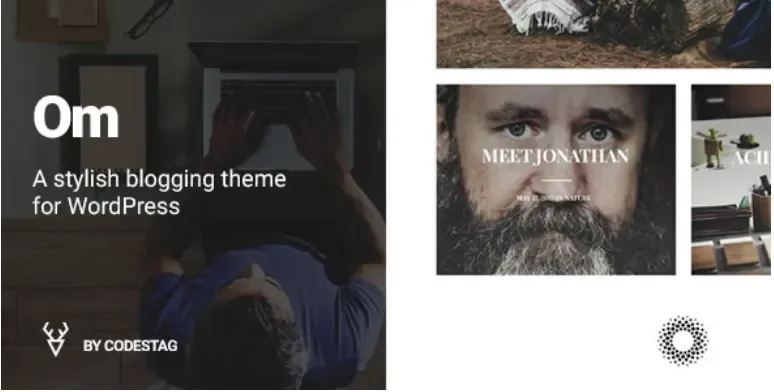
Om is a WordPress photoblogging and visual storytelling theme engineered for writers, photographers, and agencies that publish narrative-driven content requiring balanced typography and precise palette control. The package targets the recurring bottlenecks of visual blogs — uncontrolled image rendering, inconsistent type scales, and rigid homepage structures — through a widgetized homepage composer and granular Customizer options covering accent color, text color, font family, and font sizes. Within production workflows, it operates as the presentation layer for editorial sites, rendering blog feeds, archives, search results, single posts, pages, author views, and contact pages inside one coherent template hierarchy.
Technical Specifications & Deployment Matrix
| Engineering Metric | Deployment Specification |
|---|---|
| Base Technology / Framework | Underscores starter framework, version 1.4.1 |
| Runtime / Language Requirements | WordPress 5.0.x through 5.8.x; PHP, CSS, and JS files |
| Browser Compatibility | IE9, IE10, IE11, Firefox, Safari, Opera, Chrome |
| Plugin Interoperability | Gravity Forms, Contact Form 7, Jetpack, WPML, StagTools, Stag Custom Sidebars |
| Editor & Display Support | Gutenberg optimized, Retina / HiDPI ready, responsive two-column layout |
| Localisation & Design Deliverables | .po/.mo translation files, layered PSD sources |
Template Hierarchy & Rendering Pipeline
Om executes its rendering pipeline through the native WordPress template hierarchy, extended by the Underscores starter framework. Inbound requests resolve to template files — blog index, archive, search, single post, page, and author views — each overridden with a two-column layout in which the primary column carries narrative flow. Typography settings are persisted as theme modifications via the WordPress Customizer API, so font family, size, and color decisions are injected at render time rather than hard-coded into stylesheets. The homepage departs from the standard loop-first pattern: it is assembled entirely from widget areas, with each registered sidebar mapping to a homepage section, letting administrators reorder the page from the Widgets administration screen instead of editing PHP templates.
Font assets load through the standard enqueue mechanism — Google Web Fonts by default, with Typekit integration available as an alternate type stack configured from the Customizer. Accent and text colors are exposed as color picker controls whose saved values print directly into the generated CSS output. Retina and HiDPI displays receive double-density assets, and the layout scales responsively from header to footer. Gutenberg blocks render with dedicated styling, since the codebase is optimized for the block editor introduced in WordPress 5.0.
Core Technical Capabilities of Om
- Widgetized Homepage Composer: Every homepage section is a widget area supporting drag-and-drop reordering without template edits; header and footer widget regions follow the same mechanism.
- Customizer-Driven Typography: Font family, sizes, and colors are stored as theme mods and applied at render time, removing stylesheet dependencies from routine content changes.
- Plugin Interoperability Layer: Verified compatibility with Gravity Forms, Contact Form 7, Jetpack, WPML, StagTools shortcodes and widgets, and Stag Custom Sidebars allows forms, contact pages, and translated content streams to run without adapter code.
- Retina / HiDPI Pipeline: High-resolution assets and density-aware CSS rules serve double-resolution imagery on supported displays.
- Child Theme Extension Path: The codebase supports child theme overrides so template and stylesheet modifications survive parent theme updates.
For editorial teams that need structured content models — photographer credits, story metadata, extended image captions — beyond what the Customizer exposes, Advanced Custom Fields provides a field-group layer whose values can be rendered through template overrides within the same hierarchy.
Production Implementation & Operational Resilience
Deployment targets WordPress 5.0.x through 5.8.x, with browser coverage reaching back to IE9 and graceful handling of modern CSS in IE10 and IE11. The contact page template depends on the Gravity Forms plugin combined with StagTools, both retrievable from the WordPress.org repository, so a functioning staging environment requires those plugins active before form markup renders. Widget-heavy page builds benefit from Stag Custom Sidebars, which generates context-specific widget sets for individual posts, pages, and archives without duplicating sidebar registrations.
Localisation ships as .po/.mo files, and WPML compatibility enables multilingual deployments in which translated strings and permalinks stay synchronized across language configurations. When customization exceeds the Customizer’s scope, the sanctioned path is a child theme: overrides and stylesheet changes live in the child directory while the parent’s update channel remains intact, protecting modifications during version upgrades. For minimalists evaluating a content-first alternative on the same platform, Pick is a responsive WordPress blog theme oriented around clean, fast editorial layouts. Layered PSD files accompany the code deliverables, letting designers prototype adjustments in source documents before committing equivalent CSS changes to production.
Frequently Asked Questions
Are layered PSD source files included alongside the code deliverables?
Yes — the package contains PHP, CSS, and JS files plus layered PSD files, so design adjustments can be prototyped in source documents before corresponding changes are committed to the production stylesheets.
Can homepage sections be reordered without editing template files?
Yes — the homepage is fully widgetized, and each section corresponds to a widget area that can be rearranged from the WordPress Widgets screen, eliminating PHP modifications for layout sequencing changes.
Does the package include translation files for multilingual deployments?
Yes — full localisation support ships with .po/.mo files, and WPML compatibility allows translated content to run alongside the base language install without modifying the theme’s template files.