Northwood – Eco-Friendly Cabin Rental Adventure Elementor Template Kit
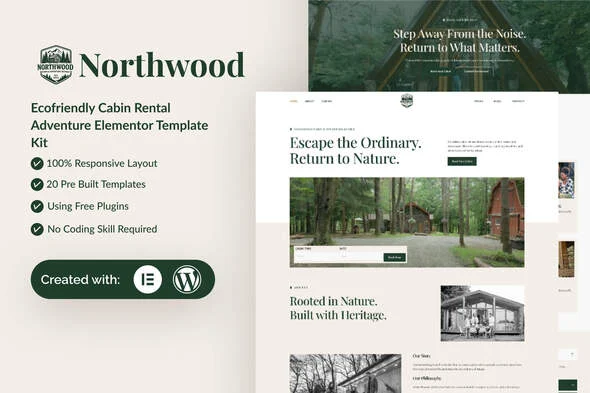
Northwood Overview & Layout Architecture for Eco-Tourism Rentals
Northwood is an Elementor Template Kit engineered for hospitality operators and web agencies building marketing sites for cabin rentals, glamping resorts, forest lodges, and off-grid retreats. The package resolves a recurring delivery bottleneck: assembling a multi-page, inquiry-driven accommodation website without authoring theme files or hand-writing CSS. In production workflows, it operates as an importable design layer for an existing WordPress installation, supplying twenty page blueprints that render entirely through Elementor’s container engine.
Technical Specifications & Deployment Matrix
| Engineering Metric | Deployment Specification |
|---|---|
| Base Technology / Framework | Elementor 3.10.x page builder, distributed in Envato Template Kit format |
| Import Runtime | Envato Template Kit Import plugin for WordPress, or direct import through the Elementor editor |
| Layout Engine | Flexbox Container architecture with Global Theme Style definitions |
| Required Dependencies | Elementor, ElementsKit Lite, MetForm, Gum Elementor Addon, Ultimate Addons for Elementor Lite |
| Data Exchange / Structure | JSON layout records; form logic managed through the MetForm builder |
| Styling Layer | Unlimited color tokens, 900+ ready fonts, responsive breakpoint rules |
Container-Based Layout Engine & Design Token Pipeline
Northwood delivers its layouts as structured JSON data that the import plugin parses into editable Elementor documents. Every blueprint is built on Elementor’s Flexbox Container system rather than legacy section-column widgets, so nesting depth, spacing, and stacking direction are governed at the container level across each responsive breakpoint. A Global Theme Style definition centralizes typography and color decisions, allowing a single token edit to propagate across all twenty pages instead of requiring per-widget overrides. The rendering path remains front-end only: WordPress publishes the page, Elementor interprets the stored layout data, and the browser executes the resulting markup with flex rules — no theme-level file editing enters the workflow at any stage.
Architectural & Functional Highlights
- Container-first page construction: Flexbox containers reduce nested wrapper depth and give each breakpoint explicit direction, alignment, and gap control, producing predictable responsive behavior with fewer structural overrides.
- Global design token system: Unlimited color values and access to 900+ ready fonts are bound to the Global Theme Style, so brand adjustments cascade sitewide through one configuration surface.
- Twenty-page deliverable set: Home, About, Services, Service Details, Adventure, Pricing, Team, Review, Gallery, FAQs, Error 404, Blog, Single Post, and Contact pages ship alongside header, footer, contact form, cabin form, appointment form, and newsletter form templates.
- MetForm interaction layer: Inquiry, appointment, and newsletter capture are implemented as importable MetForm blocks, each editable through the form builder after attachment to its host page.
- Cross-browser validated output: Rendered layouts are verified across Chrome, Firefox, Safari, and Opera, constraining vendor-specific layout drift.
For agencies scouting standalone alternatives in adjacent outdoor-service niches, Niwa targets garden and landscaping businesses on the same builder platform as a separate, independently deployed kit.
Production Implementation & Operational Resilience
Before import, confirm that the host’s wp_memory_limit accommodates the Elementor editor workload; container-heavy pages on constrained shared hosting benefit from a raised allocation to prevent the editor from failing mid-load. The dependency stack — ElementsKit Lite, Gum Elementor Addon, and Ultimate Addons for Elementor Lite — must be activated prior to import so widget references resolve cleanly; missing modules cause imported pages to render with unresolved placeholders instead of their intended components.
Header and footer regions follow two supported paths. Licenses with Elementor Pro maintain these areas under Theme Builder. Without it, the Ultimate Addons Header Footer module takes over: a new header record is created, assigned display across the entire site, published, then populated by inserting the imported header template from the My Templates library; the footer repeats the identical cycle. When a client brief demands mobile navigation behavior beyond the imported header — multi-level drawer menus or off-canvas triggers — deploying Responsive Menu Pro supplies those interaction patterns without altering the kit’s source layouts.
Form templates require a defined import sequence: the MetForm block template is imported first, the host page is opened, the Navigator locates the MetForm widget, and the saved form is attached from the My Templates tab before the page is updated. Skipping this order leaves form areas empty until the attachment step is completed.
Frequently Asked Questions
Does Northwood function as a standalone WordPress theme?
No. The package contains Elementor design data only and is installed through the Envato Template Kit Import plugin or directly inside Elementor, never activated as a theme.
Is Elementor Pro required to publish the kit’s forms?
No. MetForm supplies the contact, cabin, appointment, and newsletter form blocks; Elementor Pro users may skip MetForm entirely and manage headers and footers through Theme Builder instead.
Are the demo photographs and blog articles bundled with the download?
No. Demo images originate from Envato Elements and require separate licensing or substitution, and blog content will not display in templates until posts are added within WordPress.