Niobe – Spa & Salon WordPress Theme
Niobe Spa Salon WordPress Theme Overview & Front-End Presentation Architecture
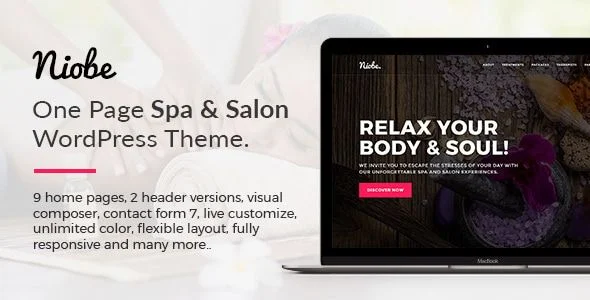
Niobe Spa Salon WordPress Theme is a Bootstrap 3-based WordPress theme engineered for spa, salon, wellness, and massage service providers that need an industry-specific web presence without commissioning custom front-end development. The package removes the bottleneck of hand-building a beauty-sector site from scratch by bundling nine prebuilt home variants, the WPBakery Page Builder plugin, and a one-click demo import pipeline that replicates the reference site structure. Within an agency delivery workflow, it operates as a self-contained presentation layer: PHP template files, compiled CSS, and JS assets drop into a standard WordPress installation and immediately expose layout controls through the native Customizer.
Technical Specifications & Deployment Matrix
| Engineering Metric | Deployment Specification |
|---|---|
| Base Technology / Framework | Bootstrap 3, Font Awesome (630+ icons), Google Fonts integration |
| Runtime / Language Requirements | WordPress 4.9.x through 7.0.x; PHP-driven template stack |
| Data Exchange / Communication Protocols | Contact Form 7 form handling; WPML multilingual compatibility |
| Front-End / Engine Dependencies | Bundled WPBakery Page Builder (v8.7.2 as of theme v1.3.2) |
| Browser / Rendering Footprint | IE11, Chrome, Firefox, Safari, Opera, Edge; W3C-valid markup |
WPBakery-Driven Layout Engine & Rendering Pipeline
The core layout mechanism routes every page composition through WPBakery shortcode parsing layered on top of the standard WordPress template hierarchy. When a visitor requests a URL, WordPress resolves the appropriate theme template file, and the builder engine interprets the element metadata stored in post content, converting each row, column, and module definition into structured DOM output. Because layout state lives in the database as post content rather than hardcoded templates, editors restructure pages visually while the underlying PHP layer remains untouched. The theme also registers per-post layout metadata, allowing left sidebar, right sidebar, no sidebar, and full-width configurations to be assigned at the individual page level rather than enforced globally.
Styling state is managed through the WordPress Live Customizer, where unlimited color values are written as theme modifications and previewed in real time before publication. The one-click demo importer populates posts, pages, media references, and builder element structures so a staging site mirrors the reference demo within a single deployment step. Wide and boxed layout modes toggle the global container behavior, while widget-ready regions accept any standard WordPress widget. For teams comparing sibling offerings that run on the same WordPress runtime, Wellness Bliss represents a parallel spa-and-salon theme path worth evaluating during platform selection.
Architectural & Functional Highlights
- Nine prebuilt home variants: Each variant ships as a distinct composition of builder elements and template configurations, letting an agency spin up differentiated salon, spa, wellness, massage, or one-page concepts from a single codebase without re-architecting templates.
- Per-page layout metadata: Sidebar placement and full-width rendering are resolved per post or page through stored layout settings, so mixed sidebar strategies coexist across the same navigation tree.
- Translation-ready string layer: Included .pot files expose every translatable string, and confirmed WPML compatibility allows parallel-language content trees to share the same template layer.
- W3C-valid markup with cross-browser fallbacks: The validated markup and IE11 support establish a conservative CSS baseline, which constrains modern layout techniques but guarantees consistent rendering across legacy and current engines.
- Widget-registered regions: Standard WordPress widget slots accept arbitrary sidebar content blocks, decoupling auxiliary content from the builder pipeline entirely.
Production Implementation & Operational Resilience
Deploying the package in a client staging environment follows the standard WordPress theme activation sequence: upload, activate, then run the bundled plugin installer to register WPBakery before executing the demo import. Form handling is delegated to Contact Form 7, which manages field validation, spam mitigation, and mail dispatch independently of the theme layer, keeping presentation and submission logic decoupled. Multilingual production deployments rely on WPML for content duplication and term synchronization, with the .pot catalog serving as the translation substrate for theme-side strings.
Several operational boundaries deserve attention before go-live. The theme is not optimized for the Gutenberg block editor, so editorial workflows should remain on the WPBakery pipeline to avoid layout conflicts. Bootstrap 3 defines the CSS baseline, meaning component styling inherits that framework’s grid semantics rather than modern utility-first conventions. Update history shows maintenance releases tracking WPBakery plugin versions, indicating that builder compatibility is the primary upgrade vector. For studios exploring separate standalone alternatives outside the WPBakery runtime altogether, Cantiq offers an Elementor-based template kit as an independent design path for comparable beauty and therapy verticals.
Frequently Asked Questions
Does the package include the WPBakery Page Builder plugin without a separate plugin purchase?
Yes, the theme ships with WPBakery Page Builder bundled at no additional plugin cost, and the bundled version is updated alongside theme releases, reaching v8.7.2 in the current 1.3.2 build.
Can the theme be edited natively in the Gutenberg block editor?
No, the package is explicitly documented as not Gutenberg-optimized. Page composition is designed around the WPBakery shortcode pipeline, so agencies should standardize client editorial training on the builder interface rather than the block editor.
Does a single installation support multiple language versions of the same salon site?
Yes, confirmed WPML compatibility combined with the included .pot translation files allows parallel language content trees to run on one template layer, with theme strings translatable through the standard catalog.
-
1.3.2 LatestOct 29, 2026