Ninja Fruit Slice [ Construct 3 , HTML5 ]
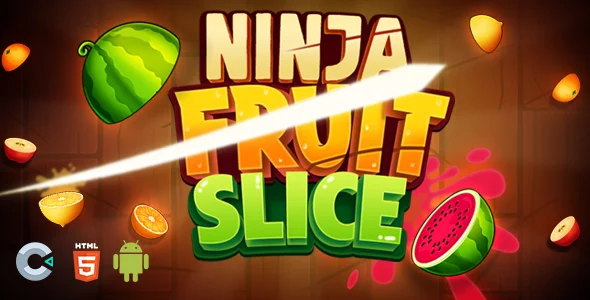
Ninja Fruit Slice Overview & Endless Arcade Slicing Engine
Ninja Fruit Slice is a Construct 3 HTML5 arcade game source package, engineered for casual game developers and web studios to deploy an endless fruit-cutting experience across desktop and mobile browsers. The core engineering challenge it resolves is input-driven arcade responsiveness: the gameplay loop demands low-latency swipe recognition, projectile object spawning, and hazard discrimination between sliceable fruits and bombs that terminate the run. Within an agency delivery pipeline, the package functions as a self-contained build target — an editable .c3p project plus an export-ready HTML5 bundle that can be dropped onto any static host or embedded into an existing content site.
Technical Specifications & Deployment Matrix
| Engineering Metric | Deployment Specification |
|---|---|
| Base Technology / Framework | Construct 3 (visual event-sheet engine, .c3p project files included) |
| Runtime / Language Requirements | JavaScript, HTML, CSS — standard browser runtime, no server-side language |
| Compatible Browsers | Chrome, Edge, Firefox, Safari, Opera, and legacy Internet Explorer 6 through 11 |
| Front-End / Engine Dependencies | None beyond the exported Construct 3 runtime; no external libraries or plugins required |
| Persistence Footprint | Stateless session scoring; no database layer or backend service dependency |
| Deliverable Assets | .c3p source files, HTML5 export build, 512×512 game icon |
Swipe-Driven Slicing Mechanics & Execution Pipeline
The core mechanism is a pointer-gesture slicing loop: every swipe dispatches input events that the Construct runtime translates into blade trails intersecting airborne fruit sprites. Execution begins at the input layer, where mouse movement on desktop and touch gestures on mobile devices feed identical pointer coordinates into the engine’s event sheet. The event system evaluates each frame: spawned fruits follow ballistic trajectories while a parallel spawner injects bombs into the same object stream. When a swipe path intersects a fruit sprite, the collision logic splits the object into sliced fragments and increments the score counter; when the same path intersects a bomb, the run terminates and the game-over state is rendered. Difficulty compounds over time — as the session extends, spawn density and velocity increase, pushing reaction timing and gesture precision toward their ceiling. This escalation curve is what gives the endless mode its retention profile for casual and family audiences, since every run is a fresh attempt at a higher personal score. For developers assembling a Construct-based web arcade lineup, this runtime pattern shares its deployment model with Ninja Boy Adventure 2, which ships on the same engine stack with a platformer genre instead of a reflex-arcade loop.
Core Technical Capabilities of Ninja Fruit Slice
- Gesture-Based Slicing Engine: Swipe input is captured as a continuous pointer trail, and each segment is tested against fruit hitboxes, so scoring reflects the player’s actual blade geometry rather than a simple tap registration.
- Hazard Discrimination Logic: Bombs occupy the same spawn pipeline as fruits, forcing the input-validation layer to distinguish valid slice targets from run-ending hazards on every gesture — the central risk/reward mechanic of the endless mode.
- Cross-Device Input Abstraction: A single event-driven input model maps both mouse movement and touch swipes to identical slicing behavior, allowing the same build to run on desktop workstations and mobile handsets without a separate code path.
- Escalating Difficulty Curve: The spawner increases intensity as the session progresses, converting runtime duration directly into a measurable difficulty parameter that governs the challenge ceiling.
- Complete Source Deliverables: The .c3p project files expose every event sheet, layout, and asset for editing inside the Construct 3 editor, while the pre-exported HTML5 build permits immediate deployment with zero compilation steps.
Production Implementation & Operational Resilience
Deployment follows a static-host model: the exported HTML, CSS, and JavaScript files upload directly to any web server, CDN, or subdirectory without a build pipeline, database provisioning, or runtime configuration. Because the entire game executes client-side, server load scales linearly with file delivery rather than session state — each visitor runs an isolated game instance inside their own browser tab. The broad browser matrix, extending back to legacy Internet Explorer releases, indicates the runtime avoids modern-only JavaScript features, which matters for deployments targeting institutional or older-device audiences such as school and family portals. When serving the build from a domain different from the embedding page, correct CORS headers on the static host ensure the engine assets load cleanly inside an iframe wrapper. For studios weighing alternate slicing-genre implementations outside this browser runtime, Slice It Up exists as a standalone Unity package with AdMob monetization wired for native mobile distribution — a separate codebase on a different engine, not an extension of this one.
Secondary development centers on the .c3p project: every spawn rate, trajectory parameter, sprite, and event condition is editable inside the Construct 3 editor, so tuning difficulty, reskinning fruits, or adjusting the bomb ratio requires no external IDE or handwritten JavaScript. The 512×512 icon asset covers standard listing and homescreen presentation for distribution portals. One operational boundary deserves emphasis: the package ships as a game build and source, not as a monetization framework — ad-network wiring or analytics instrumentation must be added within Construct 3 or at the host-wrapper level. For teams planning a broader HTML5 catalog beyond reflex arcade titles, puzzle-oriented entries such as Tim The Traveler demonstrate the same Construct 3 delivery format applied to a level-based progression structure.
Frequently Asked Questions
Does the package include editable Construct 3 source files?
Yes, the deliverables contain the full .c3p project files, so every event sheet, layout, and asset can be opened and modified directly inside the Construct 3 editor without reverse-engineering the exported build.
Can the exported HTML5 build be uploaded to a web server without additional compilation?
Yes, the HTML5 export is ready to upload as-is, consisting of JavaScript, HTML, and CSS files that run client-side on any standard web host with no server-side processing required.
Does the game support touch input on mobile devices?
Yes, the slicing mechanic accepts finger swipes on mobile touchscreens and mouse movement on desktop computers, with both input methods driving the same gesture-based gameplay through the engine’s pointer handling.
Is the game classified as high-resolution artwork?
No, the listing explicitly marks the asset as not high resolution; the visuals are designed for fast-loading casual play rather than HD asset pipelines, and a 512×512 icon is included for store presentation.