Nimis – eCommerce Shop HTML Template
Nimis eCommerce Shop HTML Template Overview & Static Storefront Architecture
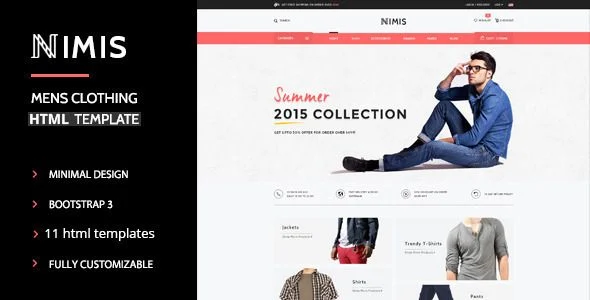
Nimis eCommerce Shop HTML Template is a static HTML5/CSS3 storefront package built on the Bootstrap framework, engineered for front-end developers and agencies to prototype and deploy online store layouts for retail verticals such as clothing, furniture, and technology. It removes the bottleneck of hand-coding multi-page shop interfaces—catalog grids, product detail views, and cart screens—by supplying twelve prebuilt HTML pages with consolidated CSS, JavaScript, and layered PSD design sources. Within an agency delivery pipeline, the package operates as a design-to-code deliverable: pages can be published to any web server unchanged, restyled for a client brand, or ported as a front-end reference for commerce engines such as WooCommerce, Magento, OpenCart, or PrestaShop.
Technical Specifications & Deployment Matrix
| Engineering Metric | Deployment Specification |
|---|---|
| Base Technology / Framework | HTML5, CSS3, and jQuery-based JavaScript composed on a responsive Bootstrap grid system |
| Runtime / Language Requirements | Fully static delivery; a PHP-enabled host is required only for the bundled contact form handler |
| Data Exchange / Communication Protocols | HTTP form POST to the internal PHP mail script; Google Maps embed; Google Web Fonts requests |
| Front-End / Engine Dependencies | Font Awesome icon set, Google Web Fonts, Bootstrap layout framework |
| Database / Persistence Footprint | None; the package ships no database layer and persists no session or cart state |
| Browser Compatibility Matrix | IE9, IE10, IE11, Firefox, Safari, Opera, Chrome |
| Included File Formats | Layered PSD, HTML files, CSS files, JS files, PHP files |
Bootstrap Page Composition & Front-End Execution Pipeline
The engine renders twelve prebuilt HTML pages through a Bootstrap grid, layered with CSS3 transitions and a compact set of jQuery-driven interactions. Because every page is a static document, the browser executes a direct parse-and-paint cycle: markup loads, the linked stylesheets apply grid and typography rules, and the JavaScript bundle binds UI behaviors after DOM readiness. There is no server-side templating, routing layer, or build step between the source files and the rendered storefront.
Structurally, the codebase targets a 4-plus column layout architecture, letting product grids collapse across viewport breakpoints without layout rewrites. The included 404 page extends the same header and footer partials, keeping navigation consistent when visitors land on a missing route. Retina output is handled through Font Awesome vector glyphs rather than raster sprites, so icons stay resolution-independent across high-density displays while eliminating separate image requests for iconography.
The only component that crosses into server execution is the contact form. It posts field payloads to a bundled PHP script, which validates the submission and dispatches it through the host mail transport. For decoupled implementations outside a static HTML workflow, AndShop Ecommerce Vue JS Template exists as an independent SPA storefront alternative on a reactive JavaScript stack; the two assets target separate runtimes and neither codebase merges into the other.
Core Technical Capabilities of Nimis eCommerce Shop HTML Template
- Twelve-page static module set: Store, product, cart, contact, and 404 documents arrive pre-wired with shared stylesheets, reducing per-page markup duplication and keeping the asset footprint small enough for any shared hosting environment.
- Working PHP contact form: The bundled handler receives POST payloads, performs field validation, and forwards messages via the server mail function—the single runtime dependency in an otherwise serverless package.
- Vector iconography and web typography: Font Awesome glyphs plus Google Web Fonts deliver resolution-independent rendering, removing image-sprite icon requests and sustaining sharp output on retina-class displays.
- CSS3 animation layer: Transition and hover effects are applied through stylesheet declarations; because the structural grid relies on Bootstrap, layout integrity is preserved on legacy IE builds where certain animation properties are unsupported.
- Layered PSD design sources: Source compositions ship alongside the code, allowing designers to adjust brand elements, imagery, and layout mockups before propagating changes into the HTML and CSS files.
Production Implementation & Operational Resilience
Deployment is deliberately low-friction: the HTML, CSS, JS, and image assets can be copied to the document root of any Apache or Nginx host and served immediately. The single environmental prerequisite is PHP availability plus a configured mail transport if the contact form must operate in production; without PHP, every storefront page still renders normally and only the form submission path goes dormant.
Browser resilience spans IE9 through IE11 alongside Firefox, Safari, Opera, and Chrome. The Bootstrap grid carries the structural load across these engines, while progressive enhancement governs the animation layer—modern browsers render the full transition set and older engines fall back to static states rather than broken layouts. No CORS configuration is required, since the package issues no cross-origin API calls beyond standard font and map embeds.
Customization boundaries follow a static-asset model. Visual changes happen by overriding stylesheet rules, swapping the layered PSD compositions and re-exporting imagery, or editing markup directly per page; there are no hooks, filters, or theme-child mechanisms, because no CMS templating hierarchy exists. Teams should also understand that cart screens are presentational: the package contains no checkout engine, order persistence, or inventory logic, so transactional capability requires porting the layouts into a real commerce platform. Agencies that additionally need a back-office control surface for an operations dashboard can evaluate Axelit Bootstrap 5 Admin Dashboard Template as a separate standalone asset sharing the same CSS foundation.
Frequently Asked Questions
Does the package include editable design source files?
Yes. Layered PSD files ship alongside the HTML, CSS, JS, and PHP files, so designers can open the original compositions, adjust brand elements or layout mockups, and re-export the resulting graphics into the template assets.
Is server-side shopping cart or checkout logic included?
No. Only the contact form executes PHP. The store, product, and cart pages are static layouts intended for front-end presentation, so processing actual transactions requires rebuilding the screens inside a full commerce engine.
Does the layout remain functional in Internet Explorer 9?
Yes. Documented compatibility covers IE9, IE10, and IE11 in addition to Firefox, Safari, Opera, and Chrome. The Bootstrap grid preserves structural integrity on legacy IE builds, while some CSS3 animation effects render only on newer engines.