Newsify – Modern Magazine WordPress Theme
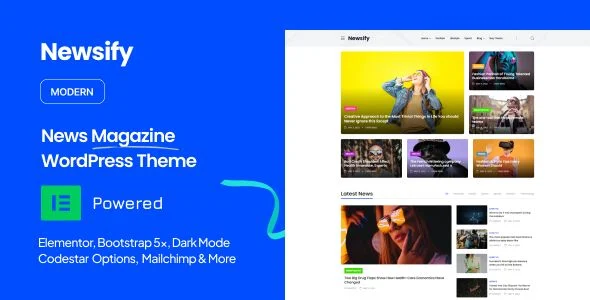
Newsify Overview & Editorial Publishing Architecture
Newsify is an Underscores-based magazine and blog WordPress theme engineered for publishers, editorial teams, and agencies to deploy high-density news and lifestyle sites without hand-coded front-end work. The package targets the recurring bottleneck of building multi-column editorial grids — home pages, category archives, and article detail templates — by shipping prebuilt layout variations that render across 4+ column structures. In an agency delivery pipeline it operates as a self-contained PHP, CSS, and JS deliverable that installs through the standard WordPress theme uploader and is configured from the admin options panel and Live Customizer.
Technical Specifications & Deployment Matrix
| Engineering Metric | Deployment Specification |
|---|---|
| Base Framework | Underscores starter theme with a Bootstrap responsive grid system |
| Runtime Requirements | WordPress 5.4.x through 6.7.x; PHP, CSS, and JS files included in the deliverable |
| Browser Compatibility | Firefox, Safari, Opera, Chrome, and Edge |
| Front-End Dependencies | Elementor page builder with 20+ custom blocks; FontAwesome and Icofont icon sets; Google Web Fonts |
| Form & Data Layer | Contact Form 7 and Mailchimp form compatibility; widget-ready sidebars; standard WordPress database footprint |
| Layout Attributes | Responsive, high-resolution rendering; HTML5 validated markup |
Template Hierarchy & Rendering Pipeline
Newsify assembles pages through the native WordPress template hierarchy layered on an Underscores foundation, with Elementor serving as the visual composition engine. When a visitor requests a category archive or a single article, WordPress resolves the matching template from the theme’s PHP file set, applies the layout variant chosen in the Lightweight Theme Options panel, and streams Bootstrap grid markup to the browser in a structure spanning 4+ columns with HTML5 validation. Because the codebase declares Elementor compatibility and bundles more than twenty custom Elementor blocks, layout construction happens inside the page builder canvas rather than inside template files, keeping PHP edits out of routine editorial workflows.
Configuration state is split between the options panel and the WordPress Customizer, where Live Preview renders pending changes before they are committed to production. One-click demo import writes the reference home variations, category layouts, and blog detail structures into the database, so a staging environment mirrors the finished site immediately after activation. Widget-ready regions accept standard WordPress widgets, and translation is handled through PO files that can be edited with Loco Translate or PO-edit software — or directly via the options panel.
Architectural & Functional Highlights
- Elementor Block Library (20+ Widgets): custom blocks map magazine-specific UI patterns — grids, category modules, and editorial carousels — onto drag-and-drop canvas elements, removing manual shortcode composition from layout assembly.
- One-Click Demo Import: a single import routine provisions demo content, home variations, and template assignments, collapsing a multi-day staging setup into one administrative action.
- Layout Variation System: distinct home, category, and blog-detail template sets allow per-section structural changes without duplicating theme files.
- Localization Pipeline: PO-file support plus options-panel translation enables non-English editorial deployments using Loco Translate or desktop PO editors.
- Editorial Metadata Layer: post read-time computation, related-posts queries, a social counter, and Mailchimp plus Contact Form 7 handlers extend each article with engagement and subscription mechanics.
Production Implementation & Operational Resilience
In client staging environments, the theme supports every WordPress release from 5.4.x to 6.7.x and renders consistently across Firefox, Safari, Opera, Chrome, and Edge, which narrows cross-browser QA to visual spot checks rather than structural debugging. The Customizer’s Live Preview allows administrators to iterate on typography, colors, and layout options against real content before publication, reducing configuration regressions on live properties. Memory headroom should be verified before the demo import routine, since bulk content provisioning is the heaviest single operation in the deployment sequence.
One documented boundary matters for editorial teams: the theme is not Gutenberg-optimized. The WordPress block editor remains available for content entry, but Elementor is the intended design layer, and teams standardizing on block-based editing should plan their workflows accordingly. For publishers comparing parallel editorial packages, Innovation: News, Magazine & Blog WordPress Theme occupies a comparable publishing niche as an independent, self-hosted codebase, and Pressroom – News Magazine Template offers another separate news-layout reference point for teams evaluating different template philosophies.
Secondary development stays inside declared extension points: the options panel governs styling and layout variables, widget regions accept custom widgets, and Elementor blocks compose new page structures. Structured data, sitemap generation, and redirect management sit outside the theme’s scope by design; installing Rank Math SEO Pro keeps that optimization at the plugin layer, so template PHP remains untouched when SEO requirements evolve across client sites.
Frequently Asked Questions
Can layouts be built with the native WordPress block editor instead of Elementor?
No, the theme is not Gutenberg-optimized. While the block editor can be used for basic content entry, the declared design layer is Elementor with its bundled 20+ custom blocks, and layout construction is intended to happen on that canvas.
Does the package include the files needed to publish in a non-English language?
Yes. The codebase ships translation-ready PO files, supports direct translation through the options panel, and works with the Loco Translate plugin or PO-edit desktop software, allowing full front-end string localization.
Are subscription and contact forms handled without writing custom form logic?
Yes. The theme declares compatibility with Contact Form 7 and Mailchimp form integrations, so newsletter capture and reader contact workflows deploy through those established plugins rather than through custom PHP form handlers.
-
1.0 LatestNov 7, 2026
-
13 November 2022September 25, 2026