NestKeeper – Hotel, Resort & Property Management System with Booking & Rental
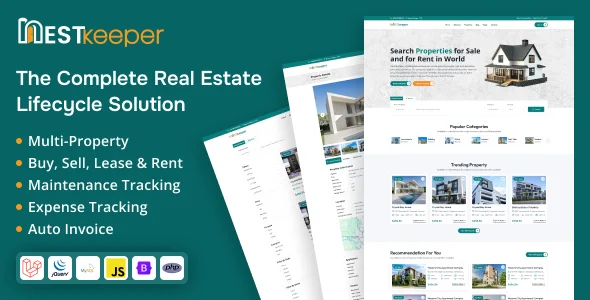
NestKeeper Overview & Self-Hosted Property Management Engine
NestKeeper is a Laravel 12 hotel, resort and property management system engineered for hospitality operators to administer buildings, tenants, bookings, agreements, invoices and maintenance from one self-hosted codebase. The platform consolidates functions normally scattered across separate tools — reservation approval, recurring rent invoicing, lease e-signature capture, work-order dispatch and tenant communication — into a single MySQL-backed application governed by role-based access control. In production it operates as an internal SaaS: administrators configure properties and payment gateways, owners supervise portfolios, maintainers handle assigned work orders, and tenants transact through a dedicated portal.
Technical Specifications & Deployment Matrix
| Engineering Metric | Deployment Specification |
|---|---|
| Base Framework | Laravel 12 (PHP MVC application framework) |
| Runtime Requirements | PHP 8.2 minimum, 8.3+ preferred |
| Database / Persistence Footprint | MySQL 8+ or MariaDB 10.10+ relational schema covering properties, units, bookings, agreements, invoices, tickets and notices |
| Delivered Source Files | JavaScript JS, JavaScript JSON, HTML, CSS, PHP, SQL |
| Access Control Model | Role-based permission system — Admin, Property Owner, Maintainer, Tenant — with creatable custom roles and per-role permission assignment |
| Browser Compatibility | IE11, Firefox, Safari, Opera, Chrome, Edge |
| Current Release | v1.3.5 — queued mail dispatch, payment gateway corrections, agreement signature fix, authentication redirection fix |
Booking-to-Lease Execution Pipeline & Functional Capabilities
The pipeline moves a listing from public discovery through booking approval, agreement signature and automated invoice generation without manual data re-entry. Prospective tenants browse public listings, filter by location, price and other criteria, and submit booking requests for rent, lease or sale. Administrators approve or reject those requests from a calendar view, after which dynamic agreement templates are populated per agreement type and signed electronically by the tenant inside the portal. The billing layer then generates recurring invoices on schedule, dispatches reminders for upcoming due dates, and records payments captured through the configured gateways.
For hospitality groups that need multivendor marketplace distribution — where multiple independent hotels list and sell inventory on a shared platform — rather than single-portfolio administration, MultiHotel stands as a separate booking-platform alternative built on a parallel architecture.
Architectural & Functional Highlights
- Property & Unit Registry: Buildings store address, category, spaces, images, documents and amenities, while individual units carry pricing, availability and a listing type (rent, lease or sale) that feeds the public search layer.
- Agreement Engine with E-Signature: Dynamic templates adapt to different agreement types and tenants sign digitally from the portal; signature handling was corrected in release v1.3.5 alongside an authentication redirection fix.
- Automated Billing & Reminder System: The engine auto-generates recurring invoices, supports manual invoice creation, tracks payments across multiple gateways, and fires reminders for upcoming invoices, payments, due dates and agreements.
- Maintenance & Support Dispatch: Work orders are assigned to maintainer roles with status tracking, while tenant support ticket conversations and admin notice broadcasts run through the same portal session.
- Reporting & Permission Matrix: Financial, occupancy and analytical reports sit beside a configurable permission system spanning Admin, Property Owner and Maintainer roles, with new custom roles creatable per permission.
Production Deployment & Implementation Considerations
Staging and production servers must run PHP 8.2 or higher (8.3+ preferred) with MySQL 8+ or MariaDB 10.10+, the standard Laravel 12 extension set, and a functioning queue worker, since release v1.3.5 moved mail dispatch onto a queued job system. The SQL schema ships with the package, and browser coverage extends to IE11, Firefox, Safari, Opera, Chrome and Edge, so legacy tenant-facing kiosks remain addressable. After installation, the default seeded users — admin, property owner, maintainer and tenant — should have their passwords rotated from the user management section before real occupancy data is loaded.
Customization scope is defined by the exposed Laravel source: agreement templates are dynamic and editable per agreement type, homepage and CMS content are configurable through the settings area, and payment gateways are wired via application configuration rather than hard-coded providers. The codebase is documented and structured for developer-level extension, which matters when adapting rent collection cycles or adding property-specific amenities to the registry.
One boundary worth planning around: this is a self-hosted backend PMS, not a WordPress plugin. Teams whose hospitality project is WordPress-native and needs a presentation layer rather than server-side property logic can evaluate Carmelina as an independent theme-layer path on a different runtime.
Frequently Asked Questions
Does the package ship with role-based demo accounts for testing?
Yes — demo credentials for admin, property owner, maintainer and tenant accounts are provided, and the documentation instructs rotating the default passwords from the user management section after first login before live use.
Is outbound mail processed asynchronously?
Yes — release v1.3.5 moved mail sending onto a queue system, so a configured queue worker should run on the host alongside the web server for reminder, notice and support notifications to dispatch correctly.
Does the application run on MariaDB?
Yes — MariaDB 10.10 or newer is supported alongside MySQL 8, provided the server also satisfies the PHP 8.2 minimum with 8.3 preferred for the Laravel 12 runtime.
Can the built-in homepage be extended into a full corporate marketing site?
No — homepage and CMS content are limited to the settings-driven content setup inside the package; agencies building a separate corporate marketing presence on the same PHP runtime can treat Quland as an independent Laravel CMS option.
-
v1.3.5 Latest