My Radio with Recording
My Radio with Recording Overview & Native Android Streaming Architecture
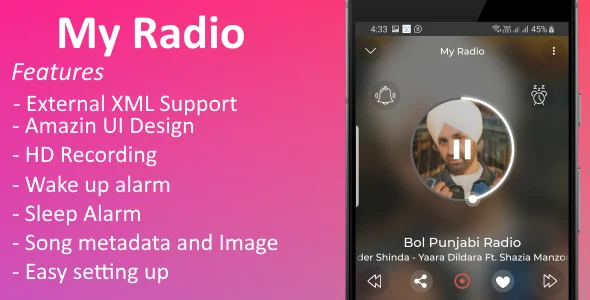
My Radio with Recording is a native Android radio streaming application source code, engineered for mobile developers and media agencies to deploy branded, multi-station radio apps with live audio capture. The codebase resolves the station-scaling bottleneck by externalizing the entire station catalog into a standalone XML file, so an unlimited number of Shoutcast, Icecast, MP3, and M3U8 endpoints can be introduced without placing request load on a hosting server. Within production delivery workflows, it operates as a rebrandable foundation delivered as .java and .xml sources alongside a compiled .apk, positioned for Google Play publication after asset replacement and configuration.
Technical Specifications & Deployment Matrix
| Engineering Metric | Deployment Specification |
|---|---|
| Base Technology / Framework | Native Android development in Java with XML layout resources |
| Runtime / OS Targets | Android 9.0, 10.0, 11.0, and 12.0 (rebuilt against the latest SDK in Version 5) |
| Streaming Protocols | Shoutcast, Icecast, MP3, M3U8, and additional stream formats |
| Source Deliverables | .apk, .java, and .xml files included in the package |
| Persistence & Services | External XML station catalog, locally stored recordings, Firebase push messaging, iTunes artwork lookup |
Streaming Pipeline, Capture Engine & Execution Flow
The execution pipeline routes an XML-parsed station catalog into a native streaming player whose capture path writes playable recordings to device storage. At launch, the application parses the external XML station list, materializing each endpoint with its name and stream URL for client-side search and filtering. When a listener selects a station, the player negotiates the stream codec — AAC and MP3 among the supported formats — and renders audio while a notification music bar sustains playback outside the foreground activity lifecycle. The recording subsystem runs alongside playback, writing the captured stream to local storage; since Version 2, recorded files expose a seekbar during playback and accept in-app renaming. Metadata flows in parallel: Version 3 replaced the Last.fm lookup with an iTunes album art fetch keyed to the now-playing station, populating cover art without manual asset entry. Favorites persist user selections, the sleep alarm schedules automatic playback shutdown, social sharing dispatches station details through native Android intents, and Firebase Cloud Messaging delivers push notifications to installed clients.
Core Technical Capabilities of My Radio with Recording
- External XML Station Catalog: Unlimited stations are declared in a decoupled XML file parsed at runtime, removing per-station backend provisioning and keeping server-side load at zero for catalog changes.
- Stream Capture Subsystem: Live streams record to local device storage with seekbar navigation and file renaming on playback — with the documented boundary that M3U8 (HLS) links cannot be recorded.
- iTunes Album Art Pipeline: Artwork retrieval is keyed to now-playing metadata via iTunes, replacing the earlier Last.fm dependency as of the Version 3 iteration.
- Background Playback & Push Layer: A notification music bar sustains playback across activity changes, while Firebase push messaging enables station announcements without app updates.
Where a delivery scope expands beyond terrestrial-style radio into live television, movies, and on-demand streaming, pairing the Android client with Mini OTT supplies the WordPress-hosted media backend that this radio codebase intentionally does not ship with.
Production Implementation & Operational Resilience
Deployment follows the standard native Android release path: import the .java and .xml sources into Android Studio, replace branding assets, point the parser at the production XML station file, and sign a release build for store submission. The live Google Play demo build documents actual runtime behavior across the supported Android 9.0 through 12.0 range, and the version history demonstrates active maintenance — Version 4 corrected an image-rendering defect on certain Pie-generation devices, and Version 5 raised the project to the latest SDK. Operationally, resilience is anchored in client-side behavior: search filters the station list by name locally, favorites persist selections, and the sleep alarm terminates playback on a timer to prevent overnight battery drain. Teams should treat the M3U8 recording exclusion as a sourcing constraint when curating station endpoints, since HLS streams play but produce no capture. Paid customization is available from the author for modifications beyond configuration, and technical assistance is handled through email or the item discussion section; the author’s GMT+5:30 working window and twice-daily triage cadence set realistic response expectations for integration planning. For single-station brand deployments where a multi-endpoint catalog adds unnecessary configuration surface, My Radio – Android Radio App (Single Station) reduces the setup footprint to one dedicated stream.
Frequently Asked Questions
Can the app record M3U8 (HLS) stream links?
No, the recording subsystem excludes M3U8 (HLS) links from capture. Shoutcast, Icecast, and plain MP3 streams are recorded to local storage, while HLS endpoints remain playback-only, a documented boundary that should shape station sourcing before deployment.
Can new stations be added without server-side code changes?
Yes, stations are declared in an external XML file that the app parses at runtime, so the catalog scales to an unlimited number of endpoints without additional server load or backend redeployment. Editing the XML is the only required change.
Does the app run on Android 12 devices?
Yes, supported runtime targets span Android 9.0 through Android 12.0. Version 5 rebuilt the project against the latest SDK, and Version 4 resolved an image-rendering defect affecting certain Pie-generation devices, so verify testing across that range before store submission.
Is album artwork fetched automatically?
Yes, since Version 3 the app fetches album artwork from iTunes, replacing the earlier Last.fm lookup. Cover images populate automatically from the now-playing station metadata, eliminating manual artwork entry per station in the XML catalog.
Can recorded files be managed directly on the device?
Yes, recorded audio gains a seekbar during local playback and supports in-app renaming as of Version 2. These controls let end users navigate long captures and label files without leaving the application or using a separate file manager.