
 My Account
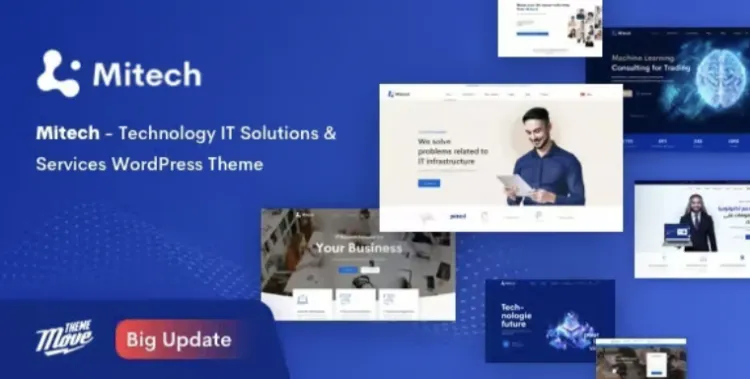
Core Engineering & Runtime Architecture of Mitech Pro
Mitech Pro – Technology IT Solutions & Services WordPress Theme is an enterprise-grade IT solutions theme engineered specifically for managed service providers, cloud consulting agencies, and enterprise software firms to establish high-converting service showcases and technical case studies. Built to interface cleanly with the core WordPress template hierarchy, the codebase isolates template parts into modular PHP components that reduce redundant server queries during initial document rendering. Script dependencies load conditionally per page template, preventing administrative or utility JavaScript libraries from populating user-facing landing pages and ensuring maximum efficiency for Core Web Vitals.
Architectural Capabilities & Implementation of Mitech Pro
- Modular Elementor Extension Framework: The theme executes custom widget render functions with flat DOM structures, omitting unnecessary parent wrapper divisions to maintain low DOM depth scores across complex layout assemblies.
- Granular Asset Dequeueing Engine: Asset management configured within Mitech Pro allows system administrators to deregister global CSS styles and scripts on specific routes, isolating heavy charting or interactive elements strictly to relevant solution pages.
- Native Semantic Schema Injection: The codebase embeds microdata structures directly into custom post types for technical services and case studies, facilitating automated JSON-LD entity graph construction for enterprise search indexing.
- Decoupled Asynchronous Navigation System: Multi-tiered mega menus compile to native CSS grid states with minimal JavaScript execution overhead, eliminating layout shifts and latency during mobile viewport hydration.
Real-World Deployment Scenarios
- Managed IT and Infrastructure Providers: Technical teams deploying this IT solutions theme for managed service providers can structure multi-tiered SLA matrices, hardware compatibility lists, and interactive uptime data representations using native dynamic query loops.
- Cybersecurity Advisory Consultancies: Agencies presenting multi-vector security audits can systematically map compliance documentation, ISO frameworks, and remediation workflows through modular tabbed and accordioned UI components.
- Custom Enterprise Software Houses: Product engineering firms require high-density project retrospectives; the portfolio routing system supports multi-taxonomical categorization by stack, delivery lifecycle, and client industry verticals.
Technical Specifications & Ecosystem Support
The runtime requirements for the production environment demand PHP 8.1 or higher with memory limits configured to at least 256MB to process batch layout generation. The core logic executes entirely within standard WordPress action hooks and filters, ensuring that database read operations utilize indexed meta queries rather than resource-heavy unindexed lookups across the `wp_postmeta` tables. Standard execution metrics indicate complete page tree assembly inside 180 milliseconds on standard Nginx configurations utilizing FastCGI caching and Zend OPcache byte-code compilation.
Integration with multi-tiered caching stacks operates reliably without layout regression due to the static decoupling of client-side variables from server session states. Redis and Memcached object caching configurations interface with the theme query cache automatically, preventing transient bloat during high-concurrency traffic events. Static assets route cleanly through standard Content Delivery Network (CDN) edge rules without triggering CORS origin violations on custom icon font families or WebP image manifests.
Technical & Integration FAQ for Mitech Pro
Q: Does the theme support full asset minification and concatenation when running alongside server-level caching layers?
A: The theme enforces native script localization via standard WordPress dependency arrays, allowing plugins like Redis Object Cache or Varnish edge engines to concatenate and defer scripts without breaking inline dependency execution.
Q: How does the template structure prevent layout shifts during font hydration?
A: Font loading mechanisms define localized CSS font-display swap attributes across all typography definitions, guaranteeing system fallbacks render instantaneously until custom web fonts settle in the browser buffer.
Q: Can developers override core service portfolio templates via a standard child theme architecture?
A: Child theme directories inherit the entire PHP template hierarchy directly, enabling engineers to override single-service and archive layouts without modifying the parent core codebase.





mangoViewport
Advanced features matched my use cases perfectly.
Jacob Wilson
No index bloat; archives stayed trim.
Audrey Miller
Zoom at 125% still feels clear.