Mini Relaxing Games – (Unity – Admob)
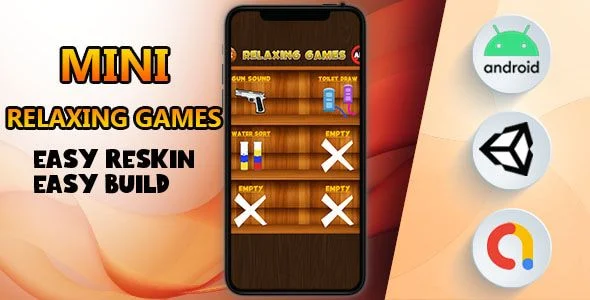
Mini Relaxing Games Overview & Mobile Game Foundation Architecture
Mini Relaxing Games is a Unity-based mobile game source code package, engineered for indie developers and studios to launch a monetized casual puzzle collection without building the underlying engine layer from scratch. The package eliminates the two largest production bottlenecks in mobile game delivery: wiring ad-network mediation into the Unity runtime and structuring a persistence layer for level progression and daily reward loops. In a production workflow, it functions as a deployable Android project that can be reskinned, rebranded, and submitted to app stores, shortening the path from concept to a revenue-generating release.
Technical Specifications & Deployment Matrix
| Engineering Metric | Deployment Specification |
|---|---|
| Base Technology / Framework | Unity engine, complete editable project source code |
| Runtime / Language Requirements | C# scripting runtime; Android build target with 64-bit architecture support |
| Monetization / Communication Layer | Google AdMob SDK (banner, interstitial, rewarded ad units) plus In-App Purchase flow for ad removal |
| Front-End / Engine Dependencies | Unity UI system driving multiple bundled mini-game scenes |
| Persistence Footprint | Local device storage for level progression states, daily reward timers, and IAP entitlement flags |
Monetization Pipeline & Game Loop Execution Flow
The core mechanism is an AdMob-integrated Unity project that dispatches three ad formats through a single monetization layer. When the application launches, the Unity runtime initializes the AdMob SDK before gameplay scenes mount, allowing banner units to attach to screen edges while interstitial and rewarded units are queued behind game-loop events such as level completions and retry triggers. Rewarded placements feed back into the reward economy, granting in-game bonuses in exchange for a completed video view, while the In-App Purchase module writes an ad-removal entitlement that suppresses ad dispatch across all subsequent sessions.
Gameplay is distributed across multiple bundled mini-games, each built around low-friction puzzle mechanics that produce a short learning curve and sustained session length. A level progression system tracks player advancement and gates content accordingly, and a daily reward timer issues scheduled incentive payouts that pull users back into the session loop on consecutive days. Because every system runs inside the editable Unity project, studios can trace how scene transitions, ad callbacks, and persistence writes interact before modifying any layer.
Architectural & Functional Highlights
- Three-Format AdMob Integration: Banner, interstitial, and rewarded ad units are wired into the Unity runtime, covering passive placement, transition-based interstitials, and opt-in rewarded video views tied to the reward economy.
- IAP-Driven Ad Suppression: The In-App Purchase system records an ad-removal purchase that disables ad dispatch at runtime, giving the monetization model a paid tier without restructuring the ad layer.
- Progression & Retention Systems: Level progression gates and daily reward timers are bundled as functional systems, providing the retention mechanics that casual titles rely on for repeat sessions.
- 64-Bit Android Build Support: The project targets 64-bit Android architecture, satisfying Google Play’s current submission requirement for native library compliance.
- Reskin-Ready Project Structure: Art assets, themes, and branding elements are organized for replacement, allowing a full visual rebrand without rewriting game logic.
Production Implementation & Operational Resilience
Deployment begins by importing the complete Unity project, replacing the default AdMob application identifiers with your own ad-unit configuration, and pointing the IAP product identifiers at your store listing before generating a signed release build. The included documentation walks through this setup sequence, covering SDK configuration steps and the build parameters required for store submission. Because the package ships as full source code rather than a precompiled binary, every ad callback, progression gate, and persistence write is inspectable and modifiable at the C# level.
Reskinning operates within defined boundaries: visual assets, color themes, and branding elements can be swapped directly, while changes to monetization logic or game mechanics require editing the underlying Unity scripts. Studios expanding a portfolio beyond a single title can run parallel production tracks, and for teams evaluating additional Unity-based launch vehicles, Wood Stair offers a hyper-casual template with the same Unity-AdMob monetization pattern, while Math Riddles provides a puzzle-format alternative with AdMob units already configured. Each operates as an independent project rather than a module of this codebase. Error handling in the monetization layer follows standard AdMob callback patterns, where failed ad requests fall back to gameplay without blocking the session loop, and 64-bit support removes the architectural rejection risk at store review.
Frequently Asked Questions
Does the package include the complete Unity project source code or only precompiled binaries?
Yes, the deliverable is a complete Unity project with editable source code, allowing developers to modify game logic, ad configurations, and visual assets directly inside the Unity editor before compiling a release build.
Can ads be disabled for paying users through the built-in purchase system?
Yes, the In-App Purchase system includes an ad-removal product that suppresses banner, interstitial, and rewarded ad dispatch once the purchase is recorded, creating a paid ad-free tier within the same build.
Does the build satisfy the 64-bit requirement for Google Play submission?
Yes, the project is optimized for Android with 64-bit architecture support, meeting the current Google Play Console requirement for native builds and reducing the risk of store rejection during release review.
Are retention mechanics like daily rewards included as working systems or only as design references?
Yes, both the daily reward system and the level progression system ship as functional implementations inside the project, ready to run on device with persistence handled locally without additional third-party backend services.
2-in-1 | Mindfulness + Vibez – Relaxing Sounds Android App + Admob Ads
AiVision Powered By Chat GPT-4o/gpt-4o-mini , Image Input, AI Chat, Complete Android App

Sleep Sounds – Relax & Sleep, Relaxing, Meditation sounds(Supported android 14 and SDK 34 )