Midi – Sound & Music School WordPress Theme
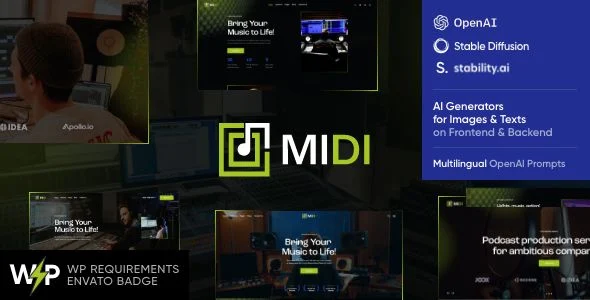
Midi Sound & Music School WordPress Theme Overview & Architecture for Music Education Delivery
Midi Sound & Music School WordPress Theme is an Elementor-driven WordPress theme engineered for music schools, recording studios, DJ bureaus, and entertainment agencies to publish lessons, event schedules, and merchandise from a single codebase. The package resolves the common bottleneck of assembling a music-education site from disconnected plugins by bundling a proprietary theme framework, custom post types, widget sets, and prebuilt demo skins that deploy through a one-click importer. Within agency delivery workflows, the codebase operates as the presentation layer: production teams inherit global Customizer settings, override them per page, and ship client builds without hand-writing PHP templates.
Technical Specifications & Deployment Matrix
| Engineering Metric | Deployment Specification |
|---|---|
| Base Technology / Framework | WordPress 4.9.x through 7.0.x, HTML5 and CSS3 markup, ThemeREX Addons framework, Gutenberg-optimized editor styles |
| Runtime / Language Requirements | PHP, CSS, and JS source files; rewritten CSS/JS minification pipeline; PHP 8.5 compatibility verified in the changelog |
| Data Exchange / Communication | Interactive AJAX search, AJAX cart updates, hardened AJAX request handlers with additional safety checks |
| Front-End / Engine Dependencies | Elementor and Elementor Pro, Slider Revolution, Swiper slider, Google Fonts, Fontello icon set |
| Commerce / Persistence Footprint | WooCommerce 5.x to 8.x with cart, search, login, and shipping flows; WPML multilingual support; MySQL via WordPress core |
| Browser & Layout Matrix | Firefox, Safari, Opera, Chrome, Edge; 100% responsive layout, retina image support, 4+ column grids, boxed and fullwidth modes |
Rendering Pipeline & Theme Framework Execution
The rendering flow is governed by a setting-inheritance and override system that propagates global values from more than 750 Customizer options down to individual posts, pages, and custom post types. When a request enters the WordPress template hierarchy, the framework first resolves inherited skin and layout settings, then applies any page-level overrides before the selected template renders its DOM tree. Because headers and footers are themselves Elementor documents, layout containers, popups, and overlay panels are assembled through the same widget engine as page content, and the TrxAddons Layouts widget exposes responsive panel sizing, overlay styling, and close-button controls at the container level.
Content delivery leans on the rewritten minification layer, which merges and safely separates JavaScript files and handles edge cases such as comments inside regular expressions. The scroll-to-anchor routine was reworked to respect per-anchor easing, duration, delay, and offset parameters configured in the Menu Anchor widget, and active menu detection now fires at 30% from the viewport top rather than the midpoint, which reduces layout shift in long one-page builds. Demo import clears the Elementor file cache automatically so imported layouts render with fresh asset references on first load.
Core Technical Capabilities of Midi
- Setting Inheritance & Override System: Global Customizer values cascade across custom post types, blog feeds, and widget areas, so a single color or typography change propagates site-wide while individual pages retain override granularity.
- Elementor Header/Footer Authoring: Site chrome is edited as page-builder documents, with responsive panel controls, sticky-section backdrop blur settings, and menu anchor animation parameters available per layout element.
- WooCommerce Commerce Layer: Cart, product filtering, wishlist, and crypto payment flows (via the elegro plugin) run against WooCommerce 5.x through 8.x, including a product filter widget with searchable, scrollable attribute lists for catalogs with 15 or more terms.
- Performance & Asset Pipeline: A rewritten minification routine, optional editor style loading via add_editor_style or enqueue_style, and forced-off hyphenation on mobile devices target predictable rendering across devices.
- Security Hardening: Documented fixes cover stored XSS in Elementor background text and Instagram widgets, SSRF vectors in URL-loaded SVGs, object injection in settings decoding, and an LFI risk during pagination.
Production Implementation & Operational Resilience
For staging and high-traffic deployments, the framework exposes a grab_output_allowed toggle that disables output buffering on managed hosts such as WordPress.com, where buffered output can break header-based operations. Admin notices for skin updates include a theme-core version check that warns when the core package lags behind a skin update, preventing missing-function errors during upgrades. The QW Extension addon and ThemeREX Updater handle patch distribution, while compatibility layers target WordPress 7.0+ admin styles and The Events Calendar table migrations (tec_events and tec_occurrences) when exporting event data.
Accessibility and mobile behavior received direct engineering attention: keyboard focus loops in the mobile menu, iOS submenu tap handling that no longer closes immediately after opening a parent item, and hidden form controls that avoid scrolling the page to the top on keyboard focus. Booking flows run through the Booked Appointments plugin, event calendars through The Events Calendar, and email capture through MC4WP Mailchimp integration. To attach lesson syllabi or studio rate cards as inline documents without writing custom embed code, integrating PDF Embedder adds a responsive document viewer inside posts and product pages. For decoupled implementations outside the WordPress runtime, the Miraculous Online Music Store HTML Template exists as an independent static front-end path for bands and record labels that do not require a CMS backend.
Frequently Asked Questions
Does the theme support multilingual music school deployments?
Yes. The package is WPML-compatible, allowing translated course pages, event listings, and WooCommerce product catalogs to share the same theme framework, custom post types, and inherited layout settings across every active language.
Are the demo preview images and clipart shipped inside the downloadable package?
No. All images are copyrighted to their respective owners, sourced from depositphotos.com, peopleimages.com, and flaticon.com, and the live-preview media is excluded from the template deliverables.
Does the codebase run on PHP 8.5 hosting environments?
Yes. Version 1.20.0 of the changelog explicitly lists PHP 8.5 compatibility fixes, alongside earlier PHP 8 corrections for string and integer operations and child post queries.
-
v1.14 LatestOct 22, 2026