Medicom – Medical & Health WordPress Theme | Health & Beauty
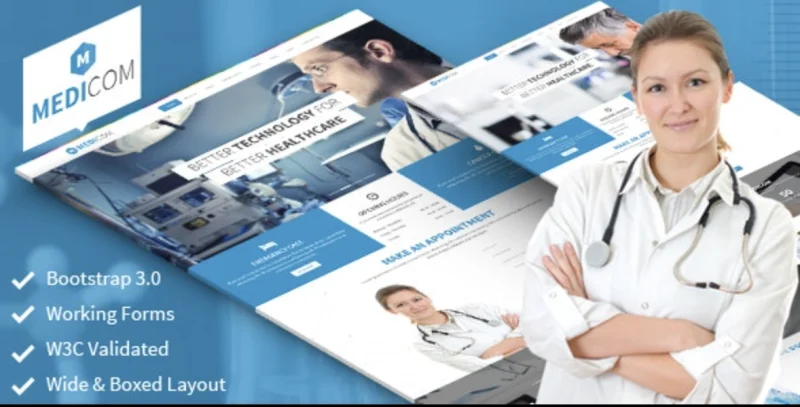
Medicom Medical & Health WordPress Theme Overview & Clinic Site Architecture
Medicom is a WordPress theme engineered on a lightweight templating framework, built for hospitals, dental clinics, and independent practitioners who need a production-ready medical website without custom PHP development. The theme addresses the architectural bottleneck of data-heavy clinic pages—department listings, doctor archives, and event timetables—by keeping DOM depth shallow and moving schedule queries to AJAX endpoints so the browser never re-renders an entire document to filter availability. Within an agency delivery pipeline, it functions as the presentation and content-structure layer: administrators assemble department pages, service grids, and testimonial sections as modular blocks while all configuration persists through the WordPress Customizer API, leaving core source files untouched.
Technical Specifications & Deployment Matrix
| Engineering Metric | Deployment Specification |
|---|---|
| Base Technology / Framework | WordPress theme on a lightweight templating framework with a shallow template hierarchy |
| Runtime / Language Requirements | PHP and MySQL as provisioned by a standard WordPress host environment |
| Data Exchange / Communication Protocols | AJAX endpoints for timetable filtering and doctor directory search queries |
| Front-End / Engine Dependencies | Drag-and-drop page builder integration for modular block composition; WooCommerce for store operations |
| Database / Persistence Footprint | Custom post types and taxonomy assignments for doctors and departments; settings stored via the WordPress Customizer API |
Scheduling Engine & Content Rendering Pipeline
The core mechanism is an AJAX-driven timetable module that renders department schedules without full page reloads.
When a visitor queries availability, the timetable component dispatches a filtered request—by department or by staff member—to a theme-level AJAX endpoint instead of navigating to a new URL. The server resolves recurring time slots for the requested scope, returns the filtered dataset, and the module patches only the affected region of the DOM. Because the template hierarchy maintains low node depth across department listings, doctor archives, and event timetables, the browser performs fewer layout recalculations when those partial updates are applied, which keeps interaction latency low on schedule-heavy pages.
Content modeling follows a structured pattern: each physician is stored as a custom post type, assigned to a department taxonomy, and linked to related service pages. This lets a hospital publish staff directories, specialty groupings, and connected service pages from a single administrative interface rather than duplicating content across static templates. On the assembly side, the drag-and-drop page builder treats departments, service grids, and testimonial sections as modular blocks, so layout composition happens through block reordering rather than PHP template edits. For agencies evaluating parallel health-and-wellness solutions on the same WordPress runtime, Monalisa covers spa and wellness center deployments where scheduling intensity is lower than a multi-department clinic.
Core Technical Capabilities of Medicom
- AJAX Timetable & Scheduling Engine: Accepts recurring time slots and filters them by department or staff member through asynchronous endpoints, so availability queries update the UI without a document reload or loss of scroll position.
- Doctor & Department Management: Custom post types with department taxonomy assignment enable normalized staff directories, specialty groupings, and bi-directional links to service pages from one admin screen.
- WooCommerce Commerce Layer: Full store compatibility lets a clinic operate an online pharmacy or retail health and beauty catalog, with product archives inheriting the responsive grid and checkout templates matching global theme styling.
- Customizer-Based Configuration: Color schemes, typography stacks, header layouts, and footer composition are persisted through the WordPress Customizer API, guaranteeing zero core file modification during setup and safer update paths.
- Responsive & Retina-Ready Rendering: Fluid media queries and retina-scaled assets preserve typography and iconography fidelity across viewport widths and high-density displays.
Production Implementation & Operational Resilience
For agency staging environments, the recommended deployment sequence is: install WordPress, activate the theme, configure departments and doctor post types first, then compose page layouts through the builder, and finally attach the WooCommerce layer if a pharmacy or retail catalog is in scope. Because all global configuration—headers, footers, typography, color schemes—routes through the Customizer, a child theme is only necessary when template-level overrides are required; ordinary brand adjustments never touch source files, which keeps theme update cycles conflict-free.
Performance boundaries deserve attention. AJAX schedule and directory queries bypass page caching by design, so the object cache and database response times govern filtered-view latency; static assets, conversely, benefit from fragmentation and minification. Pairing the deployment with WP Rocket allows static page caching, delayed JavaScript execution, and automated CSS optimization to reduce initial payload weight on cached routes while the AJAX endpoints continue to serve live schedule data. The shallow DOM depth documented across department and archive templates also limits cumulative layout shift when partial timetable updates land, since fewer ancestor nodes recalculate geometry.
Operational limits are pragmatic: recurring-slot definitions and taxonomy-based directory filters run server-side through WordPress, so heavy multi-department datasets scale with host PHP and MySQL headroom rather than client capability. For clinics whose commercial model centers on cosmetic product retail rather than appointment logistics, Dr. Leigh exists as an independent shop-oriented theme targeting dermatology and cosmetics storefronts on the same platform.
Frequently Asked Questions
Does Medicom modify WordPress core files during theme setup?
No. Color schemes, typography stacks, header layouts, and footer composition are all persisted through the WordPress Customizer API, so no core source files are modified while configuring the theme.
Can visitors filter doctor availability without triggering a full page reload?
Yes. The timetable module dispatches filtered AJAX requests by department or staff member and patches the schedule display in place, so availability queries never force a complete document re-render.
Does the theme require editing PHP templates to build department and service pages?
No. The drag-and-drop page builder integration lets administrators compose department pages, service grids, and testimonial sections as modular blocks, removing direct PHP template editing from routine content workflows.