
MediCenter Pro – Health Medical Clinic WordPress Theme
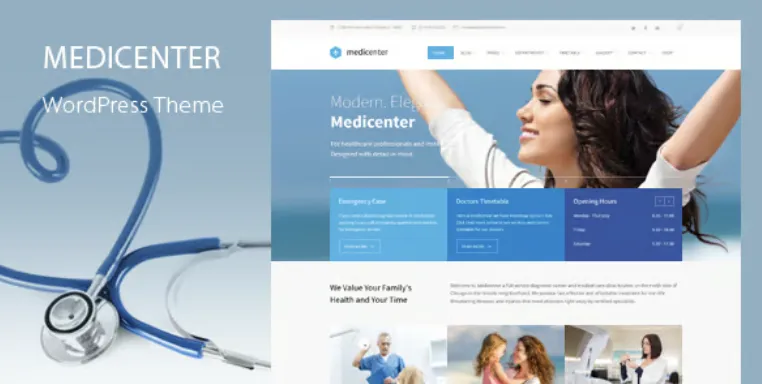
Core Architecture and Healthcare Data Processing in MediCenter Pro
MediCenter Pro – Health Medical Clinic WordPress Theme is a specialized medical clinic WordPress theme engineered specifically for private practices, regional hospitals, and ambulatory surgical centers to streamline patient intake and clinical schedule discovery. The template constructs an asset-minimized layout pipeline that renders clinical timetables and practitioner profiles without inflating DOM depth or blocking main-thread execution. Data queries route through native WordPress transients and custom post types, bypassing redundant database lookups during peak consultation inquiry windows. Front-end assets utilize conditional enqueuing protocols, executing departmental schedules and appointment modal scripts exclusively on pages containing their explicit action hooks.
The layout relies on standard CSS Grid and Flexbox primitives to maintain sub-pixel rendering accuracy across varying display viewports. Asset payloads remain compact through automated script minification and native SVG iconography, reducing Cumulative Layout Shift (CLS) during asynchronous data fetching. By abstracting clinical taxonomies into decoupled database entities, the theme allows administrators to manage physician rosters, operational departments, and weekly shift tables without modifying template files.
Key Functional Features of MediCenter Pro for Modern Deployments
- Synchronous Timetable Schedule Engine: Employs structured custom post types to bind physician rosters to day-and-hour matrix grids, utilizing localized JSON objects to filter shifts on the client side without triggering secondary HTTP page requests.
- Practitioner Taxonomy Management: Leverages WordPress metadata structures to map practitioner specialties, consultation rooms, and operational certifications, ensuring MediCenter Pro maintains sub-second script execution during multi-attribute search queries.
- Departmental Asset Isolation: Loads specialized clinic style packages and contact endpoints conditionally based on template hierarchy, which prevents non-critical stylesheet overhead on core service landing pages.
- AJAX Appointment Form Handlers: Dispatches patient intake inquiries via localized
admin-ajax.phpand REST endpoints, complete with nonce validation and server-side field sanitation, establishing a secure transmission standard for a high-performance medical clinic WordPress theme.
Operational Implementation Scenarios
- Multi-Specialty Outpatient Networks: Configures segmented timetable instances across discrete clinic sub-departments, enabling triage nurses and prospective patients to cross-reference doctor availability by facility wing or clinical discipline.
- Urgent Care and Diagnostic Imaging Facilities: Delivers lightweight, mobile-first appointment dispatch workflows, allowing patients on low-bandwidth networks to identify active walk-in hours and dispatch preliminary check-in requests directly to registration desks.
Compatibility & System Requirements
| Component | Specification Standards |
|---|---|
| PHP Runtime Environment | PHP 7.4 through PHP 8.2 with memory_limit allocated at 256M minimum |
| Database Architecture | MySQL 5.7+ or MariaDB 10.4+ with InnoDB storage engine support |
| Web Server Infrastructure | Apache 2.4+ (with mod_rewrite enabled) or Nginx 1.18+ fastcgi setups |
| CMS Core Framework | WordPress 5.8 or higher with REST API endpoints accessible |
Frequently Asked Questions
How does the internal schedule module mitigate database read exhaustion during high concurrency?
The schedule module serializes weekly timetable arrays into the WordPress Object Cache and localized transient records, ensuring high-frequency roster views execute from active memory rather than triggering repeated relational SQL table queries.
Does the practitioner directory support customization via template overrides in child themes?
The practitioner directory leverages standard template part hierarchies, enabling developers to copy individual doctor card markup directly into a child theme directory to modify HTML output without modifying core theme functions.
Can third-party reverse proxies like Varnish or Fastly cache the clinical timetable views without breaking shift status updates?
Timetable components support edge caching protocols because filtering mechanisms execute via client-side JavaScript evaluations, allowing reverse-proxy CDNs to deliver cached static HTML payloads while user interactions remain dynamic.
-
v16.1 LatestSep 10, 2026