MediaCenter Pro – Electronics Store WooCommerce Theme
MediaCenter Pro Overview & Storefront Architecture Role
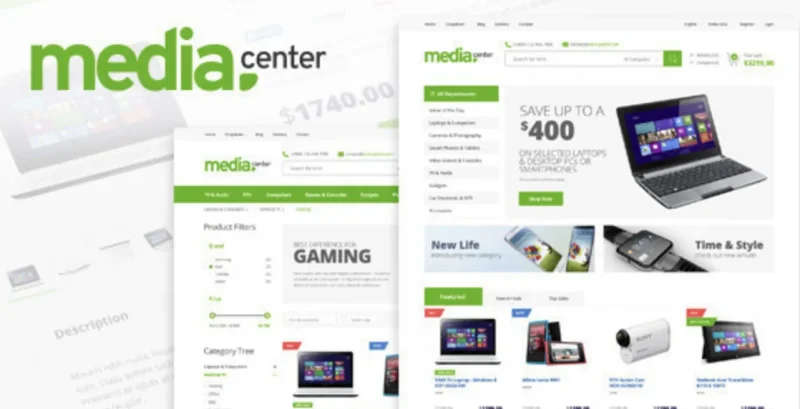
MediaCenter Pro is a WordPress and WooCommerce theme package engineered for electronics retailers and the agencies building their storefronts. It targets the structural bottlenecks of electronics merchandising — high SKU counts, brand-driven discovery, and specification comparison — by layering a Brands custom taxonomy, extended layered navigation, live search, and wishlist or comparison flows on top of WooCommerce’s native template hierarchy. In production workflows it functions as a prebuilt storefront foundation: importable demo data, six preset color schemes, and bundled WPBakery and Slider Revolution tooling compress the path from staging to launch.
Technical Specifications & Deployment Matrix
| Engineering Metric | Deployment Specification |
|---|---|
| Base Technology / Framework | WordPress theme built on Bootstrap 3 with LESS source files |
| Runtime / CMS Requirements | WordPress 5.9.x through 6.8.x; WooCommerce 7.x.x through 9.x.x |
| Page Builder & Slider Engines | WPBakery Page Builder (Visual Composer) and Slider Revolution bundled |
| Commerce Extensions | YITH WooCommerce Compare integration, Ecwid CSS compatibility, widget-ready sidebars |
| Browser & Layout Coverage | Chrome, Firefox, Safari, Opera, Edge; responsive layout with RTL support |
| Persistence / Content Footprint | WordPress database via WooCommerce products, brand taxonomy records, and widget configurations |
Catalog Execution Pipeline & Merchandising Mechanics
The storefront pipeline routes every catalog request through the WooCommerce template hierarchy, which MediaCenter Pro overrides at the theme layer to output electronics-specific commerce views. WordPress resolves archive, single-product, and taxonomy URLs via its rewrite engine, matches them against the WooCommerce template files inside the theme directory, and renders the resulting markup on a Bootstrap 3 grid. Two header variants and two menu styles — including a vertical megamenu — define the document structure, while six preset color schemes, more than 650 integrated Google Web Fonts, and 369 Font Awesome glyphs feed a stylesheet layer compiled from the bundled LESS sources. Page composition runs through WPBakery Page Builder, where draggable content elements are persisted as shortcode blocks, and Slider Revolution renders the homepage carousel layers. On the commerce side, a Brands custom taxonomy is registered alongside the product post type and the layered navigation widget is extended to filter it, so shoppers can narrow large inventories by manufacturer. Live search returns matched products as the query is typed, and lazy loading defers offscreen product image requests until they approach the viewport, keeping the initial DOM payload lean.
Core Technical Capabilities of MediaCenter Pro
- Brand taxonomy with layered filtering: A dedicated Brands taxonomy is attached to products and wired into the layered navigation widget, letting shoppers constrain catalogs by manufacturer while filter state is carried through the query layer and additional brand-filter widgets.
- Live search execution: Search input is dispatched as the visitor types and matched products are returned inline, removing a full page round-trip from the discovery funnel and reducing bounce on large catalogs.
- Deferred media payloads: Lazy loading holds offscreen product imagery out of the initial request set, and six catalog display modes — sidebar layouts with two, three, or four products per row and fullwidth grids of three to six — control rendered DOM density.
- Wishlist and comparison pipelines: Visitors can park products on a wishlist for later purchase, while the bundled YITH Compare integration renders side-by-side specification tables, the core decision pattern for electronics buyers evaluating hardware.
- Custom product labels: Beyond the default On Sale badge, arbitrary labels can be attached to products, supporting merchandising states such as new arrivals or featured lines without template edits.
Because the builder runtime here is WPBakery rather than the block editor, agency teams that standardize page composition on Elementor should treat The Plus as an independent widget path; it operates as a separate plugin on a different page-builder stack, not as an extension of this theme’s codebase.
Production Implementation & Operational Resilience
Deployment begins with the bundled dummy data import, which populates catalog, page, and slider content so a staging environment mirrors the demo storefront before live SKUs replace the seed records. Visual overrides follow two tracks: the LESS sources allow design tokens to be recompiled for custom palettes, while theme option fields accept custom CSS and custom JavaScript for surgical corrections without touching template files. Two About page variants and two contact pages with Google Maps direction support shorten client review cycles, and three blog layouts plus support for standard, gallery, video, audio, quote, link, aside, status, and image post formats give content teams room to publish without additional theming. Cross-browser rendering is verified against Chrome, Firefox, Safari, Opera, and Edge, with the responsive grid adapting the megamenu and product grids across viewport breakpoints.
Maintenance cadence is documented in the release history: version 2.7.23, dated March 2025, patched an account eye-icon display defect, handled a WooCommerce notice error, and updated the bundled YITH Compare plugin, confirming active compatibility work through WooCommerce 8.5.x and the WordPress 6.x line. The package also ships Ecwid CSS files, giving merchants a hosted-cart runtime that reuses the theme’s visual language. For electronics retail programs committed to Shopify instead of WordPress, Volga stands as a standalone Liquid-based megashop alternative on a separate commerce runtime; it shares no PHP code with this package and is evaluated as a parallel solution rather than a combined stack.
Frequently Asked Questions
Is MediaCenter Pro optimized for the native WordPress block editor (Gutenberg)?
No. The compatibility matrix explicitly lists the theme as not Gutenberg-optimized; page composition instead runs through the bundled WPBakery Page Builder and its shortcode-based element library rather than native block patterns.
Can MediaCenter Pro operate with Ecrid in addition to WooCommerce?
Yes. Ecwid compatibility is declared in the theme’s attributes, and Ecwid-specific CSS files are included in the package, allowing the same visual system to skin an Ecwid-hosted catalog alongside standard WooCommerce store pages.
Is the codebase prepared for multilingual and right-to-left deployments?
Yes. The theme ships with .po and .mo language files, is flagged WPML-ready, and carries RTL support, so translated storefronts and right-to-left locales can be served without modifying core template files.