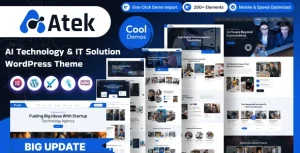
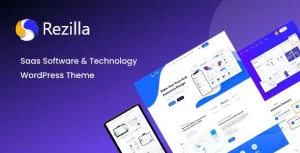
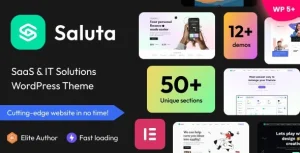
Manit – IT Solutions & Technology WordPress Theme

Manit: Engineering Overview & Architecture
Manit – IT Solutions & Technology WordPress Theme is a premium Elementor-based WordPress theme engineered for IT consultancies, SaaS product teams, and digital agencies that need to present complex technical services online. Its template architecture keeps DOM depth minimal by compiling each section into a flat hierarchy of semantic containers, which removes redundant wrapper nodes that typically bloat page weight on service-heavy layouts. Content updates such as portfolio filtering, contact form submission, and dynamic section loading run through AJAX endpoints that patch only the affected DOM fragments, eliminating full-page reloads during visitor interaction.
Component assembly is handled through deep integration with the Elementor page builder, so every pre-built section is delivered as an editable widget stack with live inline previews rather than static shortcodes. The centralized theme options panel exposes granular controls for global color palettes, Google Fonts typography scaling, header and footer layout variants, logo placement, and per-page sidebar configuration. A dedicated performance panel lets administrators toggle asset minification and disable unused widget scripts per template, keeping the runtime footprint proportional to what each page actually renders.
Key Functional Features of Manit for Modern Deployments
- Elementor Drag-and-Drop Building: Every layout module ships as a native Elementor widget with live preview rendering, allowing developers to restructure hero sections, pricing tables, and service grids without touching PHP template files.
- Pre-Built Homepage Demos: A curated set of homepage designs targets distinct IT niches, including SaaS landing pages, managed service providers, and software development studios, each installable with its full page structure intact.
- Comprehensive Inner Page Templates: Production-ready layouts cover About Us, Services, Case Studies, Portfolio, and Blog archives, with consistent spacing tokens and reusable section components shared across templates.
- Mobile-First Responsive Grid: Media queries are written at sub-breakpoint granularity, so navigation collapses into an off-canvas menu, and multi-column service grids reflow to single-column stacks without horizontal overflow on screens from 320px upward.
- Performance-Optimized Asset Pipeline: JavaScript dependencies are conditionally loaded per widget, and CSS is scoped by template, which reduces render-blocking resources and keeps Largest Contentful Paint within Core Web Vitals thresholds on standard hosting.
- Advanced Typography and Color Controls: The options panel manages font pairing, line-height scales, and dynamic color systems globally, propagating changes across every template in a single save operation.
Real-World Deployment Scenarios
- SaaS Product Launch Site: A software vendor deploys the theme as a technology WordPress theme for its product launch, using the demo homepage, pricing widgets, and case study templates to publish a full marketing site within a two-day sprint.
- Managed IT Services Provider: An MSP firm builds its service catalog with dedicated service detail layouts, publishes compliance documentation on inner pages, and routes leads through the integrated contact forms into its CRM workflow.
- Digital Agency Portfolio: A development agency configures the portfolio grid with AJAX filtering, showcases client case studies with metric callouts, and runs a technical blog on the included archive templates to support organic search acquisition.
Technical Architecture & Compatibility Standards
The theme is tested against WordPress 6.x core, PHP 8.0 through 8.3, and current versions of Elementor, WooCommerce, Contact Form 7, and WPML for multilingual deployments. Code follows WordPress PHP coding standards, enqueues assets through the standard dependency API, and registers theme options through the Customizer and a dedicated options framework rather than modifying core files.
Performance targets align with Core Web Vitals: conditional script loading keeps Total Blocking Time low, lazy-loaded imagery defers offscreen media requests, and preconnect hints for font delivery reduce connection setup overhead. Because templates are served as editable Elementor data, updates to the theme core do not overwrite customized page content, and child-theme support is available for advanced PHP-level overrides.
Frequently Asked Questions
Does the theme require coding knowledge to build pages?
No, all layouts are assembled through the bundled Elementor widget system with live previews, so complete pages can be built and restructured visually without editing PHP, HTML, or CSS files directly.
Can I use this theme for a SaaS or startup website?
Yes, the package includes homepage demos and pricing, feature-grid, and case study widgets specifically structured for SaaS product sites and early-stage startup marketing pages.
Does the theme support WooCommerce for selling digital products?
Yes, compatibility with current WooCommerce versions is built in, allowing shop, product, and checkout templates to inherit the theme’s styling system for consistent storefront presentation.
Can demo content and pre-built pages be installed without manual setup?
Yes, the bundled importer installs the demo homepage, inner page templates, widgets, and media assets into a fresh WordPress installation so the site matches the preview immediately after setup.
Will page speed suffer on shared hosting?
No, conditional asset loading, per-template CSS scoping, and lazy image loading keep the rendered footprint small, which maintains acceptable Core Web Vitals results even on entry-level shared hosting environments.
-
1.0.2 LatestOct 29, 2026