Magzin – Modern High-Performance Blog WordPress Elementor Theme
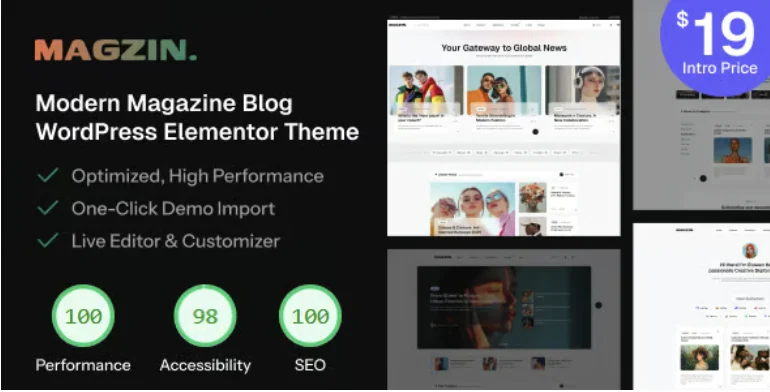
Magzin Overview & Editorial Publishing Architecture
Magzin is a WordPress magazine and blog theme engineered for publishers, editors, and agencies that need to deploy editorial websites without hand-coding presentation templates. The package addresses the recurring delivery bottleneck of magazine builds — assembling article grids, archive variations, and single-post layouts — by shipping pre-built Elementor templates together with a companion core plugin that governs the custom rendering layer. In production workflows, it operates as the front-end tier over a standard WordPress install (5.5.x through 6.8.x), with an optional WooCommerce binding for content sites that also sell physical or digital products.
Technical Specifications & Deployment Matrix
| Engineering Metric | Deployment Specification |
|---|---|
| Base Technology / Framework | WordPress 5.5.x – 6.8.x, PHP template files, widget-ready regions, 4+ column grid layouts |
| Runtime / Editing Requirements | Elementor (free) required for visual page editing; Elementor Pro and Elementor Header & Footer supported |
| Data Exchange / Plugin Interoperability | WooCommerce 6.x – 9.x, WPML, Contact Form 7, WPForms, Jetpack |
| Front-End Dependencies | Responsive viewport handling, retina-ready assets, dark/light mode toggle, full RTL directionality, Gutenberg optimization |
| Deliverable Footprint | Parent theme + child theme, Magzin Core plugin, one-click demo data, .POT translation file, Figma design source |
Template Rendering Pipeline & Core Capabilities
The rendering pipeline routes every request through the standard WordPress template hierarchy, then delegates layout composition to the Elementor engine, whose drag-and-drop document model overrides native PHP template output without code edits. A bundled core plugin registers the theme’s custom post modules — including a portfolio system for project showcases — while dedicated Elementor widgets such as Posts Listing and Posts Slider pull post data into configurable grid structures. Display parameters for dates, view counts, and reading-time estimates can be toggled per widget, and thumbnail height controls allow precise control over media blocks. Cross-browser output is validated from legacy IE8 through current Chrome, Firefox, Safari, and Opera builds, and dual color-scheme state is applied consistently across both dark and light modes.
Architectural & Functional Highlights
- Emoji Reaction System: Eight reaction states are dispatched on the front end with multi-layer anti-spam validation guarding the write path, integrated through a single code insertion rather than per-template patching.
- RTL Directionality Engine: Full right-to-left language support (introduced in version 4.0) mirrors layout geometry, widget alignment, and typography flow without requiring a separate RTL stylesheet fork.
- Portfolio Module: A dedicated content type extends the default post architecture, enabling designers and studios to publish project and product showcases alongside editorial output.
- One-Click Demo Import: Pre-built homepage, archive, and single-post layouts are materialized into the database in a single operation, shortening staging-to-production cycles for multi-client agency rollouts.
- Widget Configuration Layer: Ten preloader styles, logo height controls, and per-widget metadata toggles (date, views, reading time) expose granular presentation switches inside the Elementor editing surface.
Production Implementation & Operational Resilience
Deployment follows the conventional theme upload path: the parent theme, child theme, and core plugin are installed, after which demo data can be imported in one action. The inclusion of a child theme establishes a safe override boundary — custom template modifications belong in the child layer, leaving the parent package updatable without losing site-level changes. A hosting quirk worth noting from the changelog: certain hosting environments previously triggered demo import failures, which the development track resolved in version 2.2, so restrictive PHP execution limits or import timeouts on budget hosting should be verified before staging. The .POT file ships in the package for multilingual string extraction, and WPML compatibility covers translated deployments end to end.
On the performance axis, the codebase uses clean markup, minimized requests, and lazy-loaded imagery to protect Core Web Vitals — LCP and CLS — across long-form editorial pages. Semantic HTML and schema markup support are built in, and for editorial teams that need richer structured data (review snippets, breadcrumb graphs, redirect governance), deploying Rank Math SEO Pro alongside the theme consolidates on-page optimization into a single control panel. For high-traffic magazine properties where uncached PHP rendering becomes the bottleneck, layering SpeedyCache introduces page caching, asset minification, and database cleanup that compound the theme’s lightweight asset footprint. The Emoji reaction system’s anti-spam shielding also reduces fraudulent write traffic to the front-end interaction endpoints.
Regarding pre-deployment prerequisites: the documentation confirms Elementor (free) is mandatory for visual editing, the Figma design file is provided for design-level iteration before changes reach the codebase, and the changelog shows an active fix cadence covering mobile menu behavior, responsive regressions, and post-slider initialization timing — signals of maintained operational stability rather than an abandoned package.
Frequently Asked Questions
Does the package include a child theme for safe code-level customization?
Yes. Both the parent theme and a child theme are delivered, allowing template and function overrides to live in the child layer so future parent-package updates can be applied without overwriting custom work.
Can the theme render right-to-left languages without a separate RTL build?
Yes. Version 4.0 introduced full RTL language compatibility, covering layout direction, widget alignment, and typography flow within a single package, verified against a dedicated RTL demonstration build.
Does the emoji reaction feature include built-in abuse protection?
Yes. The reaction system exposes eight expressive reactions protected by multi-layer anti-spam mechanisms, and the feature integrates into layouts through one line of code, minimizing implementation overhead.