Magic LMS – AI Oriented Learning Management System
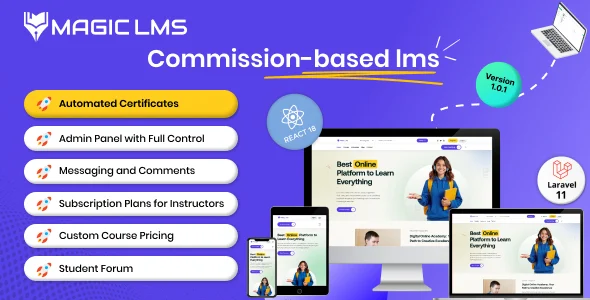
Magic LMS Overview & Application Architecture
Magic LMS is a Laravel-based learning management application, engineered for instructors, coaching centers, and training organizations to operate self-hosted e-learning platforms. The package consolidates course hosting, payment handling, messaging, and certification into a single codebase instead of requiring operators to wire together disconnected services. Within production workflows, it serves as the standalone application tier that administrators deploy on their own PHP and MySQL infrastructure, retaining direct control over student data, instructor accounts, and platform configuration.
Technical Specifications & Deployment Matrix
| Engineering Metric | Deployment Specification |
|---|---|
| Base Framework | Laravel (PHP application framework) |
| Runtime Requirement | PHP 8.x |
| Database / Persistence Layer | MySQL 8.x |
| Front-End Stack | React UI rendered through Inertia.js; assets ship as JavaScript JS, JavaScript JSON, HTML, and CSS files |
| AI Service Layer | DeepInfra integration powering the built-in content assistance tools |
| Browser Compatibility | Chrome, Edge, Firefox, Safari, Opera, and Internet Explorer 6 through 11 |
| Display Output | High-resolution rendering |
Multi-Role Learning Engine & Execution Pipeline
Every request is routed through a Laravel backend that renders the React interface via Inertia.js, dispatching each authenticated user to one of three role-specific dashboards. The permission matrix separates an administrator, who governs users, subscription plans, and platform-wide settings, from instructors who build curricula, and from students who consume them. This division determines which controllers, views, and datasets each session can reach.
Architectural & Functional Highlights
- Multi-Format Curriculum Pipeline: Instructors assemble courses from video, text, PDF resources, quizzes, and live Zoom sessions, then attach their own pricing per course rather than working from a fixed catalog rate.
- Subscription & Payment Architecture: Administrators define subscription plans at the platform level, while the payment gateway layer processes individual course purchases alongside recurring access models.
- Communication & Community Layer: Course-level comments, direct private messaging between students and instructors, and a community forum with its own dedicated theme design operate as three distinct interaction channels.
- Progress Tracking & Certification: Student dashboards record learning progress per course, expose downloadable materials, and trigger certificate generation once a course reaches completion.
- DeepInfra AI Content Tools: The AI integration layer assists with content production tasks inside the authoring workflow, reducing manual drafting effort for instructors building course material.
Development teams comparing self-hosted delivery engines can also examine Onest LMS, an independent LMS web application maintained as a separate codebase outside this architecture.
Production Deployment & Implementation Considerations
Deployment requires a server provisioned with PHP 8.x and MySQL 8.x, since the Laravel runtime targets these major versions; environments running older PHP branches cannot execute the application. As a self-hosted script rather than a hosted SaaS product, all server maintenance, backups, and data custody rest with the deploying organization, which is the trade-off for full platform ownership. Live Zoom sessions and the DeepInfra AI features depend on correctly configured external service credentials before those modules become operational in staging or production.
Customization operates through multiple theme support, including a dedicated design for the forum area, allowing visual rebranding without modifying core application logic. Operators needing a course delivery frontend on a WordPress stack rather than a Laravel server can consider Zilom, a separate education theme that exists as an independent design path outside this codebase. Within the package itself, the release history shows active iteration: version 1.0.1 added a preloader, newsletter and blog menu entries, verification fixes for student and instructor accounts, and corrections to the instructor profile image handling.
Frequently Asked Questions
Can instructors set their own prices for individual courses?
Yes. Instructors assign pricing to each course they publish, while administrators configure platform-level subscription plans separately, giving the two roles distinct monetization responsibilities that coexist within a single deployment without conflict.
Does the platform generate certificates without a manual admin approval step?
Yes. Certificate generation is bound to course completion events on the student dashboard, so finishing the required curriculum triggers issuance automatically as part of the learning pipeline for every enrolled learner.
Is a community discussion space available outside private messaging?
Yes. A built-in community forum with its own dedicated theme design supports peer discussion, complementing the course comment system and the direct private messaging channel between students and instructors across the platform.
Can the application run on a PHP 7.x server environment?
No. The Laravel framework version used in this codebase requires PHP 8.x together with MySQL 8.x, so the hosting environment must be provisioned on these major versions before the application can be deployed.
-
v1.0.1 Latest