LocalBoost AI – Review Booster, Booking, Coupons, Feedback & Lead Generation SaaS
LocalBoost AI Overview & Multi-Tenant Local Marketing Engine
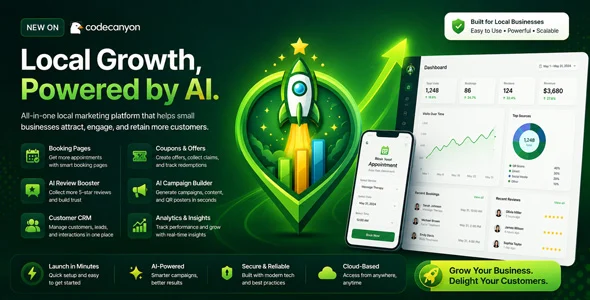
LocalBoost AI is a Laravel-based SaaS application, engineered for agencies and service providers to operate a self-hosted local marketing platform that consolidates review generation, appointment booking, coupon campaigns, feedback capture, and lead management. The codebase targets the operational bottleneck of juggling disconnected marketing tools by unifying business profiles, public campaign pages, QR distribution, and customer records inside a single MySQL-backed workspace system. In production workflows, it functions as a billable subscription product: administrators define plans, enforce per-plan usage limits, and onboard local business clients who each operate their own campaign stack under branded domains.
Technical Specifications & Deployment Matrix
| Engineering Metric | Deployment Specification |
|---|---|
| Base Framework | Laravel (MVC architecture) |
| Runtime Requirement | PHP 8.x server environment |
| Database / Persistence | MySQL 8.x, SQL schema included in package |
| Front-End Assets | JavaScript (JS/JSON), HTML, CSS, XML |
| Browser Compatibility | Chrome, Firefox, Safari, Edge, Opera |
| Delivery Model | Self-hosted SaaS with users, plans, limits, and admin controls |
| External Integrations | Configurable AI provider settings for content generation |
Review Routing & Campaign Execution Pipeline
Campaign data flows from public landing pages and QR scan destinations into business-scoped records, with each submission type routed to a dedicated management module.
Architectural & Functional Highlights
- Review Booster Routing Logic: Public review request pages collect a star rating first; high scores redirect the customer to public review platform links, while low-score feedback is captured privately with name, email, phone, and message fields before it reaches public channels.
- QR Design Studio: Each business profile carries its own QR print configuration—foreground, background, accent, and surface color controls, minimal/label/card frame styles, and optional logo embedding in the code center—exportable as PNG or SVG with scan tracking and dynamic destinations.
- Template Engine: A reusable template layer covers campaigns, landing pages, forms, and AI prompt presets, with JSON import/export, team sharing, public submission and approval workflows, ratings, and industry packs for restaurants, spas, clinics, gyms, retail, real estate, and auto service verticals.
- Custom Domain Layer: Branded domains attach to any customer-facing URL through a TXT verification record workflow with pending, verified, and failed states, plan-based domain limits, and admin-level availability control supporting white-label agency operations.
- Customer Record Synchronization: Submissions from leads, bookings, coupon claims, feedback, and reviews write into unified customer records with source attribution and duplicate prevention via phone and email matching.
Booking requests move through a defined status lifecycle—pending, confirmed, cancelled, and completed—giving owners a stateful queue rather than a flat inbox. Coupon campaigns operate on a claim-and-redemption model with expiry dates and claimed/used tracking, while lead forms record campaign intent and source for attribution reporting. For operators whose booking requirements are confined to a single marketplace vertical, Yate exists as an independent booking-platform implementation outside this multi-campaign architecture. Similarly, teams running WordPress storefronts that need only automated review solicitation can evaluate YITH WooCommerce Review Reminder Premium as a plugin-scoped alternative within that separate runtime.
Production Deployment & Implementation Considerations
Deployment requires a server provisioned with PHP 8.x and MySQL 8.x, plus the SQL schema shipped in the package. The AI Campaign Builder and Content Writer modules depend on AI provider settings configured in the admin panel; without that configuration, template generation and copy generation cannot execute, though all non-AI campaign tooling remains operational. Custom domain activation demands DNS access to publish the required TXT verification record and point the domain toward the correct server or application endpoint; propagation delays vary by provider, DNS cache, and hosting configuration, and SSL configuration is recommended so public campaign pages load over HTTPS. Plan-based constraints govern coupon campaign counts and custom domain availability, so capacity planning should map client tiers to those limits before onboarding. Customization operates through the Laravel MVC structure, the template engine’s import/export pipeline, and per-business brand settings—color variables, page titles, and landing page blocks—rather than code-level forks of the core modules.
Security Audit & VirusTotal Malware Verification
PHP ScriptsPre-deployment cloud scan •
e615b554a500e6783dc39eeeb7c5bffa56985539c4b142dc7c69a7f74fe6abae
Frequently Asked Questions
Does the booking module manage request states beyond initial submission?
Yes. Booking requests pass through pending, confirmed, cancelled, and completed states, and owners receive a business-level booking overview with submission tracking tied to each public booking page and QR destination.
Are QR codes exportable in vector format for print production?
Yes. The QR Design Studio exports both PNG and SVG, supports per-business color and frame styling with logo embedding in the code center, and includes a live preview before saving for use on flyers, menus, and table cards.
Is a working demo available to evaluate before installation?
Yes. A live demo is accessible with the published demo credentials, exposing the portal, business profiles, campaign pages, QR tools, analytics, and admin features. Demo data may be reset periodically.
Does the platform include subscription billing infrastructure for selling plans?
Yes. The SaaS layer ships with user management, plan definitions, usage limits, workspace-based administration, and monetization controls, allowing operators to package campaign tools as tiered subscriptions for local business clients.