Live Tv Android App
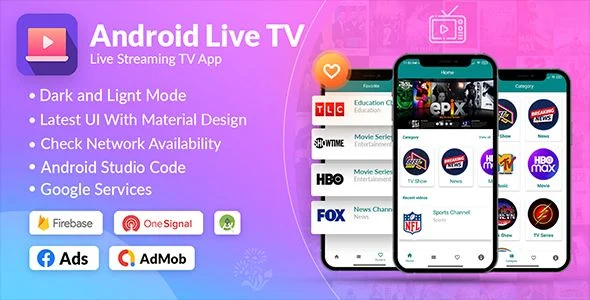
Live TV Android App Overview & Streaming Delivery Architecture
Live TV Android App is a Kotlin 1.x Android application template, engineered for solo developers and mobile agencies to deploy monetized live television streaming products on Google Play. The package eliminates the two hardest bottlenecks in IPTV-style delivery: multi-protocol stream ingestion and remote content administration, by pairing a native Android client with a server-side admin panel that publishes channels over REST-driven JSON payloads. In production workflows, it functions as a deployable foundation where channel catalogs, featured placements, and advertisement configurations are managed centrally, then consumed by the client without republishing the binary.
Technical Specifications & Deployment Matrix
| Engineering Metric | Deployment Specification |
|---|---|
| Base Technology / Framework | Kotlin 1.x native Android application |
| Runtime / Language Requirements | Android 9.0, 10.0, 11.0, and 12.0 |
| Data Exchange / Communication Protocols | m3u8, HLS, RTMP, RTSP; YouTube API, MP4, MKV, WebM, and embedded video sources |
| Front-End / Engine Dependencies | AdMob and Facebook Audience Network ad SDKs; OneSignal notification service; Chromecast casting |
| Database / Persistence Footprint | .db, .java, .xml, .apk, .dex sources with PHP/HTML/JavaScript admin panel and sample seed data |
Content Pipeline, Ad Mediation & Execution Flow
The architecture routes every media asset through the admin panel before it reaches the device. Channel records are created server-side, tagged as live or featured, and serialized into JSON that the Android client parses and binds into its navigation layers, home sliders, category views, and detail pages.
Playback dispatch is protocol-agnostic within the supported matrix. When a viewer selects a channel, the client resolves the stored source descriptor and hands it to the player engine, which negotiates m3u8/HLS segmented delivery, RTMP or RTSP socket streams, or direct MP4/MKV/WebM and embedded URLs. Cast operations mirror this resolution onto a big-screen receiver, so movies, TV series, and live channels can be projected without re-encoding the source. Channel ordering follows the last-uploaded timestamp, giving the home feed a predictable recency contract.
Monetization runs through a dual-network mediation layer. Banner, interstitial, and native placements can be toggled between AdMob and Facebook from the admin panel, which means inventory decisions happen at runtime rather than through a rebuild cycle. Notification delivery is handled by OneSignal, including TV series reminders and smart triggers that fire when user ratings diverge.
Architectural & Functional Highlights
- Onboarding Flow Modules: Splash, intro, and slide pages establish the entry sequence before the home screen renders, giving the client a controlled cold-start path that can be rebranded per deployment.
- Remote Ad Network Switching: Interstitial, banner, and native ad units for both AdMob and Facebook are driven from the admin panel, decoupling monetization configuration from the compiled APK.
- Rating-Triggered Feedback Loop: Ratings below three stars launch an in-app feedback prompt, while ratings above three stars redirect the user to the Google Play listing to complete the review, splitting sentiment capture from public review generation.
- Smart OneSignal Notifications: Push dispatch covers general messaging and TV series alerts, with conditional logic attached to in-app rating behavior so notification relevance tracks engagement signals.
- Cross-Format Playback Matrix: HLS, RTMP, RTSP, MKV, WebM, MP4, YouTube API, and embedded players are all supported within a single channel-detail pipeline.
Production Implementation & Operational Resilience
Deployment begins with importing the full Kotlin source into Android Studio, pointing the client at the admin panel endpoint, and configuring OneSignal and ad network identifiers. The admin panel ships as PHP, HTML, CSS, and JavaScript with sample seed data, so the first publish can be validated against known-good channel records before live m3u8 or RTSP sources are bound. A demo admin credential set (admin at gmail dot com / 12345678) is provided for evaluation of the control surface.
Operational boundaries worth planning around: the package does not include hosting, a live production server, or streaming content, so infrastructure provisioning and CDN or origin capacity for HLS and RTMP delivery remain the deployer’s responsibility. Because RTSP and RTMP depend on origin uptime, channel validation should be part of any staging checklist. The codebase targets Android 9 through 12, so new targetSdk obligations beyond that range require verification against the current Play Console requirements before store submission. Secondary development is structurally supported: the layered separation between admin-defined content and client-side rendering means new channels, categories, and featured slots can be pushed without touching the APK, while deeper feature changes demand source-level modification.
For studios evaluating parallel native Android deployments on the same delivery pattern, WebView Android News App With Admin Panel applies the same panel-driven content model to news distribution, and Android Online Stories App (Story Book, Admob with GDPR) demonstrates an equivalent AdMob-backed path with GDPR handling for content-reading use cases.
Frequently Asked Questions
Can advertisement placements be switched between AdMob and Facebook without rebuilding the APK?
Yes. Banner, interstitial, and native placements for both networks are governed from the admin panel, so ad inventory decisions are applied remotely instead of requiring a client recompile or a new store submission.
Does the package include hosting, a production server, or streaming channel data?
No. The deliverable contains full Android and admin panel source code with sample seed data only; hosting, live server infrastructure, and actual channel content must be provisioned separately by the deploying developer.
Does the client support casting live channels to a television screen?
Yes. Cast functionality covers movies, TV series, and live TV channels, projecting the selected stream to a big-screen receiver while reusing the same source resolution pipeline used for mobile playback.
Does the notification system react to in-app user ratings?
Yes. Smart notifications are triggered by rating behavior: scores below three stars open an in-app feedback prompt, while higher scores redirect the user to Google Play to finish the public rating.
6 App Template| Online Medicine Ordering App| Medicine Delivery App| Pharmacy eCommerce| Pharmazone
Digital Compass Live Weather – Digital Compass with Map – Live Location Weather – Geo Location App
4 App Template| Truck Delivery Booking | Truck Logistics | Delivery Management Solution | DeliTruck