LISTABLE – A Friendly Directory WordPress Theme
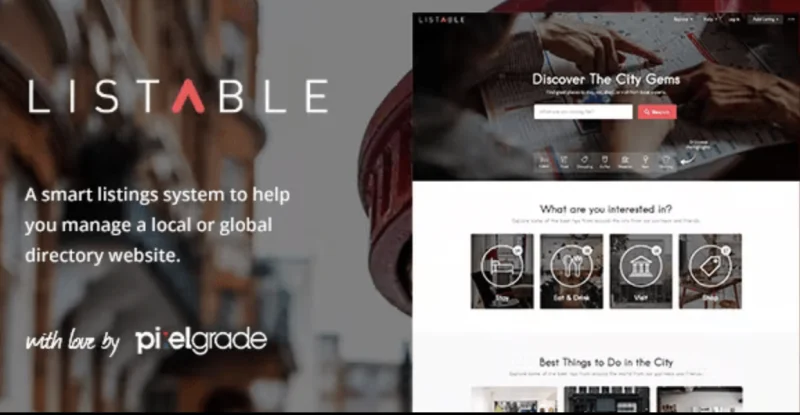
Listable Directory WordPress Theme Overview & Listing-First Architecture
Listable is a WordPress directory theme engineered for agencies, publishers, and independent operators to build, manage, and monetize location-based listing portals. The theme targets the central bottleneck of directory construction: unifying content presentation, front-end submission handling, faceted search, map-based discovery, and paid package sales inside one coherent template system instead of an improvised plugin stack. Within production delivery workflows it operates as the presentation and interaction layer for local city guides, real estate portals, and specialized service directories, pairing restrained typography and a spacious layout with WooCommerce as the underlying transaction engine.
Technical Specifications & Deployment Matrix
| Engineering Metric | Deployment Specification |
|---|---|
| Base Technology / Framework | WordPress theme built on the native template hierarchy, with listings rendered as first-class content objects |
| Runtime / Language Requirements | Standard WordPress hosting environment running a PHP / MySQL server stack |
| Data Exchange / Communication Protocols | WooCommerce commerce objects powering paid listing packages and recurring billing models |
| Front-End / Engine Dependencies | Drag-and-drop page builder support, front-end submission forms, interactive map components with marker clustering |
| Database / Persistence Footprint | Native WordPress content storage; no separate listing database engine is documented in the source package |
Listing Discovery Pipeline & Rendering Execution
Listable drives directory discovery through a filtering-and-map pipeline layered over the WordPress template hierarchy. When a request resolves to a listing collection, the theme renders archive views composed around typographic clarity and generous spacing, keeping each entry scannable at desktop and smartphone viewport widths alike. Faceted search then acts as the primary narrowing mechanism: visitors combine multiple criteria in a single query, and the result set contracts to matching listings without exposing the underlying data structure. Alongside the list view, the interactive map plots every listing as a geographic marker, and marker clustering consolidates dense geographic regions so directories carrying large location counts stay readable instead of degrading into overlapping pin noise.
Monetization runs through WooCommerce rather than a proprietary billing layer. The theme delegates checkout and recurring billing logic to WooCommerce commerce objects, letting operators define paid listing packages and recurring tiers as products while Listable handles their presentation and purchase flow. Listing owners never touch the WordPress admin to contribute content; a front-end submission form collects their entry data, keeping participation open to non-technical contributors and supporting community-driven growth. When a client deliverable expands beyond listings into physical product commerce on the same WooCommerce stack, Fitment illustrates the pattern with a dedicated Auto Parts Theme for Elementor WordPress WooCommerce built around catalog-driven storefronts.
Core Technical Capabilities of Listable
- Advanced Faceted Filtering: Multi-criteria search lets visitors intersect several attributes in one query, reducing result sets to exact matches and cutting the clicks required to reach a target listing.
- WooCommerce Monetization Layer: Paid listing packages and recurring tiers are defined as WooCommerce commerce objects, separating billing logic from theme presentation and enabling recurring revenue structures.
- Front-End Submission Pipeline: A form-based submission flow collects listing data outside the admin dashboard, lowering the technical barrier for owners and encouraging community participation at directory scale.
- Interactive Map with Marker Clustering: Geographic markers are clustered at high densities, preserving map readability for directories that scale to large numbers of locations.
- Customizable Listing Cards: Card composition can be adjusted so the fields most relevant to a given audience occupy priority positions in the rendered output.
Production Implementation & Operational Resilience
In staging and client deployments, the theme’s mobile-first layout model carries most of the responsive burden: the same content tree reflows across breakpoints, which matters operationally because directory traffic typically arrives from on-the-go smartphone sessions. Performance planning should account for the two heaviest rendering paths — map tile and marker payloads, and filtered result updates — and monitor their effect on Largest Contentful Paint and layout stability as listing volume grows. Because page builder support removes the need to edit PHP templates for layout changes, agencies can restructure archive and landing pages during QA cycles without forking theme files, keeping the upgrade path intact.
Customization boundaries follow from this architecture: visual recomposition happens in the builder, listing card field arrangement through the card controls, and monetization rules through WooCommerce product configuration. Operators comparing directory-specific presentation layers before committing to a build can also evaluate UrbanGo as an alternative Directory and Listing WordPress Theme oriented toward local data discovery.
For decoupled implementations outside the WordPress runtime, Bookinga exists as a standalone Django booking and directory template — an independent Python-stack codebase for reservation-driven listing sites, not a component that merges into a WordPress deployment.
Frequently Asked Questions
Is WooCommerce mandatory for running a Listable directory?
No. WooCommerce powers the monetization layer — paid listing packages and recurring billing — while listing presentation, faceted search, map rendering, and front-end submission operate through the theme itself, so unpaid community directories can run without it.
Does Listable support recurring paid listing models rather than only one-time packages?
Yes. The documented monetization model covers both one-off paid listing packages and recurring tiers, both defined through WooCommerce commerce objects that handle checkout and ongoing billing outside the theme layer.
Can Listable serve real estate listings as well as local business guides?
Yes. The reference use cases explicitly include real estate portals alongside local city guides and specialized service directories, and customizable listing cards allow field arrangements to match property data instead of business categories.
-
1.15.6 LatestOctober 1, 2026