Lifting Hero 3D Game Unity Source Code
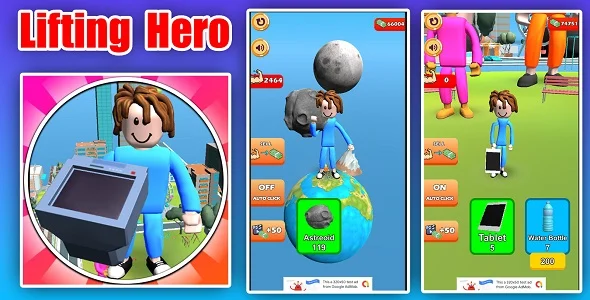
Lifting Hero 3D Game Unity Source Code Overview & Mobile Clicker Architecture
Lifting Hero 3D Game Unity Source Code is a Unity-engine casual game codebase engineered for indie publishers and mobile studios to deploy a gym-themed 3D clicker on Android. It removes the cost of prototyping an incremental lifting loop, monetization wiring, and 64-bit store compliance from scratch by shipping a playable project containing more than 60 liftable objects and pre-wired AdMob ad units. Within a production workflow, the package functions as a reskin-ready template: teams import the project into the Unity Editor, replace the layered art and audio, point the ad identifiers at their own account, and generate a publishable AAB.
Technical Specifications & Deployment Matrix
| Engineering Metric | Deployment Specification |
|---|---|
| Base Technology / Framework | Unity engine with C# gameplay scripts compiled through IL2CPP |
| Runtime / Deployment Targets | Android 9.0, 10.0, 11.0, and 12.0; ARMv64 (64-bit) AAB output |
| Monetization Layer | Google AdMob — banner, interstitial, and rewarded ad unit slots |
| Included Artifacts | .java, .dex, .dat, and .db files plus layered PNG graphics |
| Persistence Footprint | Local on-device storage via .dat / .db files; no external server backend required |
Incremental Lifting Loop & Execution Pipeline
The core loop converts rapid tap input into accumulated lifting progress and spendable muscle currency. Each tap advances the current lift; once a set completes, the muscle gained is sold, converting effort into in-game currency that unlocks heavier objects drawn from the 60+ item catalog. Because per-tap yield scales with the weight being lifted, the incremental curve keeps moving and produces natural pause points where interstitial and rewarded impressions can be scheduled without cutting off active input. The rewarded format ties directly into the economy, letting players accelerate gains in exchange for watching a video — a placement pattern common to the gym-clicker genre. For studios evaluating an additional Unity codebase in the adjacent hyper-casual category, Spikes Everywhere – Hyper Casual Unity Game exists as an independent project entirely outside this package.
On the build side, gameplay scripts are compiled through the IL2CPP backend into native ARMv64 machine code and packaged as an Android App Bundle, satisfying the 64-bit binary requirement enforced by Google Play. Progression tuning is exposed through editable graphs, meaning difficulty pacing and income curves can be adjusted as data rather than hardcoded constants, which shortens the iteration cycle during balancing passes.
Core Technical Capabilities of Lifting Hero 3D
- 60+ Item Progression Catalog: The sell-muscle / buy-heavier-object loop is driven by a large object catalog, giving the incremental economy depth and long retention arcs without additional content authoring.
- Triple-Format AdMob Monetization: Banner, interstitial, and rewarded unit types are wired into the project, with the rewarded slot feeding player acceleration — the highest-value placement in clicker economies.
- IL2CPP 64-Bit Build Path: The compilation pipeline targets ARMv64 and emits an AAB, aligning output with current store submission standards for Android 9 through 12 devices.
- Editable Curves & Reskin Surfaces: Progression behavior is tunable through exposed graphs, and graphics ship as layered PNG files, so visual rebranding proceeds without touching gameplay scripts.
Production Implementation & Operational Resilience
Deployment begins by importing the project into a Unity environment with Android Build Support installed, including the SDK and NDK toolchains required by the IL2CPP backend. From there, the workflow is configuration-driven: the AdMob application identifier and each ad unit ID are swapped to the studio’s own account values, the layered PNG assets and audio clips are replaced, and the bundled documentation walks through project setup alongside image and sound substitution. A release build is then signed with a keystore and exported as an ARMv64 AAB suitable for store upload.
Operational boundaries should be understood before committing resources. Persistence is local to the device through .dat and .db files, so server-side features such as cloud saves, leaderboards, or cross-device synchronization fall outside the shipped architecture and would require separate backend work. Monetization depends on an active AdMob account in good standing; ad calls will not return fill without valid unit identifiers, so staging builds should be verified against test ad units first. Quality assurance on physical hardware across the supported Android 9–12 range is advisable before release, since input latency and rendering behavior vary by device tier. For teams comparing genre options before allocating studio capacity, Cut To Get Star Unity Complete Project stands as a separate, decoupled mobile codebase following its own delivery path.
Frequently Asked Questions
Is a playable demo APK available for testing before buying the code?
Yes, the listing publishes a downloadable demo APK along with a demo video, allowing teams to evaluate the tap loop, visuals, and pacing on a physical Android device before committing engineering time to a build.
Does the game display correctly on tablet-sized screens as well as phones?
Yes, the project is optimized for both phone and tablet form factors, so UI scaling and 3D camera framing hold across screen sizes without maintaining separate layout branches or device-specific builds.
Can players mute audio during an active gameplay session?
Yes, a sound on/off button is built into the interface, letting players silence music and effects without exiting the session or requiring any changes to configuration values inside the project.
Is the deliverable a full Unity project rather than only a compiled binary?
Yes, the deliverable is the complete Unity source code rather than a locked or prebuilt binary, so scripts, scenes, and prefabs remain editable inside the Unity Editor after import, with documentation covering initial setup.