Lexend – Software/ SaaS Startup HTML5 Template
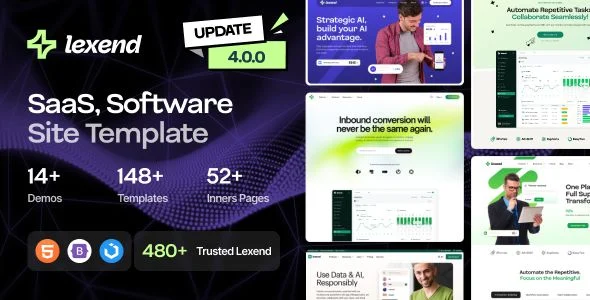
Lexend SaaS Startup HTML5 Template Overview & Front-End Foundation
Lexend SaaS Startup HTML5 Template is a multi-layout Bootstrap 5 static package, engineered for SaaS vendors, software studios, and digital agencies to ship conversion-focused marketing sites without a server-side stack. The codebase attacks the recurring bottleneck of SaaS launch pages — hero variants, pricing comparison tables, feature grids, and mega-menu navigation — by shipping fourteen prebuilt homepages plus ready-made service, shop, and blog pages as HTML, SCSS, and modular JS assets. Within agency delivery pipelines, the package operates as a pure presentation layer that any back-end team can later bind to an API or headless CMS, because every deliverable is framework-free markup compiled ahead of deployment.
Technical Specifications & Deployment Matrix
| Engineering Metric | Deployment Specification |
|---|---|
| Base Technology / Framework | Bootstrap 5.3.3, semantic HTML5, SCSS variable layers, vanilla JavaScript |
| Runtime / Build Requirements | Node.js required for the SRC development build; Vite replaces Gulp as of v4.0.0, with CLI arguments such as –minify and –lite |
| Deliverable Structure | Development SRC folder plus production-ready DIST folder, Unicons cheatsheet, and video installation/customization walkthroughs |
| Front-End Dependencies | UniCore in-house component library, Unicons icon set, PurgeCSS output optimization |
| Browser Compatibility | IE11, Chrome, Firefox, Safari, Opera, and Edge, with responsive and retina-ready rendering |
| Database / Persistence Footprint | None — static markup only; no server database or runtime storage engine |
Static Rendering Pipeline & Component Architecture
The package renders entirely client-side: a browser receives precompiled HTML from the DIST build, loads a PurgeCSS-optimized stylesheet, and hydrates interactive behavior through the in-house UniCore component library. Compilation starts in the SCSS layer, where design tokens in user-config.scss — colors, typography, breakpoints, and spacing scales — cascade into every component. The Vite pipeline then compiles, purges, and minifies output; the changelog documents the main stylesheet shrinking from a 4–6 MB raw build to roughly 130 KB after dead-selector elimination. That performance discipline is measurable: the author reports a Lighthouse performance score of 94 and SEO scores between 92 and 100 in the version history.
Directionality is handled at the utility level. Bootstrap classes were extended to support paired LTR/RTL declarations (for example, ltr:ms-2 paired with rtl:me-2), so a single markup tree renders correctly in either writing direction. Version 4.0.0 adds Arabic content for homepages 11 through 14, confirming the bidirectional engine works against real localized copy rather than placeholder strings. Theme state follows a three-way model: projects can pin dark or light as the default, or defer to the visitor’s operating-system preference, with the toggle synchronized across the DOM through CSS custom properties. A GDPR cookie popup ships as a prebuilt component, covering a common compliance gap before launch.
For delivery teams standardizing on WordPress page building instead of static markup, Saastify exists as a parallel Elementor kit covering the same SaaS vertical, and it runs on an entirely separate runtime that cannot share this codebase.
Architectural & Functional Highlights
- Fourteen-homepage section library: Each homepage composes from reusable sections, headers, footers, and mega-menu variants, letting teams assemble new landing pages by reordering markup blocks rather than rewriting them.
- PurgeCSS build stage: Unused selector stripping during the Vite build cuts the primary stylesheet to roughly 130 KB, directly reducing LCP-blocking bytes on first paint.
- Bidirectional RTL utility layer: Extended Bootstrap spacing and positioning classes emit both ltr: and rtl: variants, removing the need for a duplicated Arabic stylesheet.
- Theme-state and preloader controls: Dark/light default, system-preference detection, and an optional page preloader are toggled through documented configuration rather than source edits.
- Lite build variant: A stripped runtime ships alongside the full UniCore component set, giving high-traffic landing pages a lighter dependency graph.
Production Implementation & Operational Resilience
Deployment is split across two folders. The DIST output is drop-in ready for any static host or CDN — no Node.js runtime is needed in production. The SRC folder, by contrast, requires a current Node.js installation to run the Vite build, which is where all SCSS token overrides, section composition, and asset substitution should occur. Customization boundaries follow static-template conventions: style changes belong in user-config.scss variables, imagery is replaced file-for-file in the assets directories, and structural changes are made by duplicating and reordering existing section markup. Vendored assets (images from Freepik, brand logos from World Vector Logo) carry their own usage terms, so agencies swapping in client-owned graphics before handover is standard practice.
Because no server code executes, there are no database migrations, CORS headers, or cron routines to configure; resilience instead depends on build discipline. Running the Lite variant, keeping the PurgeCSS stage active through the –minify argument, and validating RTL output across both writing directions are the three checks worth institutionalizing before each client release.
When a SaaS engagement also requires an operator-facing dashboard, Karciz offers a parallel Bootstrap admin surface as an independent custom-code path, and for teams that prefer a full WordPress theme with equivalent SaaS flows, GeoBin operates as a separate PHP-based alternative outside this static stack.
Frequently Asked Questions
Does the download include both the development source and a deployable production build?
Yes. The package ships a SRC development folder that requires Node.js to run the Vite build, plus a DIST production folder containing precompiled files that can be uploaded directly to any static hosting environment without a build step.
Does the template work with Arabic content without extra setup?
Yes. Full RTL support is implemented through extended Bootstrap utility classes, and version 4.0.0 adds Arabic content for homepages 11 through 14, so bidirectional layouts can be verified against real localized copy rather than placeholder text.
Can dark mode be locked as the default instead of following the visitor’s system setting?
Yes. The configuration lets a project pin dark or light as the default appearance, defer to the user’s system preference, or expose a manual toggle, and the page preloader can be independently enabled or disabled.