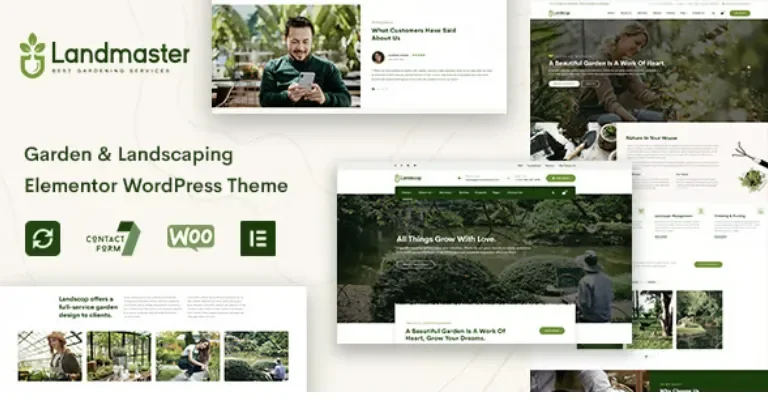
Landmaster – Garden & Landscaping WordPress Theme
Landmaster Garden & Landscaping WordPress Theme Overview & Front-End Delivery Architecture
Landmaster Garden & Landscaping WordPress Theme is an HTML5/CSS3/PHP WordPress theme engineered for landscaping agencies, lawn service operators, florists, groundskeepers, and agriculture retailers to publish service catalogs, project galleries, and plant shop storefronts from a single install. The package targets the recurring agency bottleneck of assembling page structures manually by shipping three homepage layouts and more than ninety UI blocks that compose through a drag-and-drop Elementor editing layer. In production workflows it operates as the front-end delivery layer, with a one-click demo importer seeding pages, sliders, menus, and shop structures so a client build reaches a reviewable state within minutes.
Technical Specifications & Deployment Matrix
| Engineering Metric | Deployment Specification |
|---|---|
| Base Technology / Framework | WordPress theme built on HTML5, CSS3, and Bootstrap 4.x / 5.x grid utilities |
| Runtime / Language Requirements | PHP with MySQL via WordPress core; v3.2 declares explicit “Tested up to” and “Requires PHP” headers in style.css |
| Data Exchange / Communication Protocols | Native WordPress template hierarchy rendering, AJAX-driven Customizer preview, Contact Form 7 submission handling, Google Maps embedding |
| Front-End / Engine Dependencies | Elementor (free), Revolution Slider, WooCommerce 5.x through 9.x, FontAwesome, 700+ Google Fonts |
| Database / Persistence Footprint | Standard WordPress schema (posts, options, widgets); theme options persisted through a Redux Framework-driven panel |
Template Hierarchy, Elementor Pipeline & Layout Composition
The rendering pipeline routes every inbound request through the standard WordPress template hierarchy, where packaged templates for services, projects, team, shop, and blog archives override native core defaults. Once the matching template resolves, content assembly is delegated to the Elementor engine, which stores layout definitions as structured data and outputs them as visually editable DOM sections, so agencies reposition hero blocks, galleries, and service grids without editing PHP files directly. Visual state synchronizes through the WordPress Customizer, where hundreds of settings render with live preview; version 1.0.3 migrated this panel onto the Redux Framework for structured option persistence covering color schemes, header and footer variants, and Google Fonts typography.
Media behavior executes at the asset layer: parallax and video backgrounds apply per section, masonry layouts compute column flow client-side, and carousel elements manage their own scroll loops. Cross-browser output targets IE11, Firefox, Safari, Opera, Chrome, and Edge, with the layout remaining responsive and retina-ready at the viewport level.
Architectural & Functional Highlights
- One-Click Demo Importer: transfers pages, posts, slider configurations, menus, and widget assignments in a single batch operation, then automatically enables Font Awesome 4 support so icon rendering matches the imported demo markup.
- Elementor Composition Layer: three homepage layouts and 90+ UI blocks function as reusable section fragments that can be cloned, reordered, and restyled inside the free Elementor editor, reducing rebuild effort to block-level operations.
- WooCommerce Commerce Layer: shop and product templates wire directly to WooCommerce 5.x through 9.x, including a dedicated single-product sidebar introduced in the 1.0.4 update and widget areas mapped to storefront regions.
- Real-Time Customizer & Redux Options: header and footer layout switching, color assignments, and typography changes apply in the live preview without page reloads, with all values persisted through the Redux-driven options schema.
- Form & Map Integration: Contact Form 7 handles inquiry submission, including the header contact popup added in v1.0.1, while Google Maps blocks render service-area locations within standard page sections.
For content-heavy archives, adding Blog Post Accordion Addon For Elementor extends the post-rendering layer with collapsible blog and FAQ displays that consume the same Elementor container model already powering the theme’s blog layouts.
Production Implementation & Operational Resilience
For agency staging environments, allocate sufficient PHP memory before running the demo importer, since it transfers media libraries, slider data, and widget assignments in one batch; an import that fails from memory exhaustion typically completes after raising the memory limit and re-running the operation. The v3.2 release tightened deployment hygiene by adding “Tested up to” and “Requires PHP” declarations to style.css and clearing “Requires” issues flagged by Envato Theme Check 2.0, which reduces activation friction on stricter hosting stacks.
Plugin coupling forms the primary maintenance surface. The changelog records corrective patches after WooCommerce and Newsletter plugin updates altered expected markup, and the demo data endpoint moved to a new server in v3.0, so re-imports on older theme revisions should occur only after updating the package. Customization follows standard WordPress extension paths: child themes preserve template overrides across updates, and the included CSS and JS files accept targeted patches without modifying core layout logic. For studios evaluating an independent codebase in the same vertical, Gerdnx Gardening And Landscaping WordPress Theme exists as a separate standalone option for lawn care, florist, and agriculture builds.
Frequently Asked Questions
Is the paid version of Elementor required to build or edit pages?
No, the theme runs on the free Elementor plugin, which the documentation lists as its bundled page builder engine; all homepage layouts and UI blocks compose within the free version’s editor without a commercial license dependency.
Does the package ship with demo content and the Revolution Slider plugin?
Yes, demo content is included and installed through the one-click importer, and Revolution Slider ships alongside the theme files; changelog entries across multiple versions confirm continual sample demo data regeneration.
Can pages be edited with the Gutenberg block editor instead of Elementor?
Yes, the theme is documented as Gutenberg-optimized, so the native block editor remains functional for posts and pages; the prebuilt homepage layouts and UI blocks, however, are authored and maintained in Elementor.
-
1.2 LatestSeptember 27, 2026