Labout – Laboratory & Research React Next Js Template
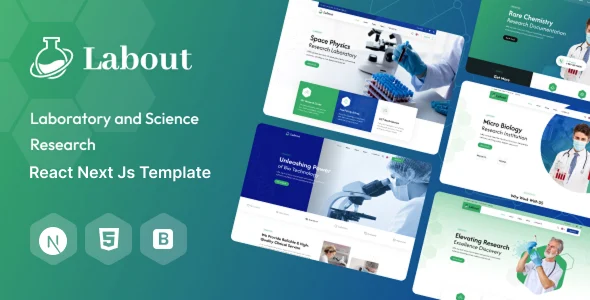
Labout: Technical Overview & Core Architecture
Labout – Laboratory & Research React Next Js Template functions as a modular React/Next.js frontend template, specifically engineered for researchers, scientific institutions, and educational bodies requiring a robust web presence. The template’s internal architecture leverages Next.js automatic code splitting and server-side rendering (SSR) capabilities, minimizing initial load times and reducing DOM overhead during high-density content presentation. Asynchronous data fetching is implemented using `getServerSideProps` or `getStaticProps` for pre-rendering, ensuring UI states update efficiently without requiring client-side re-requests for static content.
Component assembly integrates React’s declarative UI paradigm with Next.js’s file-system routing, enabling developers to construct modular page layouts and features seamlessly. The template’s configuration settings are managed via `.env` files and `next.config.js`, allowing for customization of API endpoints, routing prefixes, image optimization loaders, and environment-specific variables without direct modification of the core source code.
Key Functional Features of Labout for Modern Deployments
- Server-Side Rendering (SSR) & Static Site Generation (SSG): The template utilizes Next.js SSR and SSG for optimal performance, rendering pages on the server or pre-building them at compile time, which significantly improves initial page load speed and SEO crawlability.
- Component-Based Architecture: It implements a component-based structure, allowing for reusable UI elements across the application, which streamlines development and ensures consistent design patterns. Each component maintains its own state and lifecycle, enhancing modularity.
- Optimized Image Handling: The template integrates Next.js Image component for automatic image optimization, including lazy loading, responsive sizing, and modern format conversion (e.g., WebP), reducing bandwidth consumption and improving Core Web Vitals.
- API Route Integration: Labout provides pre-configured Next.js API routes, enabling seamless backend integration for data fetching, form submissions, or custom serverless functions directly within the Next.js framework. This simplifies full-stack development workflows.
- Responsive Design Implementation: The template’s CSS framework is built with mobile-first principles, employing sub-pixel responsive media queries and fluid layouts to ensure consistent UI presentation across diverse screen sizes and devices.
Real-World Deployment Scenarios
- Academic Research Portal: A university department deploys Labout to host research papers, team profiles, and project updates, benefiting from the template’s structured content presentation and efficient data fetching for academic publications.
- Biotechnology Startup Website: A new biotechnology firm uses the template to showcase their services, scientific methodologies, and laboratory facilities, leveraging its clean design and technical capacity for detailed information display.
- Medical Diagnostic Center Information Hub: A diagnostic center implements the template for patient information, service listings, and online appointment scheduling integration, utilizing its robust architecture for high availability and secure content delivery.
Technical Architecture & Compatibility Standards
The Labout template operates within a modern JavaScript ecosystem, requiring Node.js 16.x or higher for local development and deployment. It leverages React 18.x for declarative UI and Next.js 14.x for its full-stack capabilities, including routing, data fetching, and API routes. Styling is managed through modular CSS or a utility-first CSS framework like Tailwind CSS, ensuring pure and maintainable stylesheets.
Performance benchmarks indicate strong Core Web Vitals scores, with First Contentful Paint (FCP) typically under 1.5 seconds and Layout Shift (CLS) near zero, thanks to Next.js’s optimized rendering pipeline and image handling. The template is designed for interoperability with external RESTful or GraphQL APIs for dynamic content, and it supports deployment on platforms like Vercel, Netlify, or self-hosted environments.
Frequently Asked Questions
How does the template handle dynamic content fetching for a laboratory’s publications?
The template utilizes Next.js data fetching methods like `getServerSideProps` or client-side `SWR` hooks to retrieve publication data from a configured API endpoint, ensuring content is updated without full page reloads.
Is Labout compatible with different content management systems for backend data?
Labout functions as a frontend React/Next.js application, making it compatible with any headless CMS (e.g., Strapi, Contentful, WordPress REST API) that exposes its data via a RESTful or GraphQL API.
Can the template’s color scheme and typography be customized without modifying core files?
Yes, the template’s styling is structured to allow extensive customization of color schemes, typography, and component styles through configuration files or CSS variables, maintaining the integrity of the core codebase.