Konsultan Kit – Consulting Business Elementor Template Kit
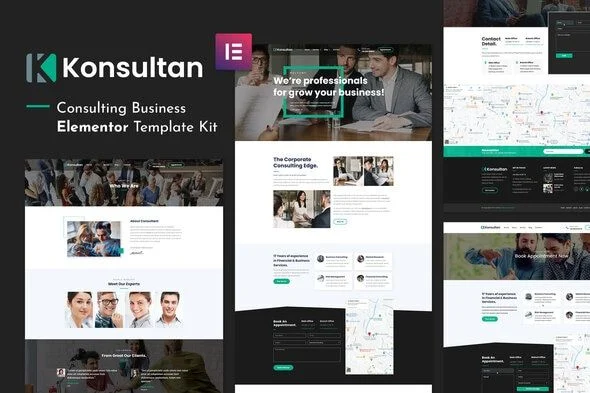
Konsultan Kit Overview & Consulting Layout Delivery Architecture
Konsultan Kit is an Elementor Template Kit engineered for consulting agencies and freelance web studios to deploy business consulting, financial advisory, and insurance websites without assembling page layouts from a blank canvas. The package resolves the structural bottleneck of hand-building every consulting deliverable — service grids, appointment funnels, blog archives, and error states — by supplying pre-composed layouts that load directly into the Elementor editor. Within production agency workflows, it functions as a drop-in layout library covering thirteen distinct page contexts, spanning landing pages through single-service detail views and 404 fallbacks.
Technical Specifications & Deployment Matrix
| Engineering Metric | Deployment Specification |
|---|---|
| Base Technology / Framework | Elementor page builder platform, WordPress 5.0 ready |
| Engine Compatibility Range | Elementor 2.8.x, 2.9.x, and 3.0.x |
| Required Premium Dependency | Elementor Pro (mandatory for the full feature set) |
| Import Channel | Envato Elements plugin, via Elements > Installed Kits upload (archive kept zipped) |
| Data Exchange Format | Pre-composed JSON layout structures parsed by the Elementor editor |
| Persistence Footprint | No dedicated database layer; layouts are stored as Elementor page data within WordPress |
JSON Template Pipeline & Consulting Page Composition
The kit operates entirely through Elementor’s template import pipeline: a zipped archive is uploaded, its component layouts are parsed by the builder, and each page is rendered through the editor’s visual container engine. No server-side scripting knowledge is required at any stage. Deployment begins with installing the Envato Elements plugin from the Plugins screen, after which the archive is uploaded through the Installed Kits screen without unzipping. Before any individual layout is pulled in, the Install Requirements control must be triggered so the dependent plugin set — including Elementor Pro — is active and the imported structures resolve correctly at render time.
Composition-wise, the package distributes thirteen templates across the full consulting information architecture: two header variants, one footer, a home page, an about page, a services index, a single-service detail page, a blog index, a single post, a contact page, an appointment booking page, a blog archive, and a 404 page. Because every layout carries its own set of editor controls, global typography and color tokens propagate across the set, letting a single design-token adjustment re-skin the entire site without opening each page individually. The same import pipeline governs kits across adjacent verticals; for automotive service clients on the same stack, CarQue follows an identical upload and requirements-activation sequence as a parallel Elementor kit deliverable.
Core Technical Capabilities of Konsultan Kit
- Thirteen-template page architecture: A complete consulting site map — headers, footer, home, about, services, single service, blog, single post, contact, appointment, archive, and 404 — arrives pre-wired, eliminating blank-canvas composition for each route.
- Global design token layer: Shared color and typography variables flow through every layout, so brand adjustments propagate site-wide from the Elementor site settings rather than requiring per-section edits.
- Responsive viewport adaptation: Each layout adapts its container structure across device widths, removing the need to rebuild separate mobile compositions for consulting traffic on handheld devices.
- Per-template control exposure: Every imported page exposes its own editor controls, meaning content, spacing, and media can be re-bound to client data without touching external stylesheets or code files.
Production Implementation & Operational Resilience
For agency staging environments, the primary operational constraint is import discipline: the documentation specifies uploading one template at a time, since batching multiple imports in a single pass can destabilize the layout-parsing sequence and produce incomplete page structures. Memory headroom matters as well — Elementor kit imports on hosting plans running a low wp_memory_limit can fail mid-parse, so raising the limit before a full site build is a sound pre-deployment step. The builder compatibility window spans Elementor 2.8.x through 3.0.x, which gives projects on slightly older builder versions a workable target while still requiring the Pro license for the complete feature set, including the header and footer rendering path.
Customization boundaries are deliberately confined to the visual editor. Because the deliverable is a layout kit rather than a coded theme, all styling overrides occur through the builder’s control surfaces and global tokens — there is no template file tree to fork. Asset boundaries are equally explicit: the demo imagery shipped in the kit and its preview site is commercially licensed through Envato Elements, so production deployments must either license those images or substitute original media before go-live. For consulting firms weighing a theme-first route where header, footer, and template logic ship inside a single WordPress package rather than a builder-dependent kit, Leroux exists as an independent alternative operating outside the Elementor import workflow entirely.
Frequently Asked Questions
Can multiple templates be imported into WordPress at the same time?
No, the documented import procedure advises against importing more than one template per pass. Sequential uploads through the Installed Kits screen keep each layout’s requirements check and parse cycle isolated, which prevents partially rendered structures from reaching the editor.
Are the demo images included in the kit free to publish on a client site?
No, all demo images used in the kit and its preview site are commercially licensed through Envato Elements. Production sites must license those assets through a subscription or replace them with original imagery before deployment to avoid copyright exposure.
Is the archive file unzipped before uploading to WordPress?
No, the kit archive is uploaded in its zipped state via the Envato Elements plugin under Elements > Installed Kits. Extracting it beforehand breaks the expected upload flow and prevents the builder from registering the contained template layouts correctly.