Knight Shot
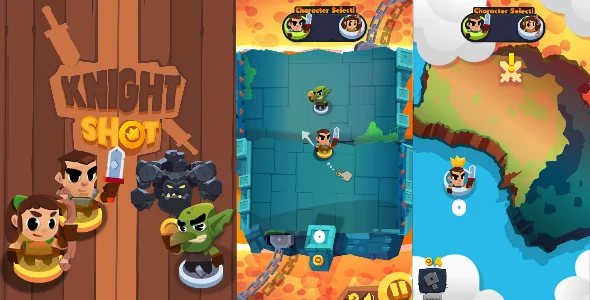
Knight Shot Overview & HTML5 Arcade Action Template Architecture
Knight Shot is a Construct 2 fantasy action game template, engineered for HTML5 developers and mobile game publishers to ship an aim-and-release arcade experience across desktop browsers and native app stores. The package removes the arcade prototyping bottleneck by supplying a fully commented .capx project file, bundled sound assets, and quick-start documentation inside a single distributable. Within agency and indie delivery workflows, it operates as a reskinnable foundation that carries a title from asset replacement through to a monetized, store-ready build.
Technical Specifications & Deployment Matrix
| Engineering Metric | Deployment Specification |
|---|---|
| Base Technology / Framework | Construct 2 game engine, editable .capx project format, documented under the Construct 3 software version class |
| Runtime / Language Requirements | HTML5 Canvas runtime; JavaScript JS and HTML files included in the package |
| Input Protocols | Unified mouse and touch pointer event abstraction covering desktop and mobile screens |
| Rendering Resolution | Full HD 1080×1920 portrait canvas output |
| Persistence / Monetization Footprint | Client-side only; no server database dependency; AdMob-ready integration points |
Aim-and-Release Combat Loop & Construct Event Pipeline
Knight Shot runs an aim, drag, and release combat loop dispatched through Construct 2’s event sheet architecture. Each session starts when the runtime preloads sprite, layout, and audio assets into the HTML5 Canvas before the first frame renders. Player input arrives as unified pointer events: a press-and-drag gesture defines the launch vector, and the release event applies the corresponding velocity to the knight sprite. The collision matrix then routes every impact — monster contacts trigger damage and destruction events, while gold pickups increment a global counter that feeds the shrine-rebuild progression state. Because each rule lives in a commented event sheet rather than raw source code, designers can re-balance launch physics, enemy health, and reward values directly inside the Construct editor without touching JavaScript. Studios scaling an arcade portfolio along the same event-sheet authoring model can pair this project with Ninja Fruit Slice, whose Construct 3 structure applies a comparable gesture-driven interaction pattern for swipe mechanics.
Core Technical Capabilities of Knight Shot
- Commented .capx source project: The full Construct 2 project ships with inline comments on every event sheet, shortening onboarding time and letting secondary developers trace collision logic, scoring rules, and progression states without reverse-engineering exported code.
- Multi-platform export path: The template compiles to HTML5 for desktop browsers and wraps into native Android and iOS builds through Cordova-based packaging, letting one codebase serve web portals and app stores simultaneously.
- AdMob-ready monetization layer: Advertising hooks are prepared inside the project structure, so developers only need to attach publisher identifiers and the ad plugin configuration during the mobile build to activate banner or interstitial placements.
- Unified mouse/touch input abstraction: A single input layer maps both mouse gestures and native touch events to the same aim-and-release handlers, eliminating per-platform control branching.
- 1080×1920 Full HD asset pipeline: High-resolution sprite and layout assets are wired into the project, supporting crisp rendering on modern portrait mobile displays while scaling down through CSS viewport fitting.
Production Implementation & Operational Resilience
In production deployment, the exported HTML5 build drops into any static hosting target, while mobile distribution routes through a Cordova WebView wrapper where the AdMob plugin binds to native ad SDKs. Browser coverage is documented from IE9 through IE11 plus Firefox, Safari, Opera, Chrome, and Edge, since the runtime targets the HTML5 Canvas API with broad legacy support — a relevant threshold for portal traffic still running older enterprise browsers. Audio playback must be unlocked by the first user interaction, as mobile browsers block automatic sound context activation; the touch-first control scheme naturally satisfies this policy on the opening tap. The 1080×1920 portrait canvas scales responsively through viewport fitting, so no media query layer is required for handset adaptation. Error handling stays client-side: because the game holds no server database or network persistence, failures reduce to asset-load verification, which the Construct loader addresses during the preloading phase. Customization boundaries are well defined — teams replace sprite sheets, audio files, and event-sheet values, but any server-side logic, leaderboards, or account systems sit outside the template scope and require separate integration. Teams assembling a multi-title arcade catalog under one delivery pipeline can combine this build with Starship Bullet, which extends the same Construct-to-HTML5 deployment pattern into a retro shooter format.
Frequently Asked Questions
Does the download include the editable .capx project file?
Yes, the package contains the complete Construct 2 project alongside the exported JavaScript and HTML files, so every event sheet, layout, and audio asset can be opened and modified directly inside the Construct editor.
Is prior programming knowledge required to customize the gameplay?
No, all game logic is authored through Construct’s visual event system, meaning level layout, launch physics, and artwork are adjusted via editor property panels rather than by editing the underlying JavaScript source.
Can Knight Shot be exported to both Android and iOS app stores?
Yes, the template is structured for Cordova-based wrapping, letting developers compile the HTML5 output into native mobile builds once the required platform SDKs, signing certificates, and store account configurations are in place.
Does the template include prepared advertising integration points?
Yes, AdMob hooks are prepared within the project structure, requiring only publisher identifiers and plugin configuration during the mobile build process to activate banner or interstitial placements across sessions.
Will the game run in older browsers such as Internet Explorer 9?
Yes, compatibility is documented from IE9 through IE11 and extends across Firefox, Safari, Opera, Chrome, and Edge, since the runtime targets the HTML5 Canvas API with broad legacy rendering support.