Kintamani – Dog Breeder & Adoption Elementor Template Kit
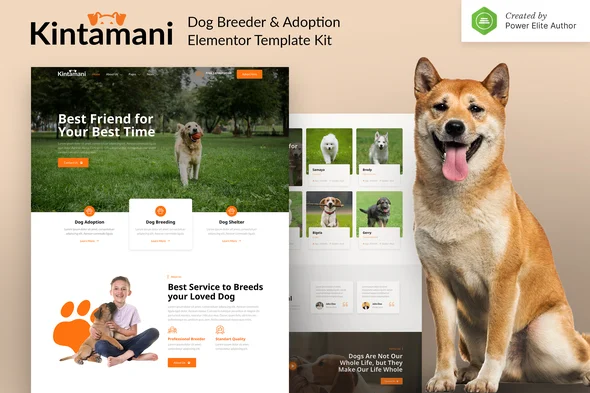
Kintamani Dog Breeder & Adoption Template Kit Overview & Layout Delivery Engine
Kintamani Dog Breeder & Adoption Elementor Template Kit is a WordPress page-building asset, engineered for dog breeders, kennel operators, and animal rescue agencies to launch an adoption-focused website without authoring custom layouts from a blank canvas. The package resolves the structural bottleneck of assembling breeder, dog-list, and adoption-request pages one section at a time by supplying 16+ pre-structured templates as importable layout objects. Within agency delivery, it functions as a rapid staging deliverable: import the archive, bind global styles, replace demo content, and hand a production-shaped site to the client.
Technical Specifications & Deployment Matrix
| Engineering Metric | Deployment Specification |
|---|---|
| Base Framework | Elementor page builder, validated on 3.4.x, 3.5.x, and 3.6.x |
| Runtime Requirements | WordPress environment with the Template Kit Import plugin active during installation |
| Data Exchange | Compressed kit archive uploaded via Elements > Installed Kits; no manual extraction |
| Engine Dependencies | Elementor (free tier), Jeg Elementor Kit, Elementor – Header, Footer & Blocks, Metform — Elementor Pro not required |
| Persistence Footprint | Layouts stored as editable Elementor page data; no dedicated database layer ships with the kit |
Template Import Pipeline & Layout Execution Flow
The kit executes page delivery through a JSON-based import pipeline rather than theme-level file rendering. After the Template Kit Import plugin is activated from Plugins > Add New, each inbound template is parsed, validated against the running Elementor version, checked for widget dependencies, and materialized as an editable container tree inside the editor.
A global token layer sits above the page layouts. The Global Theme Style template centralizes typography and color definitions, so a single token adjustment propagates across every imported page rather than requiring per-section edits. Header and footer chrome routes through a separate module: a new header record is created under ElementsKit > Header Footer, toggled to Entire Site activation, and populated from the imported template — overriding the active theme’s default output. Form capture follows its own sequence: the Metform block is imported first, then the page containing the Metform widget is opened, the widget is located through the Navigator, and the form is inserted from the widget’s template browser before the page is updated.
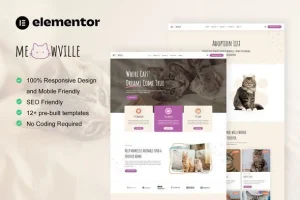
Feline-focused shelters running the identical import pipeline can adopt MeowVille as a parallel Elementor deliverable, since both kits share the same dependency stack and transfer mechanics, which keeps agency onboarding consistent across animal-care verticals.
Core Technical Capabilities of Kintamani
- 16+ pre-structured templates: Home, About Us, Service, Dog List, Dog Profile, Breeder, News, Single News, 404, FAQ, Contact Us, and form/chrome components cover the full breeding and adoption information architecture out of the box.
- Global design token layer: the Global Theme Style template stores site-wide typography and color values, letting one edit retokenize every page without touching individual widgets.
- Metform adoption capture: two dedicated form blocks — Contact Form and Request Adoption — handle visitor submissions through the free Metform engine, removing any paid form dependency from the stack.
- Free-plugin dependency chain: the entire kit operates on Elementor free, Jeg Elementor Kit, ElementsKit Header/Footer & Blocks, and Metform, keeping the runtime cost surface at zero beyond WordPress hosting.
- Responsive and retina output: layouts render fluidly across viewports with retina-scaled imagery, verified against Chrome, Firefox, Safari, and Opera rendering engines.
Production Implementation & Operational Resilience
Deployment in client staging follows a deterministic sequence: activate the required plugin set, upload the untouched archive through the kit importer, and click the Install Requirements button before any template transfer. The documentation specifies single-template imports; batching multiple layouts in one operation raises the risk of partial writes and widget dependency mismatches, so agencies delivering under deadline pressure should schedule imports sequentially and verify each page in the editor before proceeding to the next.
Server headroom matters during import. Kit parsing allocates memory to deserialize layout structures and register widget mappings, and hosts running with a low wp_memory_limit value can abort the operation mid-transfer; a 256M floor is the practical threshold for reliable imports on shared staging environments. Once an import fails, the recovery path is simply re-running the single template upload after confirming the dependency plugins are active.
For operators building adoption platforms outside the WordPress runtime, Pet-Pix Pet Adoption React Native Expo App exists as an independent mobile-native path with Figma design files for iOS and Android — it is a separate deliverable, not a component that merges into this kit’s architecture.
Post-import, resilience is maintained through revision awareness: version 1.0.1 patched the service page template after the initial 1.0.0 release, so confirming the archive revision before handover prevents shipping the earlier layout. Customization boundaries stay inside the Elementor editor — global styles govern token propagation, containers can be reordered or duplicated, and every section remains editable through the native widget panel.
Frequently Asked Questions
Does this kit require Elementor Pro to function?
No. The documented dependency chain consists of the free Elementor build alongside Jeg Elementor Kit, ElementsKit Header, Footer & Blocks, and Metform, so the entire template set imports and renders without any paid page-builder tier.
Can multiple templates be imported in a single operation?
No. The installation guidance explicitly advises against importing more than one template at a time, recommending sequential uploads so each layout’s widget dependencies resolve cleanly and no partial page data is written.
Are the demo images licensed for production use?
No. The kit references demo images sourced from Envato Elements, and those assets must be separately licensed or replaced with your own imagery before the site goes live, since the purchase covers layout structures only.