Kingmaker Academy – Roguelike Deckbuilder – Construct 3 – Mobile/Desktop/HTML5 Game
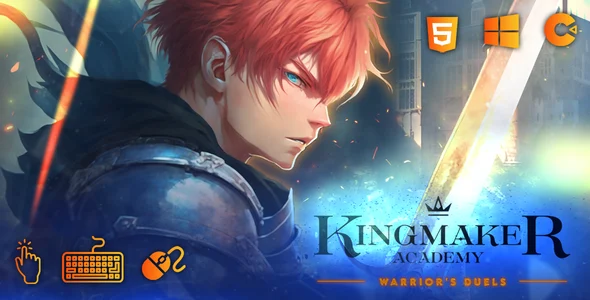
Kingmaker Academy Overview & Duel-Driven Roguelike Card Engine
Kingmaker Academy is a Construct 3 roguelike deckbuilder engineered for game studios and indie publishers to ship a turn-based card battler across HTML5 browsers, desktop builds, and mobile devices. The package resolves the production bottleneck of building replayable, run-based card systems from scratch by supplying a complete editable source project with pre-wired 1v1 duel logic, upgrade paths, and ability variance. Within an agency delivery pipeline, it operates as a deployable game foundation that can be reskinned, modified, and exported to distribution channels without starting engine work at zero.
Technical Specifications & Deployment Matrix
| Engineering Metric | Deployment Specification |
|---|---|
| Base Technology / Framework | Construct 3 event-sheet engine; source delivered as an editable .c3p project file |
| Runtime / Language Requirements | JavaScript, JSON, HTML, and CSS output executing in any HTML5-capable browser, including Chrome, Edge, Firefox, Safari, Opera, and listed legacy Internet Explorer releases |
| Input Protocols | Dual control schemes: touch gestures for mobile, keyboard and mouse for desktop, mapped to a shared command layer |
| Front-End / Engine Dependencies | Self-contained Construct runtime export; no external engine libraries or third-party frameworks required at runtime |
| Data / Persistence Footprint | Fully client-side execution with no server-side database, backend endpoint, or authenticated session dependency |
| Monetization Surface | In-App Purchase capability exposed through Construct 3 tooling; concrete purchase flows are not bundled in the source |
Card Duel Execution Pipeline & Roguelike Build Systems
The core runtime resolves every encounter as a 1v1 card duel orchestrated entirely through Construct 3 event sheets. Player actions — card selection, ability activation, and upgrade decisions — are dispatched as engine events that the event sheets evaluate against the current duel state before the rendering layer commits the resulting animations to the HTML5 canvas. Because each mechanic lives in organized, labeled event groups rather than opaque script fragments, a developer can trace how a card resolves damage or how an upgrade modifies a value without reverse-engineering compiled output.
Roguelike replayability is driven by run-level variance. Each playthrough assembles a different build from the available upgrade and ability pool, so consecutive runs resolve through divergent card combinations rather than a fixed difficulty curve. Defeat resets the loop while retained knowledge of build synergies shapes the next attempt — the structural pattern behind the genre’s long-session retention profile. For teams that also need short-session engagement mechanics outside this run-based structure, Fortune Wheel exists as an independent Construct 3 title that ships separately from this codebase.
Architectural & Functional Highlights
- Event-Sheet Duel Engine: All combat resolution is authored in structured Construct event groups, keeping duel logic auditable and modifiable independently of the rendering layer, which shortens the debugging cycle when adjusting card behavior.
- Run-Based Upgrade Variance: The upgrade and ability pool generates divergent builds per run, producing the replayability documented for the title without requiring additional content authoring.
- Dual-Input Abstraction: Touch and keyboard/mouse inputs feed a single command layer, so one project export serves both mobile Webview contexts and desktop browser sessions without input-code forking.
- Isolated Art Layer: Original game art assets are stored as replaceable project objects, allowing a visual reskin to proceed through sprite and imagery substitution while the event-sheet logic remains untouched.
Production Implementation & Operational Resilience
Deployment begins with the included HTML5 export: the JavaScript, JSON, HTML, and CSS files run from any static host and render across the documented browser matrix. The same project routes through Construct 3’s build pipeline for store-ready outputs — native mobile containers for Play Store distribution and desktop executables for PC storefronts — without a code fork, since input handling already abstracts touch and pointer hardware. Operationally, the codebase carries zero server-side dependencies: no database writes, no authenticated endpoints, no session backends. The complete game state machine executes client-side in the browser, which removes CORS configuration, backend provisioning, and database maintenance from the deployment checklist.
Two boundaries deserve attention before production submission. First, In-App Purchase APIs are reachable through Construct 3’s monetization tooling, but the concrete implementations are intentionally excluded from the delivered source — studios must wire their own product catalogs and store credentials before submitting monetized builds. Second, secondary development is expected to occur inside the event sheets: the code is documented as organized and cleaned for modification, so extending card pools, adjusting duel parameters, or rebalancing upgrades happens at the event level rather than through injected external scripts. For client sites that need a lighter interactive touchpoint instead of a full roguelike loop, Change Word stands as a standalone HTML5 puzzle title operating entirely outside this engine.
Frequently Asked Questions
Does the source project open in Construct 2 as well as Construct 3?
Yes, the project is documented as compatible with both Construct 2 and Construct 3, so teams maintaining a legacy Construct 2 pipeline can still open, edit, and re-export the event sheets without being forced into an editor migration first.
Are In-App Purchase implementations bundled in the delivered source code?
No, the package supports In-App Purchases through Construct 3’s monetization capabilities, but the concrete purchase flows are not included in the source. Studios must implement their own product configuration before submitting monetized builds to app stores.
Does the package include developer documentation alongside the source files?
Yes, the deliverables include a documentation file covering setup and modification procedures, bundled with the .c3p source project and the exported HTML5 build files, so onboarding a new developer does not depend on external guides.
Is the game ready for direct store publication after acquisition?
Yes, the product is documented as ready to publish and exportable to mobile and desktop targets through the Construct 3 build pipeline, provided teams supply their own store listing assets and monetization configuration where applicable.