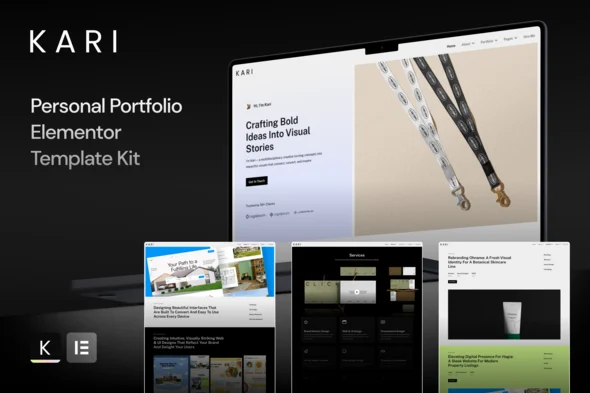
Kari – Personal Portfolio Elementor Template Kit
Kari Personal Portfolio Template Kit Overview & Brand-Site Architecture
Kari is an Envato-certified-format Elementor Template Kit, engineered for freelancers, UI designers, artists, and influencers who need a structured personal brand site without assembling layouts widget by widget. The kit removes the bottleneck of hand-building a portfolio information architecture by shipping ten prebuilt page templates — spanning case study funnels, service breakdown pages, and a dedicated hire-me conversion page — as importable Elementor design data. In agency and solo production workflows, it functions as a layout payload installed through the Envato Elements plugin, after which every section, token, and widget becomes editable directly inside the Elementor editor canvas.
Technical Specifications & Deployment Matrix
| Engineering Metric | Deployment Specification |
|---|---|
| Base Technology / Framework | Envato Template Kit for Elementor (compatible with Elementor 3.10.x) |
| Runtime / Language Requirements | WordPress with Elementor page builder active; fully editable with the free Elementor build |
| Required Plugin Stack | Elementor, ElementsKit Lite, Jeg Elementor Kit, Metform, Sticky Header Effects for Elementor |
| Front-End / Engine Dependencies | Elementor container-based rendering; Jeg Elementor Kit for global header/footer conditions; Metform for contact and hire-me form capture |
| Database / Persistence Footprint | No custom persistence layer; layout data imports into Elementor’s template store, forms persist via Metform records |
Layout Composition & Template Execution Pipeline
The kit’s execution model centers on importing predefined JSON layout structures into the Elementor editor rather than writing theme-level code.
On import, each of the ten templates — Home, About Me, Services, Service Detail, Case Studies, Case Study Detail, Blog, Single Post, Hire Me, and a 404 page — is parsed into Elementor’s section and container hierarchy. Global typography and color values behave as design tokens, so adjusting a site-wide palette or font pairing propagates across every imported page instead of requiring per-widget restyling. Dark, minimal styling defines the visual baseline, with bold typography blocks arranged to foreground case-study storytelling and personal positioning copy. The blog and single post templates bind to WordPress post loops, meaning archive and detail views render native post data once content exists. Because this is a kit and not a theme, no template hierarchy overrides or stylesheet enqueues occur; the WordPress theme in place continues to govern core markup while Elementor renders the canvas.
Core Technical Capabilities of the Kari Template Kit
- Conversion-Oriented Page Set: The Hire Me page and service detail layouts structure proposal funnels around Metform capture blocks, so lead submissions flow through a configurable form engine rather than hardcoded markup.
- Case Study Narrative Scaffolding: Dedicated case study index and detail templates allow portfolio proof to be broken into outcome-driven sections, a structure that supports both readability and search snippet extraction.
- Global Header via Jeg Elementor Kit: The header template attaches through Jeg Elementor Kit’s condition system (set to All Site), replacing reliance on theme headers with a builder-managed global element.
- Sticky Header Behavior: Sticky Header Effects for Elementor supplies scroll-triggered header state changes without custom JavaScript, keeping interaction logic inside a maintained plugin boundary.
- Free-Tier Editability: Every template operates with the free Elementor build, removing the Pro subscription as a hard dependency for page editing.
For studios managing parallel client builds on the same stack, Domzo covers the agency-side counterpart of this workflow, giving teams a matching kit format for corporate creative accounts while Kari handles individual-brand deliverables.
Production Implementation & Operational Resilience
Deployment starts by installing the Envato Elements plugin or importing the kit directly through Elementor, after which templates land in the My Templates library for per-page insertion. Two operational boundaries deserve attention during staging. First, pages built with these templates must have the Page Layout option set to Elementor Full Width; otherwise the global header and footer assigned through Jeg Elementor Kit will not render, which is a common integration gotcha on fresh WordPress installs. Second, because importing large template JSON payloads spikes memory usage, verify that the server’s wp_memory_limit accommodates Elementor’s import routine before attempting batch imports on shared hosting.
Metform integration follows a distinct sequence: import the MetForm block templates first, then open the form widget on the target page, choose Edit Form, and load the imported layout from the My Templates panel before publishing. Header assembly under Jeg Elementor Kit mirrors this pattern — create a new header template, attach the All Site condition, and insert the packaged header layout from the template library. Elementor Pro users can alternatively route headers and footers through the native Theme Builder without the Jeg plugin.
Asset and content boundaries are explicit in the kit’s documentation. Demo imagery originates from an Envato Elements collection and carries no transferable usage rights, so production deployments must either license those assets from Envato Elements or swap in owned media through the image replacement workflow. Blog templates ship empty of editorial content; several WordPress posts must be published before loop-driven sections display anything. Customization stays within style and asset substitution — color tokens, typography tokens, imagery, and copy — since kits carry design data only and expose no code-level extension surface. For teams evaluating a decoupled, theme-based portfolio path outside the Elementor runtime, Lobo Pro exists as an independent WordPress portfolio solution with its own demo import pipeline.
Frequently Asked Questions
Is this product a WordPress theme?
No. Kari is an Envato Template Kit containing Elementor design data only. It installs through the Envato Elements plugin or directly via Elementor, and your existing WordPress theme continues to govern core site markup underneath the builder canvas.
Can the kit be fully edited without Elementor Pro?
Yes. All ten templates are documented as fully editable with the free Elementor build. Header and footer regions use the Jeg Elementor Kit plugin; Elementor Pro is optional and only changes the header workflow to the native Theme Builder.
Are the demo images and blog articles included in the package?
No. Demo images come from an Envato Elements collection and require separate licensing, or replacement with your own assets. Blog content is also excluded — you must publish posts in WordPress before loop-based templates render any article data.