Karbon Pro – Industrial & Energy Elementor WordPress Theme
Karbon Pro Overview & Industrial Design Foundation
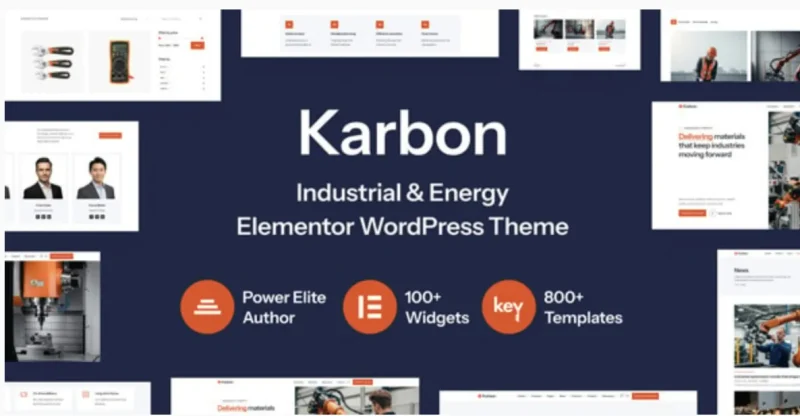
Karbon Pro is an industrial and energy sector WordPress theme engineered for manufacturers, factories, and renewable energy companies that need to publish service catalogs and capture qualified leads. The package removes the bottleneck of assembling sector-specific layouts from scratch by shipping six pre-built starter sites with complete inner-page sets, importable through a one-click demo mechanism. Within agency delivery workflows, it operates as a production-ready design foundation that runs on Elementor and Elementor Pro while remaining optimized for the native Gutenberg editor.
Technical Specifications & Deployment Matrix
| Engineering Metric | Deployment Specification |
|---|---|
| Base Technology / Framework | WordPress theme package containing PHP, CSS, and JS files, built on the Elementor page builder engine |
| Runtime / Language Requirements | WordPress 6.0.x through 7.0.x running on a standard PHP server environment |
| Front-End / Engine Dependencies | Elementor and Elementor Pro compatibility; Gutenberg optimized; widget-ready sidebar registration |
| E-Commerce & Plugin Interoperability | WooCommerce 7.x through 10.x, Contact Form 7, and WPML multilingual support |
| Browser & Layout Matrix | Firefox, Safari, Opera, Chrome, Edge; responsive layout with 4+ column grids and high-resolution assets |
| Persistence Footprint | Standard WordPress database tables populated via one-click demo import; no custom schema documented |
Elementor Composition Engine & Execution Pipeline
The theme routes every page composition task through the Elementor engine, replacing manual template-hierarchy overrides with a live drag-and-drop editing surface. When a developer places a widget into the DOM tree, state changes render in the preview immediately, so decisions on spacing, width, and element visibility are validated visually rather than through code inspection. Entrance animations, hover effects, and one-page scrolling are wired at the widget level, keeping interaction logic inside the builder instead of scattered across custom JavaScript.
Six starter sites model real industrial niches, and the demo import copies their full page structures and placeholder content into a WordPress install within minutes, after which text and media swap in directly. A global design panel centralizes font and color tokens; adjusting a token at the root level propagates to every section that references it, which prevents per-block restyling drift during client handoff. The delivered files are documented and structured so a developer can trace each layout decision back to its source widget or template block.
Core Technical Capabilities of Karbon Pro
- 70+ Elementor widgets: The widget set covers contact forms, image galleries, sliders, and testimonial sections, extending the builder’s default palette with industrial presentation patterns.
- 700+ template blocks: An exclusive library supplies blocks in both light and dark variants, styled without hard-coded values so each inherits the site’s global settings; the library expands with every update cycle.
- Front-end Header, Footer, and Mega Menu builders: Headers, footers, and mega menus are composed on the live preview with drag-and-drop elements, and distinct header or footer templates can be assigned to individual pages.
- Popup and off-canvas builder: Lead-capture layers accept form integrations and mixed media content, converting traffic into subscribers and customers through importable, pre-designed templates.
For agencies maintaining parallel industrial portfolios on the same WordPress runtime, Constix addresses construction-factory and engineering niches as an independent theme option rather than a dependency of this codebase.
Production Implementation & Operational Resilience
In staging and client environments, version management runs through an automatic update mechanism: when a release becomes available, the admin panel surfaces a notification, and a single click pulls the latest files from the vendor servers, eliminating manual FTP transfer sequences. The theme registers widget-ready sidebars against the native WordPress widget API, and its responsive layouts expose per-device controls for element visibility and positioning, so a single template adapts from desktop through tablet to smartphone breakpoints without duplicate page variants.
Operational boundaries are documented rather than assumed. The package includes PHP, CSS, and JS source files, ships with structured installation documentation, and carries verified compatibility across Firefox, Safari, Opera, Chrome, and Edge. Multi-language deployments are covered through WPML support, letting translated content trees share the same template layer. Quote-request and contact flows run through Contact Form 7 integration, while commerce paths activate through WooCommerce 7.x through 10.x, including shop widgets that can be embedded directly inside mega menus. Secondary development stays within the builder’s own extension surface: child layouts, imported header and footer templates, and global token overrides absorb most branding changes without PHP edits. Teams servicing adjacent verticals such as construction and architectural services can evaluate Bauer as a same-stack alternative for those client accounts.
Frequently Asked Questions
Are both light and dark versions included in the template block library?
Yes. Every block in the exclusive Elementor template library ships in a light and a dark variant, and the library’s database expands with each theme update, adding refined blocks for additional niches and industries.
Can Contact Form 7 forms and Google Maps be placed directly inside a mega menu?
Yes. The Mega Menu Builder integrates Contact Form 7 forms and Google Maps alongside WooCommerce shop widgets, so visitors reach quote-request forms and location details without leaving the navigation layer on any device.
Is the theme usable with the WordPress block editor in addition to Elementor?
Yes. The codebase is optimized for Gutenberg, so content editors can compose posts and pages in the native block editor while design teams continue building marketing layouts through the Elementor engine.